


Measuring health-related quality of life in patients with conservatively managed stage 5 chronic kidney disease: limitations of the Medical Outcomes Study Short Form 36: SF-36
- PMID: 27522214
- PMCID: PMC5065617
- DOI: 10.1007/s11136-016-1313-7
Measuring health-related quality of life in patients with conservatively managed stage 5 chronic kidney disease: limitations of the Medical Outcomes Study Short Form 36: SF-36
Abstract
Purpose: Chronic kidney disease (CKD) negatively affects health-related quality of life (HRQoL), which is often measured using the Medical Outcomes Study Short Form 36 (SF-36) questionnaire. However, the adequacy of SF-36 in this population has not been reported. We aimed to determine floor and ceiling effects and responsiveness to change of SF-36 in patients with conservatively managed stage 5 CKD.
Methods: SF-36 data were collected prospectively. Floor and ceiling effects were estimated for each SF-36 scale and summary measure based on raw scores. The minimal clinically important difference (MCID) was estimated using a combination of anchor-based and distribution-based methods. Responsiveness to change was assessed by comparing MCID for each scale and summary measure to its smallest detectable change.
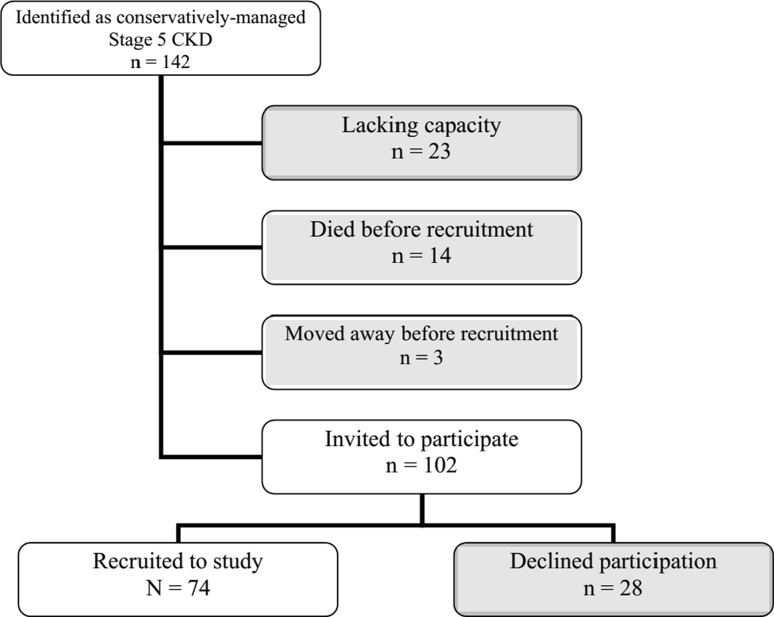
Results: SF-36 data were available for 73 of the 74 study participants. Using baseline data, floor and/or ceiling effects were detected for 3 of the 8 SF-36 scales. The anchor-based estimation of MCID based on differences in baseline functional status yielded the most reliable results. For the physical component summary, MCID was estimated at 5.7 points. Whilst the two SF-36 summary measures were responsive to change and free of floor and/or ceiling effects, six of the eight scales were not.
Conclusions: This small study of patients with conservatively managed stage 5 CKD found that only the summary measures of SF-36 and 2 of its 8 scales can be used to assess changes in HRQoL over time. These findings suggest that in this population, alternative HRQoL assessment tools should be considered for future studies.
Keywords: Chronic kidney diseases; Longitudinal studies; Quality of life; Short Form 36 Health Survey.
Figures
References
-
- Chow FY, Briganti EM, Kerr PG, Chadban SJ, Zimmet PZ, Atkins RC. Health-related quality of life in Australian adults with renal insufficiency: A population-based study. American Journal of Kidney Diseases. 2003;41(3):596–604. - PubMed
-
- Kusek JW, Greene P, Wang SR, Beck G, West D, Jamerson K, et al. Cross-sectional study of health-related quality of life in African Americans with chronic renal insufficiency: The African American study of kidney disease and hypertension trial. American Journal of Kidney Diseases. 2002;39(3):513–524. - PubMed
-
- Perlman RL, Finkelstein FO, Liu L, Roys E, Kiser M, Eisele G, et al. Quality of life in chronic kidney disease (CKD): a cross-sectional analysis in the Renal Research Institute-CKD study. American Journal of Kidney Diseases. 2005;45(4):658–666. - PubMed
MeSH terms
LinkOut - more resources
Full Text Sources
Other Literature Sources
Medical
