


Panretinal Photocoagulation Versus Ranibizumab for Proliferative Diabetic Retinopathy: Patient-Centered Outcomes From a Randomized Clinical Trial
- PMID: 27523491
- PMCID: PMC5215763
- DOI: 10.1016/j.ajo.2016.08.008
Panretinal Photocoagulation Versus Ranibizumab for Proliferative Diabetic Retinopathy: Patient-Centered Outcomes From a Randomized Clinical Trial
Abstract
Purpose: To compare patient-centered outcomes in patients with proliferative diabetic retinopathy (PDR) treated with ranibizumab vs panretinal photocoagulation (PRP).
Design: Randomized clinical trial.
Methods: Setting: Multicenter (55 U.S. sites).
Patient population: Total of 216 adults with 1 study eye out of 305 adults (excluding participants with 2 study eyes, because each eye received a different treatment) with PDR, visual acuity 20/320 or better, no history of PRP.
Intervention: Ranibizumab (0.5 mg/0.05 mL) vs PRP.
Main outcome measures: Change from baseline to 2 years in composite and prespecified subscale scores from the National Eye Institute Visual Function Questionnaire-25 (NEI VFQ-25), University of Alabama Low Luminance Questionnaire (UAB-LLQ), and Work Productivity and Activity Impairment Questionnaire (WPAIQ).
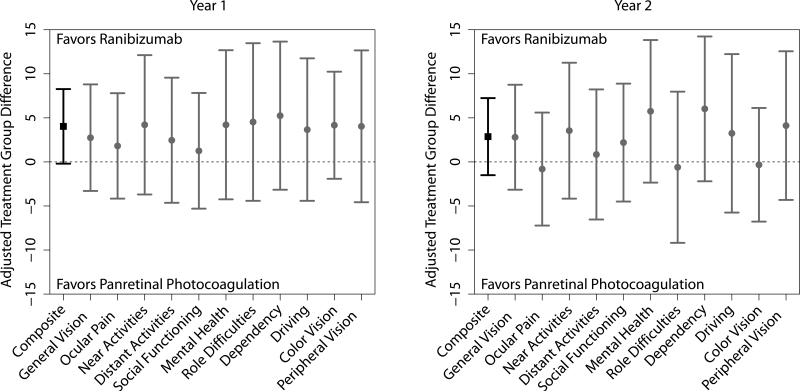
Results: For the NEI VFQ-25 and UAB-LLQ composite scores, ranibizumab-PRP treatment group differences (95% CI) were +4.0 (-0.2, +8.3, P = .06) and +1.8 (-3.5, +7.1, P = 0.51) at 1 year, and +2.9 (-1.5, +7.2, P = .20) and +2.3 (-2.9, +7.5, P = .37) at 2 years, respectively. Work productivity loss measured with the WPAIQ was 15.6% less with ranibizumab (-26.3%, -4.8%, P = .005) at 1 year and 2.9% (-12.2%, +6.4%, P = .54) at 2 years. Eighty-three ranibizumab participants (97%) were 20/40 or better in at least 1 eye (visual acuity requirement to qualify for an unrestricted driver's license in many states) at 2 years compared with 82 PRP participants (87%, adjusted risk ratio = 1.1, 95% CI: 1.0, 1.2, P = .005).
Conclusions: Though differences in some work productivity and driving-related outcomes favored ranibizumab over PRP, no differences between treatment regimens for PDR were identified for most of the other patient-centered outcomes considered.
Copyright © 2016 Elsevier Inc. All rights reserved.
Figures


Comment in
-
Reply.Am J Ophthalmol. 2017 May;177:233. doi: 10.1016/j.ajo.2017.02.010. Epub 2017 Mar 11. Am J Ophthalmol. 2017. PMID: 28292461 No abstract available.
-
Panretinal Photocoagulation Versus Ranibizumab for Proliferative Diabetic Retinopathy: Patient-Centered Outcomes From a Randomized Clinical Trial.Am J Ophthalmol. 2017 May;177:232-233. doi: 10.1016/j.ajo.2017.01.035. Epub 2017 Mar 13. Am J Ophthalmol. 2017. PMID: 28302269 No abstract available.
References
-
- Mangione CM, Lee PP, Gutierrez PR, Spritzer K, Berry S, Hays RD. Development of the 25-item National Eye Institute Visual Function Questionnaire. Arch Ophthalmol. 2001;119(7):1050–8. - PubMed
-
- Owsley C, McGwin G, Jr., Scilley K, Kallies K. Development of a questionnaire to assess vision problems under low luminance in age-related maculopathy. Invest Ophthalmol Vis Sci. 2006;47(2):528–35. - PubMed
-
- Reilly MC, Zbrozek AS, Dukes EM. The validity and reproducibility of a work productivity and activity impairment instrument. Pharmacoeconomics. 1993;4(5):353–65. - PubMed
-
- Lucentis(R) [package insert] Genentech I; South San Francisco, CA: Feb, 2015. [July 1, 2016]. http://www.gene.com/download/pdf/lucentis_prescribing.pdf.
Publication types
MeSH terms
Substances
Grants and funding
LinkOut - more resources
Full Text Sources
Other Literature Sources
Medical
Research Materials
