. 2016 Sep 1;19(3):406-14.
doi: 10.1016/j.stem.2016.07.001. Epub 2016 Aug 11.

Targeted Epigenetic Remodeling of Endogenous Loci by CRISPR/Cas9-Based Transcriptional Activators Directly Converts Fibroblasts to Neuronal Cells

Affiliations

Targeted Epigenetic Remodeling of Endogenous Loci by CRISPR/Cas9-Based Transcriptional Activators Directly Converts Fibroblasts to Neuronal Cells

Joshua B Black et al. Cell Stem Cell. .

Abstract

Overexpression of exogenous fate-specifying transcription factors can directly reprogram differentiated somatic cells to target cell types. Here, we show that similar reprogramming can also be achieved through the direct activation of endogenous genes using engineered CRISPR/Cas9-based transcriptional activators. We use this approach to induce activation of the endogenous Brn2, Ascl1, and Myt1l genes (BAM factors) to convert mouse embryonic fibroblasts to induced neuronal cells. This direct activation of endogenous genes rapidly remodeled the epigenetic state of the target loci and induced sustained endogenous gene expression during reprogramming. Thus, transcriptional activation and epigenetic remodeling of endogenous master transcription factors are sufficient for conversion between cell types. The rapid and sustained activation of endogenous genes in their native chromatin context by this approach may facilitate reprogramming with transient methods that avoid genomic integration and provides a new strategy for overcoming epigenetic barriers to cell fate specification.


Conflict of interest statement

CONFLIC OF INTEREST C.A.G. and J.B.B. have filed patent applications related to genome engineering technologies.

Figures
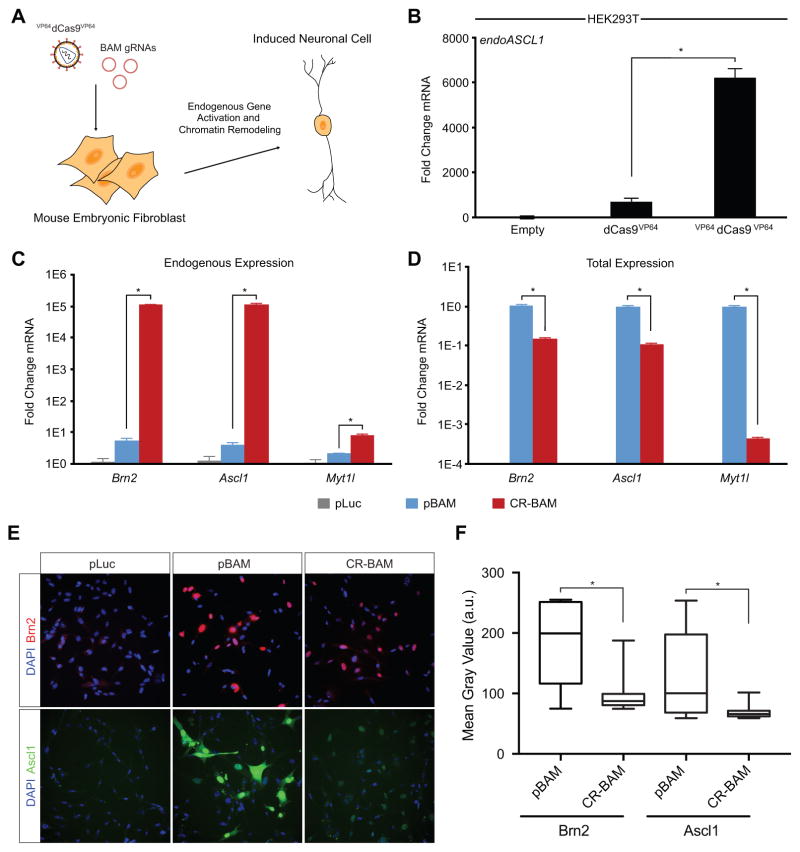
Figure 1
Figure 1. Endogenous Gene Activation of Neuronal Transcription Factors in PMEFs
(A) Reprogramming of PMEFs to neuronal cells via transduction of VP64dCas9VP64 and transfection of gRNA expression plasmids targeting the endogenous BAM factors. (B) Transcriptional activation of ASCL1 in HEK293T cells with dCas9VP64 or VP64dCas9VP64 (*p<0.05). (C) Endogenous expression and (D) total expression of the BAM factors in PMEFs with targeted activation (CR-BAM) or ectopic overexpression (pBAM; *p<0.05). (E) Immunofluorescence staining of Brn2 and Ascl1 in PMEFs demonstrated protein expression through targeted activation of the endogenous loci or expression from ectopic plasmids (scale bar = 50 μm). (F) Automated image analysis of fluorescence intensity revealed significantly more single-cell Brn2 and Ascl1 protein with pBAM transfection compared to CR-BAM (*p<0.05 between distributions of single-cell mean fluorescence; Z-test). All gRNAs used are listed in Table S1. All assays were performed on day three post-transfection. qRT-PCR data are represented as mean ± s.e.m. for n = 3 biological replicates. P-values for qRT-PCR data were determined by global one-way ANOVA with Holm-Bonferroni post hoc tests (α = 0.05). See also Figure S1.
Figure 2
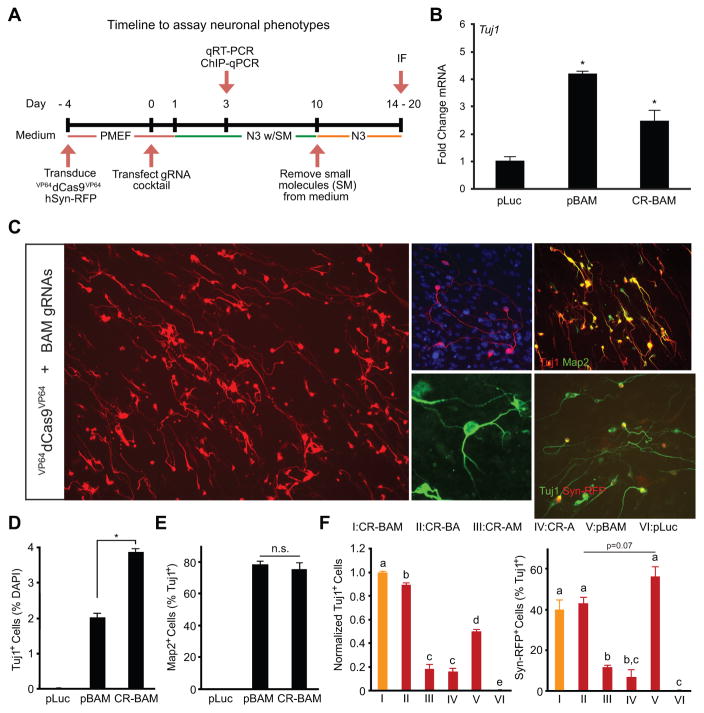
Figure 2. Induction of Neuronal Cells from PMEFs via VP64dCas9VP64-Mediated Gene Activation
(A) PMEFs were transduced with a lentivirus encoding the VP64dCas9VP64 transactivator and subsequently transfected with gRNAs targeting Brn2, Ascl1, and Myt1l. Neuronal phenotypes were assayed as indicated. (B) Transcriptional activation of Tuj1 was detected in PMEFs at day 3 post-transfection of pBAM or CR-BAM (*p<0.05 relative to transfection of a plasmid encoding firefly luciferase (pLuc)). (C) Immunofluorescence staining revealed numerous Tuj1+ cells with neuronal morphologies co-expressing Map2 at day 14 post-transfection of CR-BAM. The cells with the most elaborate neuronal morphologies activated the synapsin promoter in a Syn-RFP lentiviral reporter (scale bars = (i) 100 μm, (ii–v) 50 μm). (D) Quantitation of Tuj1+ cells as percent nuclei at day 14 post-transfection of either pLuc, pBAM, or CR-BAM (*p<0.05). (E) Quantitation of Map2+ cells as percent Tuj1+ cells at day 14 post-transfection of either pLuc, pBAM, or CR-BAM (n.s., not significant). (F) Quantitation of Tuj1+ and RFP+ cells with transfection of different combinations of gRNAs. Tuj1+ cells are normalized to CR-BAM transfection. Conditions that share the same letter (a-e) are not significantly different. P-values were determined by global one-way ANOVA with Holm-Bonferroni post hoc tests (α = 0.05). See also Figure S2.
Figure 3
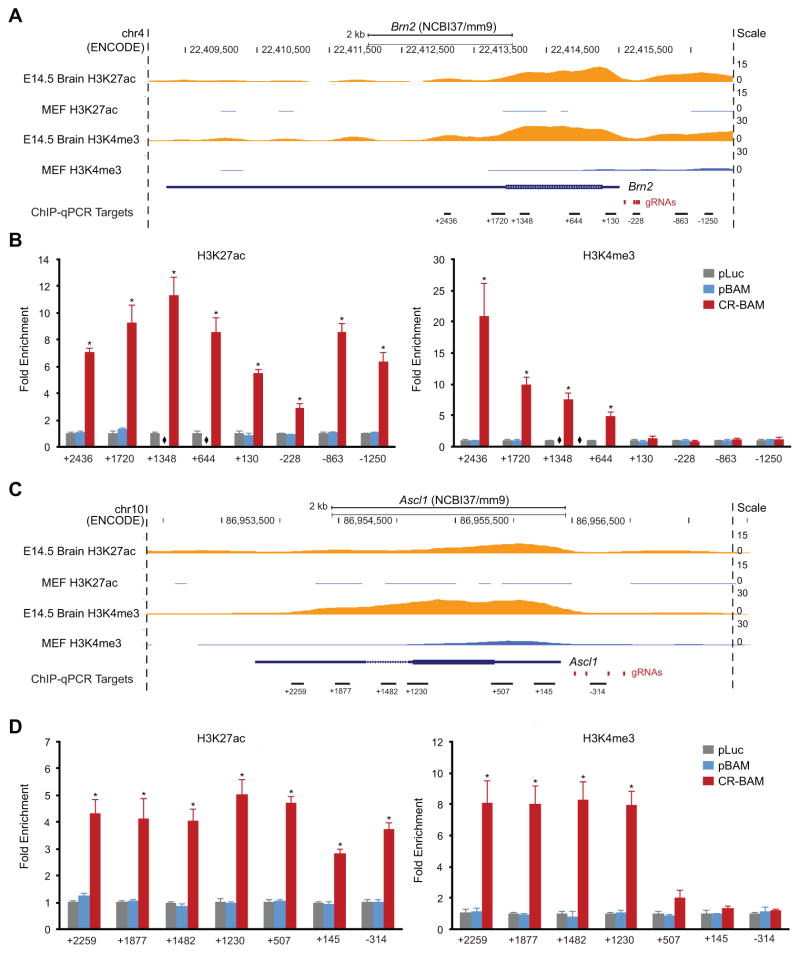
Figure 3. VP64dCas9VP64 Rapidly Remodels Epigenetic Marks at Target Loci
(A) & (C) Mouse genomic tracks depicting histone H3 modifications H3K27ac and H3K4me3 at the Brn2 and Ascl1 loci in embryonic brain tissue and fibroblasts (data from Mouse ENCODE; GSE31039). Red bars indicate gRNA target sites near the transcription start site, and black bars indicate the location of ChIP-qPCR amplicons along the gene locus. (B) & (D) Targeted activation of endogenous Brn2 and Ascl1 in PMEFs induced significant enrichment of H3K27ac and H3K4me3 at multiple sites along the genomic loci at day 3 post-transfection (*p < 0.05, one-way ANOVA with Holm-Bonferroni post hoc tests, n = 3 biological replicates). Overexpression of the BAM factors via transfection of expression plasmids encoding BAM factor transgenes did not induce a significant change in these chromatin marks. qPCR primers targeting coding regions of the genes are not included for the pBAM transfection condition, as contaminating plasmid DNA biased enrichment values. All fold enrichments are relative to transfection of a plasmid encoding firefly luciferase and normalized to a region of the Gapdh locus. See also Figure S3 and S4.
Figure 4
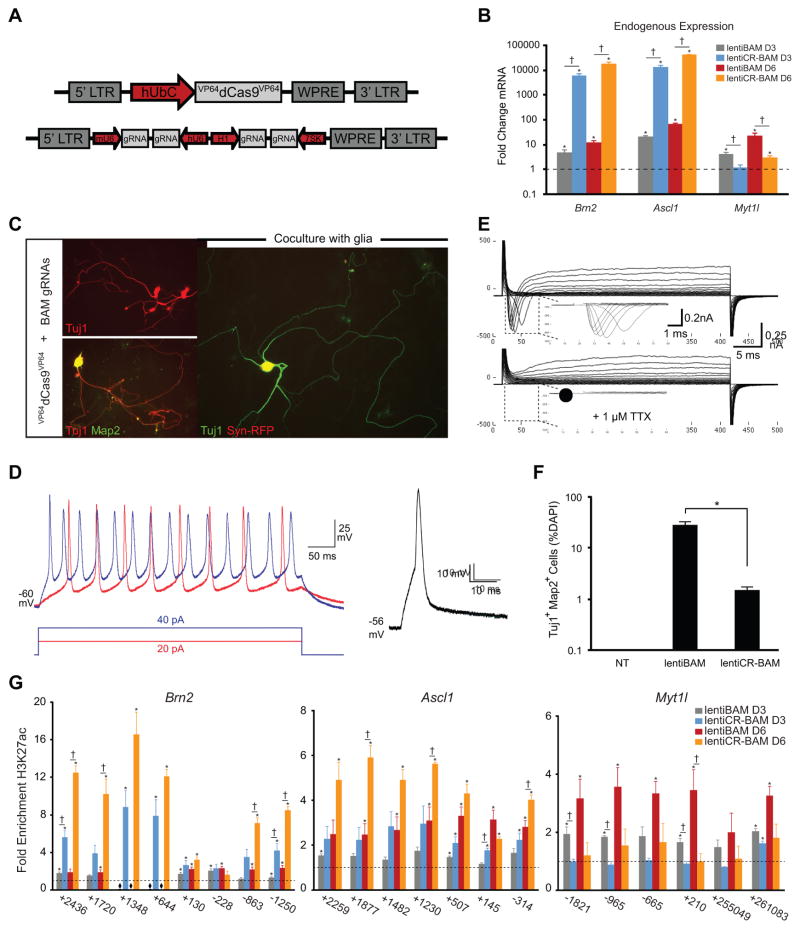
Figure 4. Generation of Functionally Mature iNs with Multiplex gRNA Vectors
(A) Schematic of VP64dCas9VP64 and multiplex gRNA lentiviral constructs used to enable stable integration and constitutive expression. (B) Relative mRNA expression of the endogenous BAM factors following transduction of transgenes encoding the BAM factors (lentiBAM) or VP64dCas9VP64 and gRNAs targeting the endogenous BAM factors (lentiCR-BAM; p<0.05 relative to non-treated PMEFs; †p<0.05 between lentiBAM versus lentiCR-BAM transduction). (C) Immunofluorescence staining of PMEFs following transduction of lentiCR-BAM. Cells were co-positive for Tuj1 and Map2 and exhibited complex neuronal morphologies (scale bar = 50 μm). (D) Action potentials were evoked from VP64dCas9VP64-induced neuronal cells in response to 5 (right) or 500 (left) ms step depolarizing current injection (6/7 cells analyzed) after empiric hyperpolarizing current injection to hold membrane potential at ~ −60 mV. (E) Representative whole-cell currents recorded with or without perfusion of 1 μM tetrodotoxin (TTX). (F) Quantitation of Tuj1+Map2+ cells as percent nuclei (*p<0.05 between lentiBAM versus lentiCR-BAM transduction; NT, non-treated PMEFs). (G) Timecourse of H3K27ac enrichment along the Brn2, Ascl1, and Mytl1 loci (*p<0.05 relative to non-treated PMEFs; †p<0.05 between lentiBAM versus lentiCR-BAM transduction). All p-values calculated by global ANOVA with Holm-Bonferroni post hoc tests (α = 0.05).

Comment in

References

    1. Adler AF, Grigsby CL, Kulangara K, Wang H, Yasuda R, Leong KW. Nonviral direct conversion of primary mouse embryonic fibroblasts to neuronal cells. Molecular therapy Nucleic acids. 2012;1:e32. - PMC - PubMed
    1. Balboa D, Weltner J, Eurola S, Trokovic R, Wartiovaara K, Otonkoski T. Conditionally Stabilized dCas9 Activator for Controlling Gene Expression in Human Cell Reprogramming and Differentiation. Stem Cell Reports. 2015;5:448–459. - PMC - PubMed
    1. Chakraborty S, Ji H, Kabadi AM, Gersbach CA, Christoforou N, Leong KW. A CRISPR/Cas9-Based System for Reprogramming Cell Lineage Specification. Stem cell reports. 2014;3:940–947. - PMC - PubMed
    1. Chavez A, Scheiman J, Vora S, Pruitt BW, Tuttle M, Iyer EPR, Lin S, Kiani S, Guzman CD, Wiegand DJ, et al. Highly efficient Cas9-mediated transcriptional programming. Nat Methods. 2015;12:326–328. - PMC - PubMed
    1. Cheng AW, Wang H, Yang H, Shi L, Katz Y, Theunissen TW, Rangarajan S, Shivalila CS, Dadon DB, Jaenisch R. Multiplexed activation of endogenous genes by CRISPR-on, an RNA-guided transcriptional activator system. Cell Res. 2013;23:1163–1171. - PMC - PubMed

Publication types

MeSH terms