


Controlling stem cell behavior with decellularized extracellular matrix scaffolds
- PMID: 27524932
- PMCID: PMC4979580
- DOI: 10.1016/j.cossms.2016.02.001
Controlling stem cell behavior with decellularized extracellular matrix scaffolds
Abstract
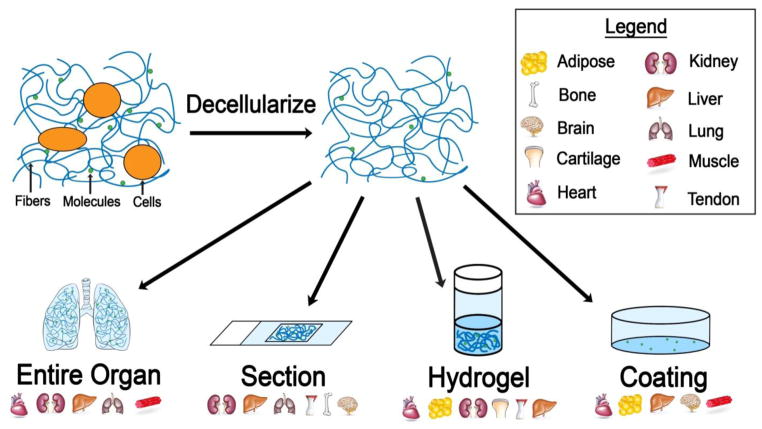
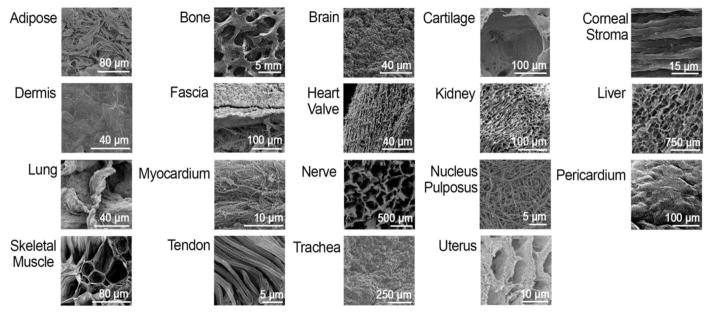
Decellularized tissues have become a common regenerative medicine platform with multiple materials being researched in academic laboratories, tested in animal studies, and used clinically. Ideally, when a tissue is decellularized the native cell niche is maintained with many of the structural and biochemical cues that naturally interact with the cells of that particular tissue. This makes decellularized tissue materials an excellent platform for providing cells with the signals needed to initiate and maintain differentiation into tissue-specific lineages. The extracellular matrix (ECM) that remains after the decellularization process contains the components of a tissue specific microenvironment that is not possible to create synthetically. The ECM of each tissue has a different composition and structure and therefore has unique properties and potential for affecting cell behavior. This review describes the common methods for preparing decellularized tissue materials and the effects that decellularized materials from different tissues have on cell phenotype.
Keywords: decellularization; differentiation; extracellular matrix; stem cell; tissue engineering.
Figures
Similar articles
-
Decellularized Matrices As Cell-Instructive Scaffolds to Guide Tissue-Specific Regeneration.ACS Biomater Sci Eng. 2018 Nov 12;4(11):3627-3643. doi: 10.1021/acsbiomaterials.7b00619. Epub 2017 Dec 5. ACS Biomater Sci Eng. 2018. PMID: 33429606
-
Development of decellularized scaffolds for stem cell-driven tissue engineering.J Tissue Eng Regen Med. 2017 Apr;11(4):942-965. doi: 10.1002/term.2061. Epub 2015 Jun 29. J Tissue Eng Regen Med. 2017. PMID: 26119160 Review.
-
Recent Advancements in Decellularized Matrix-Based Biomaterials for Musculoskeletal Tissue Regeneration.Adv Exp Med Biol. 2018;1077:149-162. doi: 10.1007/978-981-13-0947-2_9. Adv Exp Med Biol. 2018. PMID: 30357688 Review.
-
[Research progress of decellularization and application in tissue engineering].Zhongguo Xiu Fu Chong Jian Wai Ke Za Zhi. 2013 Aug;27(8):950-4. Zhongguo Xiu Fu Chong Jian Wai Ke Za Zhi. 2013. PMID: 24171349 Review. Chinese.
-
Injectable decellularized nucleus pulposus-based cell delivery system for differentiation of adipose-derived stem cells and nucleus pulposus regeneration.Acta Biomater. 2018 Nov;81:115-128. doi: 10.1016/j.actbio.2018.09.044. Epub 2018 Sep 27. Acta Biomater. 2018. PMID: 30267879
Cited by
-
Cell-Laden Composite Hydrogel Bioinks with Human Bone Allograft Particles to Enhance Stem Cell Osteogenesis.Polymers (Basel). 2022 Sep 10;14(18):3788. doi: 10.3390/polym14183788. Polymers (Basel). 2022. PMID: 36145933 Free PMC article.
-
3D Printed Stem-Cell Derived Neural Progenitors Generate Spinal Cord Scaffolds.Adv Funct Mater. 2018 Sep 26;28(39):1801850. doi: 10.1002/adfm.201801850. Epub 2018 Aug 9. Adv Funct Mater. 2018. PMID: 32595422 Free PMC article.
-
Developing Regenerative Treatments for Developmental Defects, Injuries, and Diseases Using Extracellular Matrix Collagen-Targeting Peptides.Int J Mol Sci. 2019 Aug 21;20(17):4072. doi: 10.3390/ijms20174072. Int J Mol Sci. 2019. PMID: 31438477 Free PMC article. Review.
-
A Bioprinted Cardiac Patch Composed of Cardiac-Specific Extracellular Matrix and Progenitor Cells for Heart Repair.Adv Healthc Mater. 2018 Dec;7(23):e1800672. doi: 10.1002/adhm.201800672. Epub 2018 Oct 31. Adv Healthc Mater. 2018. PMID: 30379414 Free PMC article.
-
Degenerative tendon matrix induces tenogenic differentiation of mesenchymal stem cells.J Exp Orthop. 2023 Feb 14;10(1):15. doi: 10.1186/s40634-023-00581-4. J Exp Orthop. 2023. PMID: 36786947 Free PMC article.
References
-
- Faulk DM, Johnson SA, Zhang L, Badylak SF. Role of the extracellular matrix in whole organ engineering. J Cell Physiol. 2014;229:984–9. - PubMed
-
- Keane TJ, Swinehart IT, Badylak SF. Methods of tissue decellularization used for preparation of biologic scaffolds and in vivo relevance. Methods. 2015;84:25–34. - PubMed
-
- Hoshiba T, Lu H, Kawazoe N, Chen G. Decellularized matrices for tissue engineering. Expert Opin Biol Ther. 2010;10:1717–28. - PubMed
-
- Badylak SF. The extracellular matrix as a scaffold for tissue reconstruction. Semin Cell Dev Biol. 2002;13:377–83. - PubMed
Grants and funding
LinkOut - more resources
Full Text Sources
Other Literature Sources