


Disparities in length of life across developed countries: measuring and decomposing changes over time within and between country groups
- PMID: 27524940
- PMCID: PMC4982210
- DOI: 10.1186/s12963-016-0094-0
Disparities in length of life across developed countries: measuring and decomposing changes over time within and between country groups
Abstract
Background: Over the past half century the global tendency for improvements in longevity has been uneven across countries. This has resulted in widening of inter-country disparities in life expectancy. Moreover, the pattern of divergence appears to be driven in part by processes at the level of country groupings defined in geopolitical terms. A systematic quantitative analysis of this phenomenon has not been possible using demographic decomposition approaches as these have not been suitably adapted for this purpose. In this paper we present an elaboration of conventional decomposition techniques to provide a toolkit for analysis of the inter-country variance, and illustrate its use by analyzing trends in life expectancy in developed countries over a 40-year period.
Methods: We analyze trends in the population-weighted variance of life expectancy at birth across 36 developed countries and three country groups over the period 1970-2010. We have modified existing decomposition approaches using the stepwise replacement algorithm to compute age components of changes in the total variance as well as variance between and within groups of Established Market Economies (EME), Central and Eastern Europe (CEE), and the Former Soviet Union (FSU). The method is generally applicable to the decomposition of temporal changes in any aggregate index based on a set of populations.
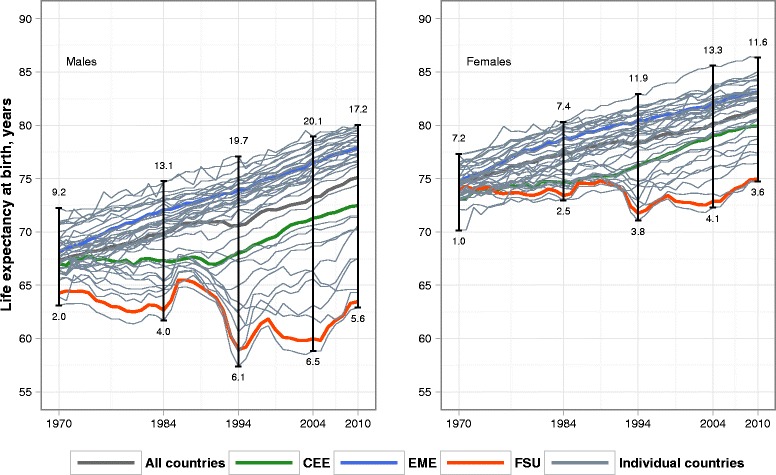
Results: The divergence in life expectancy between developed countries has generally increased over the study period. This tendency dominated from the beginning of 1970s to the early 2000s, and reversed only after 2005. From 1970 to 2010, the total standard deviation of life expectancy increased from 2.0 to 5.6 years among men and from 1.0 to 3.6 years among women. This was determined by the between-group effects due to polarization between the EME and the FSU. The latter contrast was largely fueled by the long-term health crisis in Russia. With respect to age, the increase in the overall divergence was attributable to between-country differences in mortality changes at ages 15-64 years compared to those aged 65 and older. The within-group variance increased, especially among women. This change was mostly produced by growing mortality differences at ages 65 and older.
Conclusions: From the early 1970s to the mid-2000s, the strong divergence in life expectancy across developed countries was largely determined by the between-group variance and mortality polarization linked to the East-West geopolitical division.
Keywords: Decomposition; Developed countries; East–West gap in life expectancy; Mortality disparities; Stepwise replacement algorithm.
Figures


References
-
- Wilmoth JR. Increase of human longevity: past, present, and future. Jpn J Popul. 2004;9:1.
-
- Vallin J, Meslé F, Valkonen T. Trends in mortality and differential mortality. Popul Stud. 2001;36:332.
Publication types
MeSH terms
LinkOut - more resources
Full Text Sources
Other Literature Sources
Miscellaneous
