


Torque Teno Virus Load-Inverse Association With Antibody-Mediated Rejection After Kidney Transplantation
- PMID: 27525643
- PMCID: PMC5268087
- DOI: 10.1097/TP.0000000000001455
Torque Teno Virus Load-Inverse Association With Antibody-Mediated Rejection After Kidney Transplantation
Abstract
Background: Antibody-mediated rejection (AMR) represents one of the cardinal causes of late allograft loss after kidney transplantation, and there is great need for noninvasive tools improving early diagnosis of this rejection type. One promising strategy might be the quantification of peripheral blood DNA levels of the highly prevalent and apathogenic Torque Teno virus (TTV), which might mirror the overall level of immunosuppression and thus help determine the risk of alloimmune response.
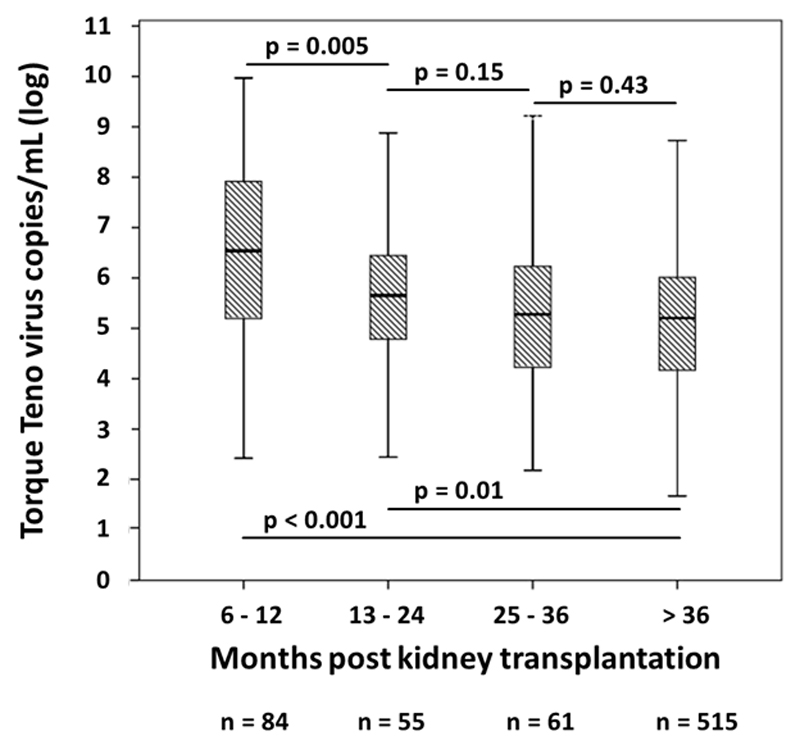
Methods: To assess the association between TTV load in the peripheral blood and AMR, 715 kidney transplant recipients (median, 6.3 years posttransplantation) were subjected to a systematical cross-sectional AMR screening and, in parallel, TTV quantification.
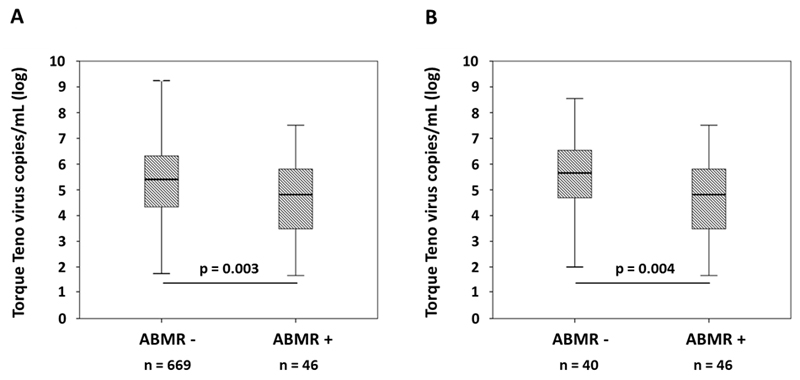
Results: Eighty-six of these recipients had donor-specific antibodies and underwent protocol biopsy, AMR-positive patients (n = 46) showed only 25% of the TTV levels measured in patients without AMR (P = 0.003). In a generalized linear model, higher TTV levels were associated with a decreased risk for AMR after adjustment for potential confounders (risk ratio 0.94 per TTV log level; 95% confidence interval 0.90-0.99; P = 0.02).
Conclusions: Future studies will have to clarify whether longitudinal assessment of TTV load might predict AMR risk and help guide the type and intensity of immunosuppression to prevent antibody-mediated graft injury.
Conflict of interest statement
The authors declare no conflicts of interest.
Figures
Comment in
-
A Snapshot of Antibody-Mediated Rejection Goes Viral.Transplantation. 2017 Feb;101(2):227. doi: 10.1097/TP.0000000000001540. Transplantation. 2017. PMID: 27779575 No abstract available.
References
-
- Lamb KE, Lodhi S, Meier-Kriesche HU. Long-term renal allograft survival in the United States: a critical reappraisal. Am J Tranplant. 2011;11(3):450–462. - PubMed
-
- Loupy A, Hill GS, Jordan SC. The impact of donor-specific anti-HLA antibodies on late kidney allograft failure. Nat Rev. 2012;8(6):348–357. - PubMed
-
- Sellares J, de Freitas DG, Mengel M, et al. Understanding the causes of kidney transplant failure: the dominant role of antibody-mediated rejection and nonadherence. Am J Tranplant. 2012;12(2):388–399. - PubMed
-
- Wiebe C, Nickerson P. Posttransplant monitoring of de novo human leukocyte antigen donor-specific antibodies in kidney transplantation. Curr Opin Organ Transplant. 2013;18(4):470–477. - PubMed
-
- Haas M, Sis B, Racusen LC, et al. Banff 2013 meeting report: inclusion of c4d-negative antibody-mediated rejection and antibody-associated arterial lesions. Am J Tranplant. 2014;14(2):272–283. - PubMed
Publication types
MeSH terms
Substances
Grants and funding
LinkOut - more resources
Full Text Sources
Other Literature Sources
Medical
