. 2016 Aug 15;11(8):e0160624.
doi: 10.1371/journal.pone.0160624. eCollection 2016.

3D Printed Multimaterial Microfluidic Valve

Affiliations

3D Printed Multimaterial Microfluidic Valve

Steven J Keating et al. PLoS One. .

Abstract

We present a novel 3D printed multimaterial microfluidic proportional valve. The microfluidic valve is a fundamental primitive that enables the development of programmable, automated devices for controlling fluids in a precise manner. We discuss valve characterization results, as well as exploratory design variations in channel width, membrane thickness, and membrane stiffness. Compared to previous single material 3D printed valves that are stiff, these printed valves constrain fluidic deformation spatially, through combinations of stiff and flexible materials, to enable intricate geometries in an actuated, functionally graded device. Research presented marks a shift towards 3D printing multi-property programmable fluidic devices in a single step, in which integrated multimaterial valves can be used to control complex fluidic reactions for a variety of applications, including DNA assembly and analysis, continuous sampling and sensing, and soft robotics.


Conflict of interest statement

Competing Interests: The authors have declared that no competing interests exist.

Figures

Fig 1
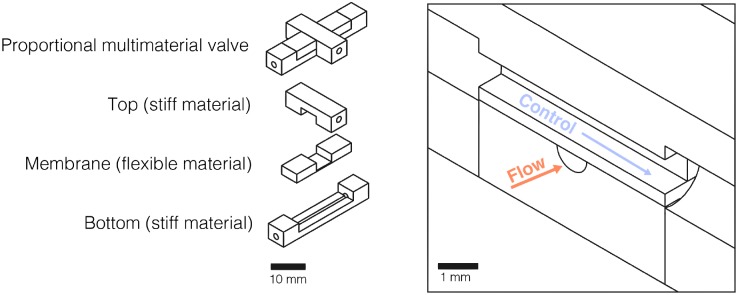
Fig 1. Multimaterial valve design.
Design and material breakdown (left). Assembled valve cross-section showing the control and flow channels (right). Applied fluidic pressure to the control channel actuates the valve by deforming the flexible membrane to obstruct the flow channel.
Fig 2
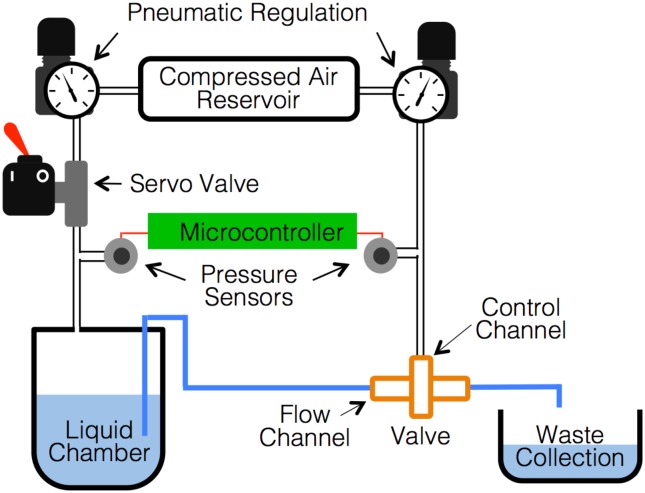
Fig 2. Experimental setup used to characterize printed fluidic valves.
Pneumatic regulators were used for control channel actuation and to pressurize the liquid chamber along with solenoid valves. Pressure sensors connected to an Arduino UNO microcontroller were used to record both control channel and liquid chamber pressures.
Fig 3
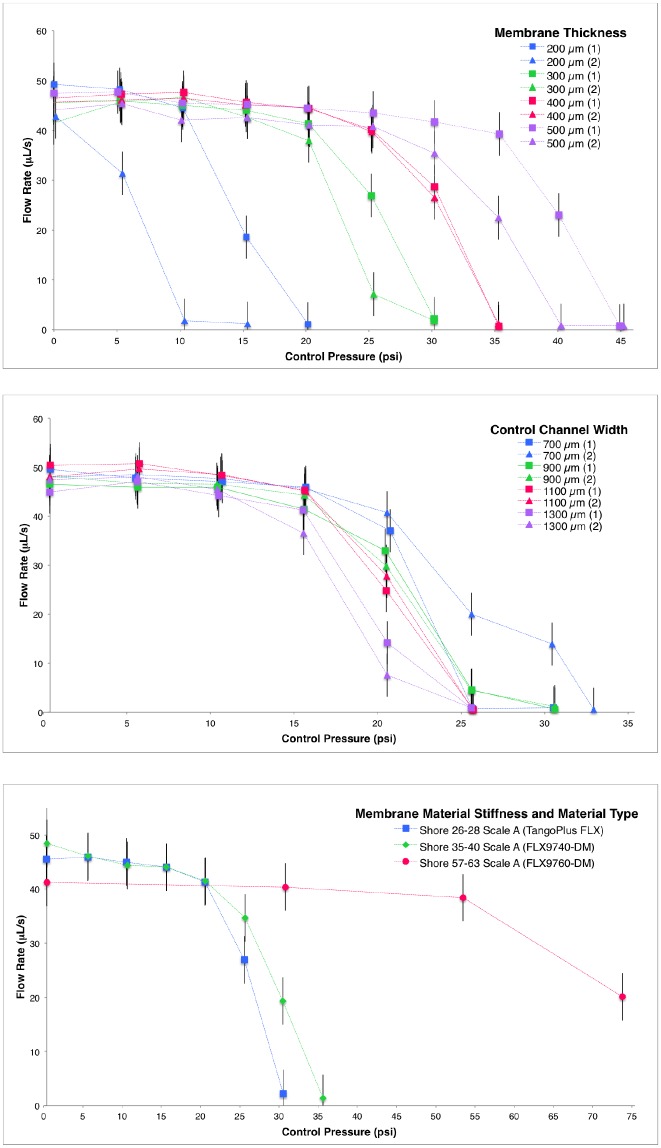
Fig 3. Fluid flow under various conditions.
Measurements of fluid flow through the 3D printed multimaterial valve with varying applied pressure to the control channel are plotted. Dimensions and materials were varied according to Table 1, with a standard membrane thickness of 300 μm, control channel width of 800 μm, control channel height of 800 μm, and a semi-circular flow channel radius of 400 μm. Proportional control of the flow rate is demonstrated and the design parameters are explored through varying membrane thickness (top), control channel width (middle), and membrane material (bottom). Connecting lines are shown only for visualization and the charted points and error bars represent the measured data. For membrane thickness and control channel width, two prints of each design file were tested and each is plotted using the average of two trials per print. The bracketed number in the legend indicates a different print of the same design file and both are plotted for clarity with the same color. Membrane material type tests used a single print. Error bars show repeatability between trials at the same pressure for different prints of the same valve specifications (± 4.4 psi, calculated with 95% confidence interval). Listed stiffness values for the membrane material are sourced from Stratasys, Ltd. Material data sheets [25]. Please see the Supporting Information for all of the data from the trials.
Fig 4
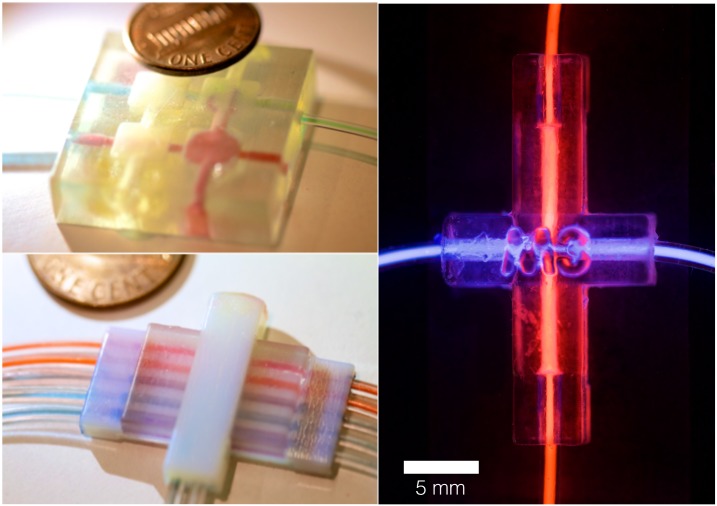
Fig 4. 3D printed microfluidic valves.
A) A 3D printed single material multichannel valve system (top left) and a 3D printed multimaterial multichannel valve system (bottom left). The single material valve contains two control channels with square chambers both above and below the flow channels and the multimaterial valve uses the same design methodology previous described in the paper. For the multimaterial multichannel valve, all channel valves are actuated at the same time by the control line. The global deformation of the single material valve system is significantly larger than the multimaterial valve during actuation, as seen in S1 Video B) A 3D printed multimaterial valve with chemiluminescent liquid in the control and flow channels for visualization (right).
Fig 5
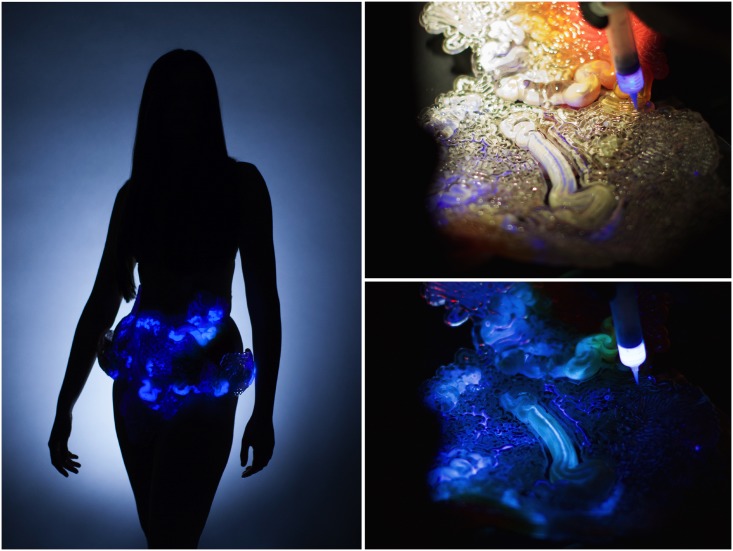
Fig 5. A product-scale wearable millifluidic system 3D printed with an experimental liquid support technique.
The digitally designed and fabrication system was printed with colleagues [32] and future work will look to further characterize this experimental printing method. For the images, a chemiluminescent liquid was pumped through the flow channels for visualization.

References

    1. Unger M, Chou H, Thorsen T, Scherer A, Quake S. Monolithic Microfabricated Valves and Pumps by Multilayer Soft Lithography. Science. 2000. April 07; 288(5463): 113–117. - PubMed
    1. Thorsen T, Maerkl S, Quake S. Microfluidic Large-Scale Integration. Science. 2002. October 18; 298(5593): 580–584. - PubMed
    1. Lee A. The third decade of microfluidics. Lab Chip. 2013. March 27; 13(9): 1660–1661. 10.1039/c3lc90031b - DOI - PubMed
    1. Kitson P, Rosnes M, Sans V, Dragone V, Cronin L. Configurable 3D printed millifluidic and microfluidic “lab on a chip” reactionware devices. Lab Chip. 2012. September 21; 12(18): 3267–3271. 10.1039/c2lc40761b - DOI - PubMed
    1. Song H, Spencer J, Jander A, Nielsen J, Stasiak J, Kasperchik V, et al. Inkjet printing of magnetic materials with aligned anisotropy. J. Appl. Phys. 2014; 115(17): E308.

MeSH terms