


Celecoxib for the Prevention of Colorectal Adenomas: Results of a Suspended Randomized Controlled Trial
- PMID: 27530656
- PMCID: PMC6272806
- DOI: 10.1093/jnci/djw151
Celecoxib for the Prevention of Colorectal Adenomas: Results of a Suspended Randomized Controlled Trial
Abstract
Background: Cyclooxygenase (COX)-2 inhibitors such as celecoxib were designed to preserve anti-inflammatory activity without inhibiting COX-1. Downregulation of COX-2 inhibits colorectal carcinogenesis.
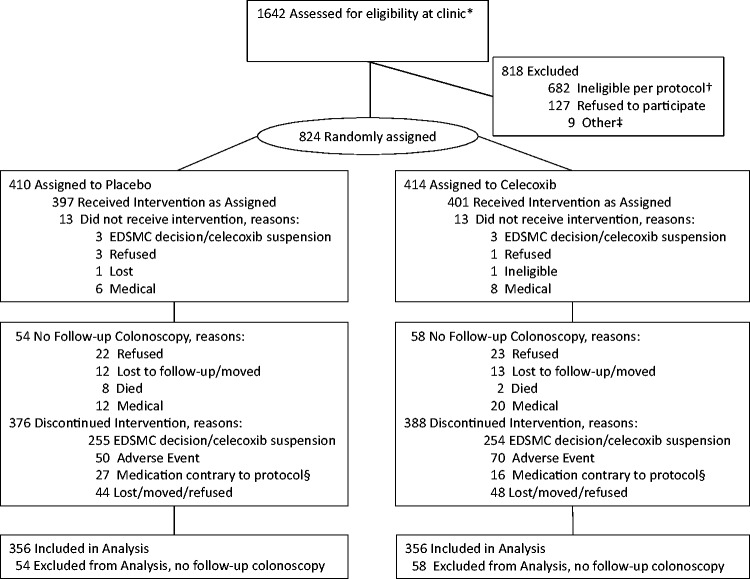
Methods: The Selenium and Celecoxib Trial was a randomized, placebo-controlled trial of once-daily selenium 200 µg and celecoxib 400 mg, alone or together, for colorectal adenoma prevention. Men and women between age 40 and 80 years were eligible following colonoscopic removal of adenomas. The primary outcome was development of new adenomas. Celecoxib was suspended early because of cardiovascular toxicity in other trials. Accrual to selenium or placebo continued. Before suspension, 824 participants were randomly assigned to celecoxib or placebo, of whom 712 (86.4%) were available for analysis. All statistical tests were two-sided.
Results: In the placebo and celecoxib arms of 356 participants each, adenoma detection was 47.5% and 49.7% (relative risk [RR] = 1.04, 95% confidence interval [CI] = 0.90 to 1.21, P = .58), respectively, after median periods of 13.6 and 14.2 months on intervention. Among participants colonoscoped within 12 months of discontinuing intervention (n = 244), overall adenoma recurrence (RR = 0.69, 95% CI = 0.48 to 0.98, P = .04) and recurrence with advanced adenomas (RR = 0.23, 95% CI = 0.07 to 0.80, P = .02) were reduced with celecoxib. Reduction of adenoma recurrence was greatest in participants with previous advanced adenomas. Celecoxib increased risk of hypertension in participants with pre-existing cardiovascular risk factors compared with placebo (hazard ratio = 2.19, 95% CI = 1.07 to 4.50, P = .03).
Conclusions: Limited-duration celecoxib prevents adenoma recurrence in patients with prior high-risk adenomas, in whom strategies to minimize cardiovascular toxicity might be feasible.
© The Author 2016. Published by Oxford University Press. All rights reserved. For Permissions, please e-mail: journals.permissions@oup.com.
Figures
Comment in
-
What to Do With the Participants/Patients in Phase III Clinical Cancer Trials That Have Been Stopped by the FDA.J Natl Cancer Inst. 2016 Dec 16;108(12):djw252. doi: 10.1093/jnci/djw252. Print 2016 Dec. J Natl Cancer Inst. 2016. PMID: 27986883 No abstract available.
References
-
- Honn KV, Bockman RS, Marnett LJ. Prostaglandins and cancer: a review of tumor initiation through tumor metastasis. Prostaglandins. 1981;21(5):833-864. - PubMed
-
- Gupta RA, DuBois RN. Colorectal cancer prevention and treatment by inhibition of cyclooxygenase-2. Nat Rev Cancer. 2001;1(1):11-21. - PubMed
-
- Thun MJ, Namboodiri MM, Heath CW., Jr. Aspirin use and reduced risk of fatal colon cancer. N Engl J Med. 1991;325(23):1593-1596. - PubMed
-
- Rothwell PM, Wilson M, Elwin C-E, et al. Long-term effect of aspirin on colorectal cancer incidence and mortality: 20-year follow-up of five randomised trials. Lancet. 376(9754):1741-1750. - PubMed
-
- Algra AM, Rothwell PM. Effects of regular aspirin on long-term cancer incidence and metastasis: a systematic comparison of evidence from observational studies versus randomised trials. Lancet Oncol. 2012;13(5):518-527. - PubMed
Publication types
MeSH terms
Substances
Grants and funding
LinkOut - more resources
Full Text Sources
Other Literature Sources
Medical
Research Materials
