Review
. 2016 Aug;12(8):20160137.
doi: 10.1098/rsbl.2016.0137.

'Disperse abroad in the land': the role of wildlife in the dissemination of antimicrobial resistance

Affiliations
Review

'Disperse abroad in the land': the role of wildlife in the dissemination of antimicrobial resistance

Kathryn E Arnold et al. Biol Lett. 2016 Aug.

Abstract

Antimicrobial resistance (AMR) has been detected in the microbiota of many wildlife species, including long-distance migrants. Inadequately treated wastes from humans and livestock dosed with antimicrobial drugs are often assumed to be the main sources of AMR to wildlife. While wildlife populations closely associated with human populations are more likely to harbour clinically important AMR related to that found in local humans and livestock, AMR is still common in remote wildlife populations with little direct human influence. Most reports of AMR in wildlife are survey based and/or small scale, so researchers can only speculate on possible sources and sinks of AMR or the impact of wildlife AMR on clinical resistance. This lack of quantitative data on the flow of AMR genes and AMR bacteria across the natural environment could reflect the numerous AMR sources and amplifiers in the populated world. Ecosystems with relatively simple and well-characterized potential inputs of AMR can provide tractable, but realistic, systems for studying AMR in the natural environment. New tools, such as animal tracking technologies and high-throughput sequencing of resistance genes and mobilomes, should be integrated with existing methodologies to understand how wildlife maintains and disperses AMR.

Keywords: animal dispersal; antibiotic resistance; disease transmission; migration; resistome; sewage treatment.


Figures

Figure 1.
Figure 1.
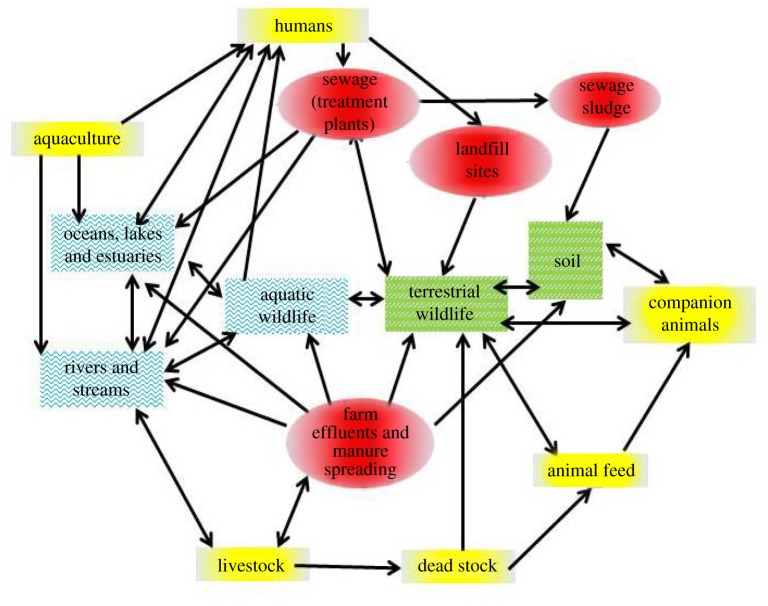
Dispersal of AMR across the landscape: between human communities, hospitals, sewage treatment plants, farms and the wider environment including via wildlife (adapted from [6]). (Online version in colour.)
Figure 2.
Figure 2.
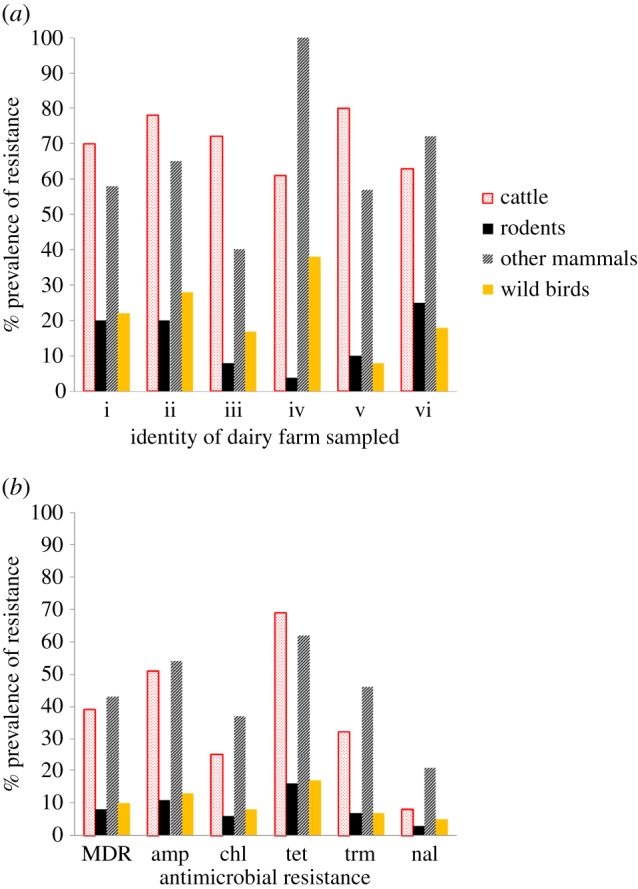
Antimicrobial resistance in wildlife on dairy farms in Cheshire, UK. The resistance patterns of Escherichia coli from the faeces of cattle, rodents (mainly Myodes glaroelus and Apodemus sylvaticus), wild birds (mainly passerines) and other wild mammals (mainly badgers and foxes) were compared. (a) Percentage of faecal samples containing E. coli resistant to at least one antibiotic on six different farms (i–vi). (b) Percentage of E. coli isolated from each group of animals resistant to various antibiotics or multi-drug resistant. Resistance to the following antibiotics was tested: ampicillin (amp), chloramphenicol (chl), tetracycline (tet), trimethoprim (trm) and nalidixic acid (nal) and also MDR (multi-drug resistance defined as resistance to three or more of the antibiotics tested). All susceptibility testing was performed according to the British Society of Antimicrobial Chemotherapy guidelines [17]. See the electronic supplementary material for details of methods. Figure adapted from [18]. (Online version in colour.)

References

    1. Jones KE, Patel NG, Levy MA, Storeygard A, Balk D, Gittleman JL, Daszak P. 2008. Global trends in emerging infectious diseases. Nature 451, 990–993. ( 10.1038/nature06536) - DOI - PMC - PubMed
    1. Wiethoelter AK, Beltrán-Alcrudo D, Kock R, Mor SM. 2015. Global trends in infectious diseases at the wildlife–livestock interface. Proc. Natl Acad. Sci. USA 112, 9662–9667. ( 10.1073/pnas.1422741112) - DOI - PMC - PubMed
    1. Huijbers PMC, Blaak H, de Jong MCM, Graat EAM, Vandenbroucke-Grauls CMJE, Husman AMDR. 2015. Role of the environment in the transmission of antimicrobial resistance to humans: a review. Environ. Sci. Technol. 49, 11 993–12 004. ( 10.1021/acs.est.5b02566) - DOI - PubMed
    1. Greig J, Rajic A, Young I, Mascarenhas M, Waddell L, LeJeune J. 2015. A scoping review of the role of wildlife in the transmission of bacterial pathogens and antimicrobial resistance to the food chain. Zoonoses Public Health 62, 269–284. ( 10.1111/zph.12147) - DOI - PubMed
    1. WHO. 2014. Antimicrobial resistance: global report on surveillance 2014. Geneva, Switzerland: World Health Organisation.

Substances