


SiglecF+Gr1hi eosinophils are a distinct subpopulation within the lungs of allergen-challenged mice
- PMID: 27531929
- PMCID: PMC5166438
- DOI: 10.1189/jlb.3A0416-166R
SiglecF+Gr1hi eosinophils are a distinct subpopulation within the lungs of allergen-challenged mice
Abstract
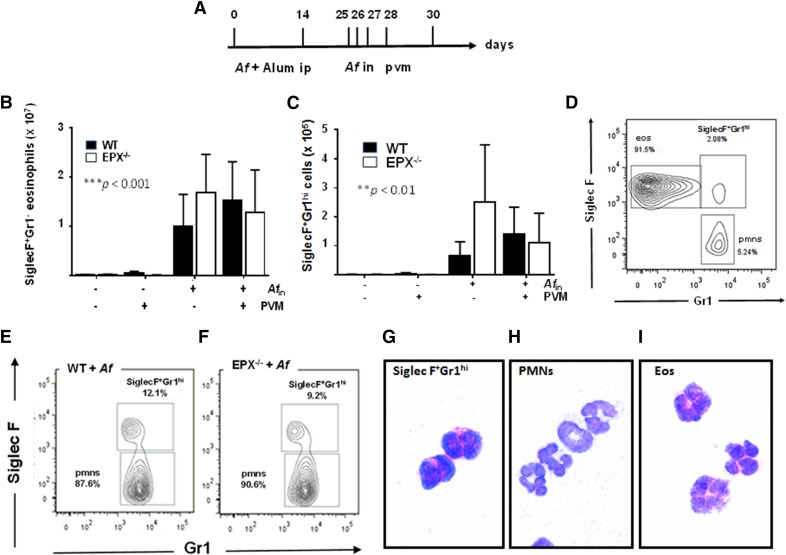
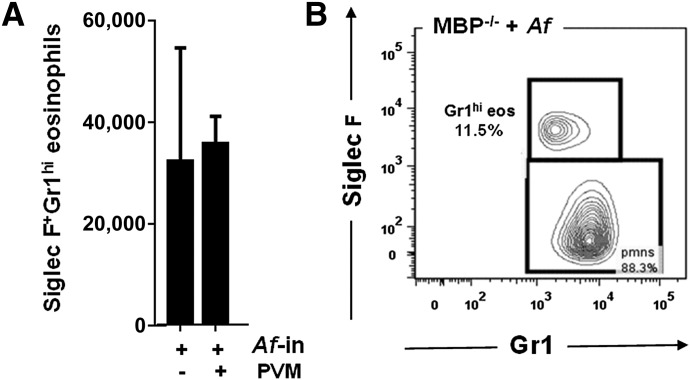
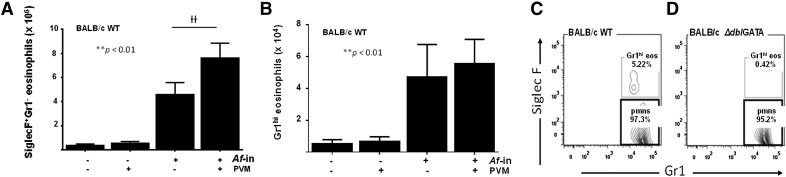
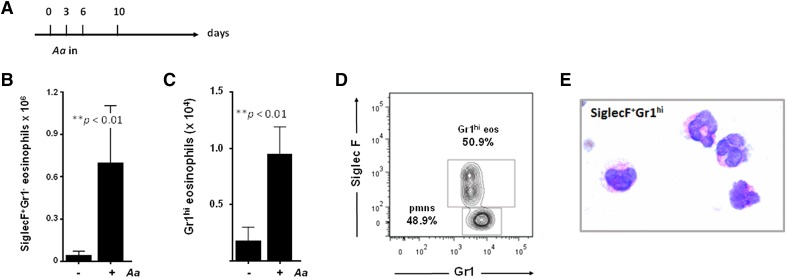
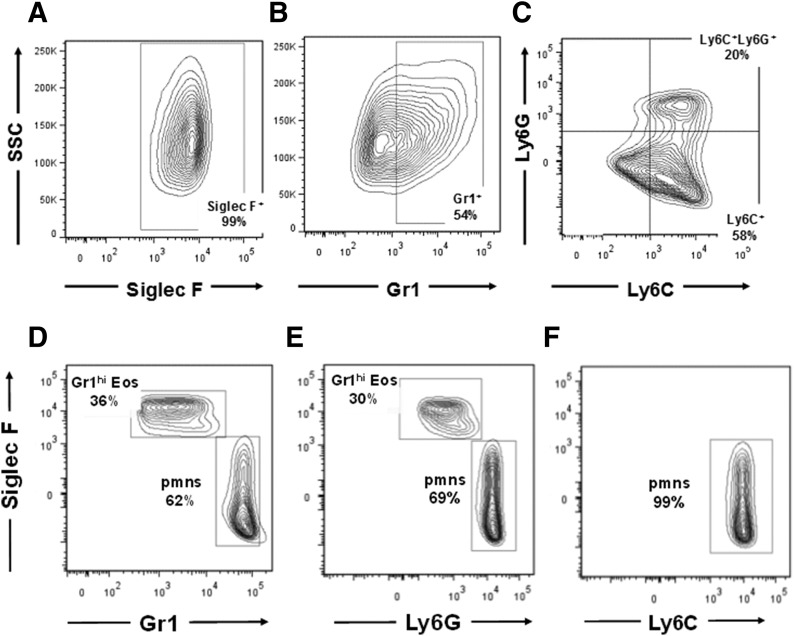
Although eosinophils as a group are readily identified by their unique morphology and staining properties, flow cytometry provides an important means for identification of subgroups based on differential expression of distinct surface Ags. Here, we characterize an eosinophil subpopulation defined by high levels of expression of the neutrophil Ag Gr1 (CD45+CD11c-SiglecF+Gr1hi). SiglecF+Gr1hi eosinophils, distinct from the canonical SiglecF+Gr1- eosinophil population, were detected in allergen-challenged wild-type and granule protein-deficient (EPX-/- and MBP-1-/-) mice, but not in the eosinophil-deficient ΔdblGATA strain. In contrast to Gr1+ neutrophils, which express both cross-reacting Ags Ly6C and Ly6G, SiglecF+Gr1hi eosinophils from allergen-challenged lung tissue are uniquely Ly6G+ Although indistinguishable from the more-numerous SiglecF+Gr1- eosinophils under light microscopy, FACS-isolated populations revealed prominent differences in cytokine contents. The lymphocyte-targeting cytokines CXCL13 and IL-27 were identified only in the SiglecF+Gr1hi eosinophil population (at 3.9 and 4.8 pg/106 cells, respectively), as was the prominent proinflammatory mediator IL-13 (72 pg/106 cells). Interestingly, bone marrow-derived (SiglecF+), cultured eosinophils include a more substantial Gr1+ subpopulation (∼50%); Gr1+ bmEos includes primarily a single Ly6C+ and a smaller, double-positive (Ly6C+Ly6G+) population. Taken together, our findings characterize a distinct SiglecF+Gr1hi eosinophil subset in lungs of allergen-challenged, wild-type and granule protein-deficient mice. SiglecF+Gr1hi eosinophils from wild-type mice maintain a distinct subset of cytokines, including those active on B and T lymphocytes. These cytokines may facilitate eosinophil-mediated immunomodulatory responses in the allergen-challenged lung as well as in other distinct microenvironments.
Keywords: allergy; cytokines; flow cytometry; inflammation.
© Society for Leukocyte Biology.
Figures
References
-
- Lee J. J., Rosenberg H. F.. 2013. Eosinophils in Health and Disease. Elsevier, Amsterdam.
-
- Chu V. T., Beller A., Rausch S., Strandmark J., Zänker M., Arbach O., Kruglov A., Berek C. (2014) Eosinophils promote generation and maintenance of immunoglobulin-A-expressing plasma cells and contribute to gut immune homeostasis. Immunity 40, 582–593. - PubMed
MeSH terms
Substances
Grants and funding
LinkOut - more resources
Full Text Sources
Other Literature Sources
Research Materials
Miscellaneous
