


Use of the National Diabetes Data Group and the Carpenter-Coustan criteria for assessing gestational diabetes mellitus and risk of adverse pregnancy outcome
- PMID: 27535366
- PMCID: PMC4989365
- DOI: 10.1186/s12884-016-1030-9
Use of the National Diabetes Data Group and the Carpenter-Coustan criteria for assessing gestational diabetes mellitus and risk of adverse pregnancy outcome
Abstract
Background: The influence of different diagnostic thresholds for gestational diabetes mellitus (GDM) on pregnancy outcomes is not fully understood. Degrees of glucose intolerance according to the Carpenter-Coustan (CC) criteria were less severe than the National Diabetes Data Group (NDDG) criteria for GDM. Recent studies have shown inconsistent results regarding the risk of adverse pregnancy outcomes between the NDDG and CC criteria. Therefore, the objective of this study was to investigate whether pregnant women who met only the CC criteria but not the NDDG criteria and those who met the NDDG criteria had increased risks of adverse pregnancy outcomes compared to a negative screening group.
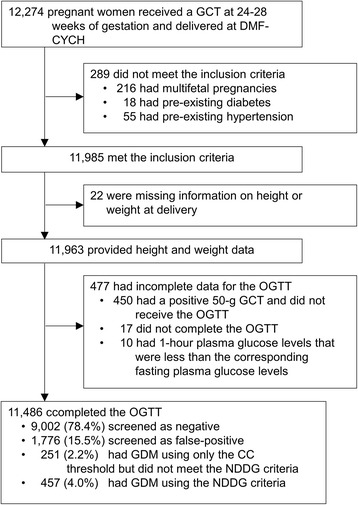
Methods: A total of 11,486 Taiwanese pregnancies were enrolled in a retrospective cohort study. The study subjects were classified as follows: (1) negative screening group: women with negative 50-g glucose challenge test (GCT) results, (2) false-positive screening group: women with positive GCT results and negative 100-g OGTT results according to both CC and NDDG criteria, (3) CC-only-GDM group: women with positive GCT results plus GDM diagnosis meeting the CC but not the NDDG criteria, and (4) NDDG-GDM group: women diagnosed with GDM using the NDDG criteria. Multiple mixed effects logistic regression analysis was used to examine the relationships between the groups and pregnancy outcomes.
Results: There were 9002 (78.4 %), 1776 (15.5 %), 251 (2.2 %), and 457 (4.0 %) study pregnancies in the 4 groups. Compared with the negative screening group, the maternal outcomes were not different within groups except for gestational hypertension/preeclampsia. For neonatal outcomes, the CC-only-GDM group had significantly greater risks of macrosomia, low birth weight, and admission to a neonatal intensive care unit [adjusted odds ratio (aOR), (95 % confidence interval, CI): 2.73 (1.18-6.31), 1.64 (1.01-2.64), and 1.61 (1.05-2.46), respectively]. The NDDG-GDM group also showed significantly greater risks, and the false-positive screening group showed no differences from the negative screening group.
Conclusion: Women who met only the CC criteria and women who met NDDG criteria had significant increased risks of adverse neonatal outcomes. This evidence adds important information to the current debate about the diagnostic criteria for GDM regarding pregnancy outcomes.
Keywords: Admission to a neonatal intensive care unit; Adverse pregnancy outcome; Carpenter-Coustan criteria; Gestational diabetes mellitus; Macrosomia; National Diabetes Data Group criteria.
Figures
References
-
- Pedula KL, Hillier TA, Schmidt MM, Mullen JA, Charles MA, Pettitt DJ. Ethnic differences in gestational oral glucose screening in a large US population. Ethn Dis. 2009;19(4):414–9. - PubMed
-
- International Association of Diabetes and Pregnancy Study Groups Consensus Panel MB. Gabbe SG, Persson B, et al. International Association of Diabetes and Pregnancy Study Groups Recommendations on the Diagnosis and Classification of Hyperglycemia in Pregnancy. Diabetes Care. 2010;33(3):676–82. doi: 10.2337/dc09-1848. - DOI - PMC - PubMed
Publication types
MeSH terms
LinkOut - more resources
Full Text Sources
Other Literature Sources
Medical
Miscellaneous
