. 2016 Nov 1;116(5):2405-2419.
doi: 10.1152/jn.00438.2016. Epub 2016 Aug 17.

Model of the songbird nucleus HVC as a network of central pattern generators

Affiliations

Model of the songbird nucleus HVC as a network of central pattern generators

Eve Armstrong et al. J Neurophysiol. .

Abstract

We propose a functional architecture of the adult songbird nucleus HVC in which the core element is a "functional syllable unit" (FSU). In this model, HVC is organized into FSUs, each of which provides the basis for the production of one syllable in vocalization. Within each FSU, the inhibitory neuron population takes one of two operational states: 1) simultaneous firing wherein all inhibitory neurons fire simultaneously, and 2) competitive firing of the inhibitory neurons. Switching between these basic modes of activity is accomplished via changes in the synaptic strengths among the inhibitory neurons. The inhibitory neurons connect to excitatory projection neurons such that during state 1 the activity of projection neurons is suppressed, while during state 2 patterns of sequential firing of projection neurons can occur. The latter state is stabilized by feedback from the projection to the inhibitory neurons. Song composition for specific species is distinguished by the manner in which different FSUs are functionally connected to each other. Ours is a computational model built with biophysically based neurons. We illustrate that many observations of HVC activity are explained by the dynamics of the proposed population of FSUs, and we identify aspects of the model that are currently testable experimentally. In addition, and standing apart from the core features of an FSU, we propose that the transition between modes may be governed by the biophysical mechanism of neuromodulation.

Keywords: HVC; central pattern generator; dynamical systems; dynamics; winnerless competition.


Figures

Fig. 1.
Fig. 1.
A functional syllable unit (FSU), comprised of 3 inhibitory interneurons (HVCI) and 3 ensembles of nucleus RA (HVCRA) neurons. Triangles and circles represent the former and latter populations, respectively. Circle- and arrow-headed lines represent inhibitory and excitatory functional connections, respectively.
Fig. 2.
Fig. 2.
Voltage traces of three HVCRA projection neurons, one in each of the three ensembles. They fire when given a low background current, in the absence of inhibition. The background current is a constant 0.3 nA with a random 3% variation.
Fig. 3.
Fig. 3.
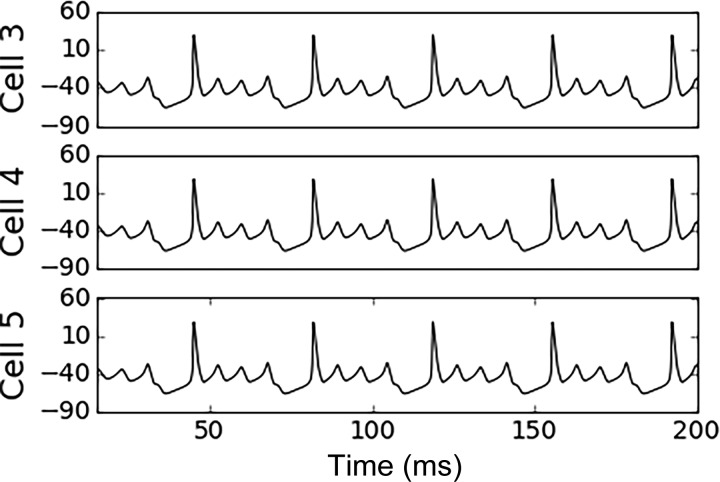
A quiescent FSU. Voltage traces of the three HVCI neurons (top) and three HVCRA neurons each representing 1 ensemble (middle), all within a quiescent FSU, where the inhibitory-upon-inhibitory coupling strengths (see Table 4) are sufficiently low to permit the HVCI neurons to fire continually, and Tmax is 0.5 mM. Bottom: corresponding schematic, where triangles (cells 0, 1, and 2) and circles (cells 3, 4, and 5) represent HVCI and HVCRA neurons, respectively. The cell numbers on the schematic correspond to the numbering of the voltage traces. Black and white shapes indicate activity above and below threshold only, respectively. Each HVCI projects to two HVCRA neurons. When all three HVCI neurons are active simultaneously, the three HVCRA ensembles are suppressed.
Fig. 4.
Fig. 4.
An active FSU, represented in a 3-frame “movie.” Here, the inhibitory-to-inhibitory coupling strengths are roughly 2 μS (Table 5) and Tmax = 1.8 mM, so that the inhibitory neurons may engage in competitive dynamics. Left: three “pairs” of voltage traces, each representing one HVCI neuron (top in each pair) and the one HVCRA ensemble to which that particular HVCI neuron does not directly project (bottom in each pair). Cells designated as “pairs” may fire simultaneously. Thus, series activity of the HVCI neurons effects a series of activity of the HVCRA ensembles. Right: the corresponding schematic of each pair, where a currently active pair is highlighted by a specific color. The activity proceeds clockwise, beginning with the “green pair” (top), followed by the “blue pair” second (middle), and “red pair” third (bottom). The numbering of cells on the schematic corresponds to the numbering of the voltage traces.
Fig. 5.
Fig. 5.
Three rotations of the series activity represented in Fig. 4, where the three inhibitory cells and excitatory ensembles are each grouped together at top and bottom, respectively. Color coding is as defined in Fig. 4.
Fig. 6.
Fig. 6.
FSU behavior as a function of Tmax and gij, where “behavior” is defined in terms of the HVCRA activity. The symbols defining behavior are listed at right. The overlaid black path represents the trajectory for one neurotransmitter injection, as dictated by Eqs. 5–8. The two chief modes [quiescence and active bursting series winnerless competition (WLC)] dominate the space and are robust to small changes in these parameter values. In fact, the top row, at Tmax = 10.5 mM, looks the same through a Tmax value of 50 mM. In addition, there exist (at least) five modes of behavior within the transition regions between the two dominant modes, which one might expect to occasionally encounter in the laboratory. The few locations on the grid that contain no symbol showed some combination of rarer modes and quiescence, and were difficult to characterize.
Fig. 7.
Fig. 7.
The time course of neurotransmitter injection, in terms of Tmax(t) (top) and gij(t) (bottom) according to Eqs. 5–8, corresponding to the black path of Fig. 6.
Fig. 8.
Fig. 8.
A raster plot of spike times of HVCRA and HVCI neurons during repeated renditions of the zebra finch motif, reproduced from Hahnloser et al. (2002). The reader may find it of interest to compare this figure to the simulated raster plot of Fig. 9. [Reprinted from Nature by permission from Macmillan Publishers (Hahnloser et al. 2002)].
Fig. 9.
Fig. 9.
A simulated raster plot of bursting HVCRA and spiking HVCI neurons during song. Top: 4 neurotransmitter injections sequentially target 4 FSUs. Ten electrodes (arrowheads) have each been inserted into one neuron, by an experimenter who is blind to the neurons' identities. The resulting action potential timings are shown at bottom. See text for important notes.

References

    1. Afraimovich V, Zhigulin V, Rabinovich M. On the origin of reproducible sequential activity in neural circuits. Chaos 14: 1123–1129, 2004. - PubMed
    1. Amador A, Perl YS, Mindlin GB, Margoliash D. Elemental gesture dynamics are encoded by song premotor cortical neurons. Nature 495: 59–64, 2013. - PMC - PubMed
    1. Andalman AS, Foerster JN, Fee MS. Control of vocal and respiratory patterns in birdsong: dissection of forebrain and brainstem mechanisms using temperature. PLoS One 6: e25461, 2011. - PMC - PubMed
    1. Ashmore RC, Wild JM, Schmidt MF. Brainstem and forebrain contributions to the generation of learned motor behaviors for song. J Neurosci 25: 8543–8554, 2005. - PMC - PubMed
    1. Barberis A, Petrini EM, Mozrzymas JW. Impact of synaptic neurotransmitter concentration time course on the kinetics and pharmacological modulation of inhibitory synaptic currents. Front Cell Neurosci 5: 6, 2011. - PMC - PubMed

Publication types

LinkOut - more resources