. 2016 Aug 1:11:1745-56.
doi: 10.2147/COPD.S111508. eCollection 2016.

Individualized lung function trends in alpha-1-antitrypsin deficiency: a need for patience in order to provide patient centered management?

Affiliations

Individualized lung function trends in alpha-1-antitrypsin deficiency: a need for patience in order to provide patient centered management?

Robert A Stockley et al. Int J Chron Obstruct Pulmon Dis. .

Abstract

Background: Chronic obstructive pulmonary disease (COPD) is characterized by fixed airflow obstruction and accelerated decline of forced expired volume in 1 second (FEV1). Alpha-1-antitrypsin deficiency is a genetic cause of COPD and associated with more rapid decline in lung function, even in some never smokers (NS) but the potential for individualized assessment to reveal differences when compared to group analyses has rarely been considered.

Methods: We analyzed decline in post-bronchodilator FEV1 and gas transfer (% predicted) over at least 3 years (mean= 6.11, 95% CI 5.80-6.41) in our unique data set of 482 patients with alpha-1-antitrypsin deficiency (PiZ) to determine individual rates of decline, implications for prognosis, and potential clinical management.

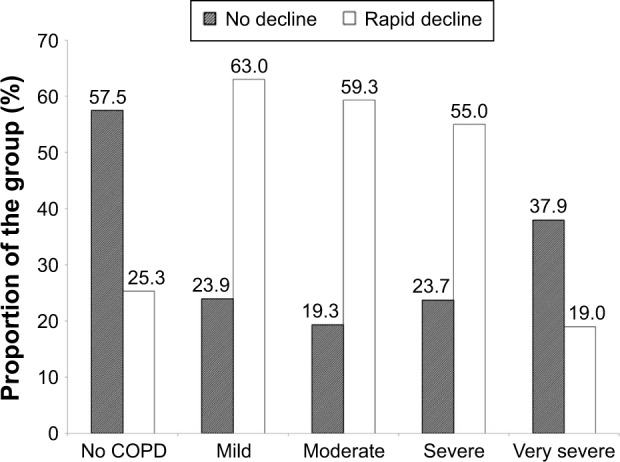
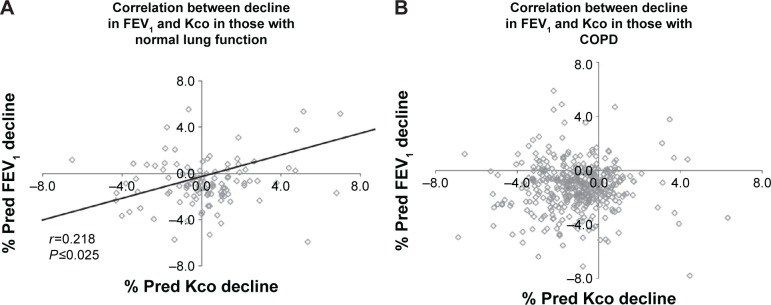
Findings: There was a marked variation in individual rates of FEV1 decline from levels consistent with normal aging (observed in 23.5% of patients with established COPD, 57.5% of those without) to those of rapidly declining COPD. Gas transfer did not decline in 12.8% of NS and 20.7% of ex-smokers with established COPD (33.3% and 25.0%, respectively, for those without COPD). There was no correlation between decline in gas transfer and FEV1 for those with COPD, although a weak relationship existed for those without (r=0.218; P<0.025).

Conclusion: These data confirm differing individual rates of lung function decline in alpha-1-antitrypsin deficiency, indicating the importance of comprehensive physiological assessment and a personalized approach to patient management.

Keywords: COPD; alpha-1-antitrypsin deficiency; emphysema; lung function.


Figures
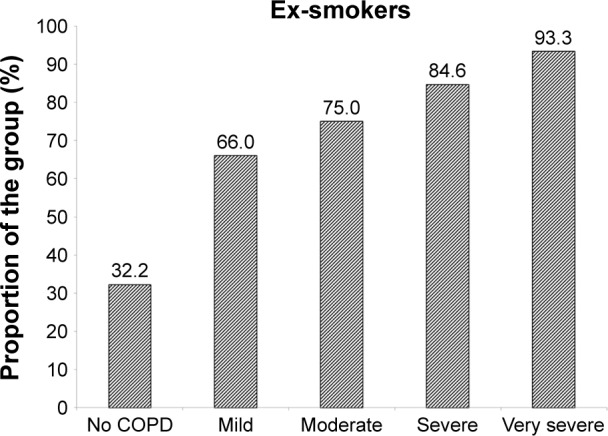
Figure 1
Figure 1
The proportion of patients who are ex-smokers. Notes: The bar chart shows the proportion of those without COPD and those with different severity stages of COPD as defined by GOLD who are ex-smokers. Abbreviations: COPD, chronic obstructive pulmonary disease; GOLD, Global initiative for chronic Obstructive Lung Disease.
Figure 2
Figure 2
The proportion of subjects showing no decline or rapid decline in FEV1. Notes: The bar chart shows the degree of decline in FEV1, categorized as no decline or rapid decline, in those without COPD and those with different severity stages of COPD. Abbreviations: COPD, chronic obstructive pulmonary disease; FEV1, forced expired volume in 1 second.
Figure 3
Figure 3
The relationship between the decline in FEV1 and Kco. Notes: The figure substratifies correlations between FEV1 and Kco values in individual patients without (A) and with (B) established COPD. The correlation coefficient (r) is shown for both the groups with its significance (P). In both the graphs, the horizontal axis goes through the point of no decline in FEV1, such that those points lying below the line have worsening FEV1, while those above it have shown an improvement. Similarly the vertical axis passes through the point of no decline in Kco, such that those points lying to the left are deteriorating, while those to the right are not. The four quadrants therefore represent decline in both FEV1 and Kco (bottom left), decline in Kco alone (upper left), decline in FEV1 alone (bottom right), and decline in neither measure (upper right). Kco is gas transfer corrected for alveolar ventilation. Abbreviations: % pred, % predicted; COPD, chronic obstructive pulmonary disease; FEV1, forced expired volume in 1 second.
Figure 4
Figure 4
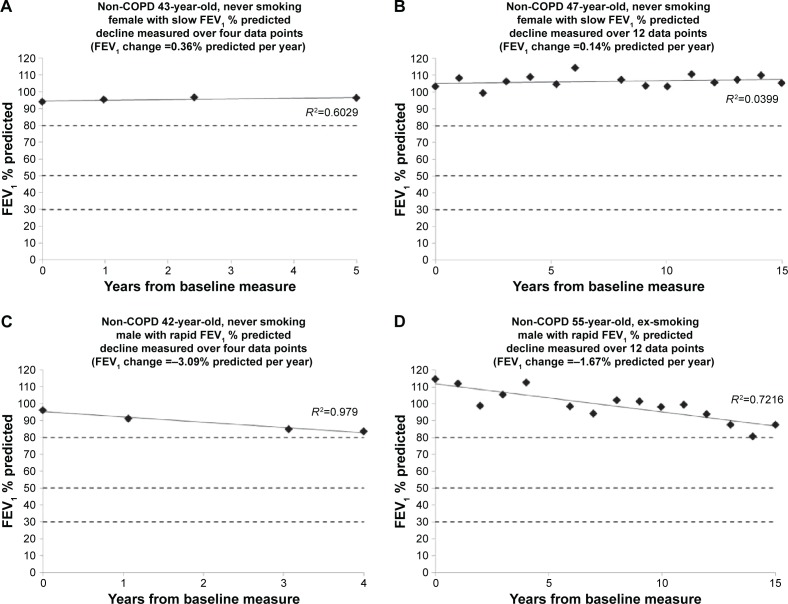
The decline in FEV1 for individual patients without COPD. Notes: Representative patients have been chosen to demonstrate the pattern of FEV1 decline in (A and B) slow/no decline and (C and D) rapid decline. The similarity of the slope in patients followed over prolonged periods (B and D) to those followed over shorter periods (A and B) demonstrates that decline is linear in an individual over time, such that shorter periods might be used to determine longer-term prognosis. Abbreviations: COPD, chronic obstructive pulmonary disease; FEV1, forced expired volume in 1 second.
Figure 5
Figure 5
Decline in FEV1 for individual patients with COPD. Notes: This figure demonstrates the pattern of slow decline (A and B) and rapid decline (C and D) in patients with COPD. A linear pattern in any given individual was seen. Abbreviations: COPD, chronic obstructive pulmonary disease; FEV1, forced expired volume in 1 second.
Figure 6
Figure 6
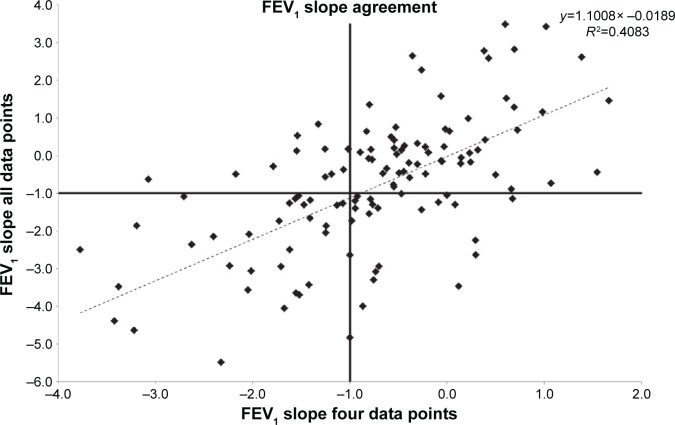
The degree of agreement between measures of FEV1 decline. Notes: The decline in FEV1 determined by linear regression analysis is shown for patients in whom both four and eleven annual data points were available. The horizontal and vertical lines indicate the threshold of 1% predicted decline used here to delineate the rapid decliners. The regression equation and r2 value is shown; there is a good relationship indicating that four data points may be adequate to determine longer-term prognosis. Abbreviation: FEV1, forced expired volume in 1 second.

References

    1. Ketelaars CA, Schlösser MA, Mostert R, et al. Determinants of health-related quality of life in patients with chronic obstructive pulmonary disease. Thorax. 1996;51:39–43. - PMC - PubMed
    1. Ebi-Kryston KL. Respiratory symptoms and pulmonary function as predictors of 10-year mortality from respiratory disease, cardiovascular disease, and all causes in the Whitehall study. J Clin Epidemiol. 1988;4:251–260. - PubMed
    1. Tockman MS, Comstock GW. Respiratory risk factors and mortality: longitudinal studies in Washington County, Maryland. Am Rev Respir Dis. 1989;140(3 Pt 2):S56–S63. - PubMed
    1. Vestbo J, Hurd SS, Agusti AG, et al. Global strategy for the diagnosis, management and prevention of chronic obstructive pulmonary disease, GOLD executive summary. Am J Respir Crit Care Med. 2013;187:347–365. - PubMed
    1. Tsuji T, Aoshiba K, Nagai A. Alveolar cell senescence in patients with pulmonary emphysema. Am J Respir Crit Care Med. 2006;174:886–893. - PubMed

MeSH terms