


Does the Time of Postoperative Bisphosphonate Administration Affect the Bone Union in Osteoporotic Intertrochanteric Fracture of Femur?
- PMID: 27536634
- PMCID: PMC4972797
- DOI: 10.5371/hp.2015.27.4.258
Does the Time of Postoperative Bisphosphonate Administration Affect the Bone Union in Osteoporotic Intertrochanteric Fracture of Femur?
Abstract
Purpose: This study was designed to investigate the effect of bisphosphonate administration starting time on bone healing and to identify the best administration time following surgical treatment of osteoporotic intertrochanteric fractures.
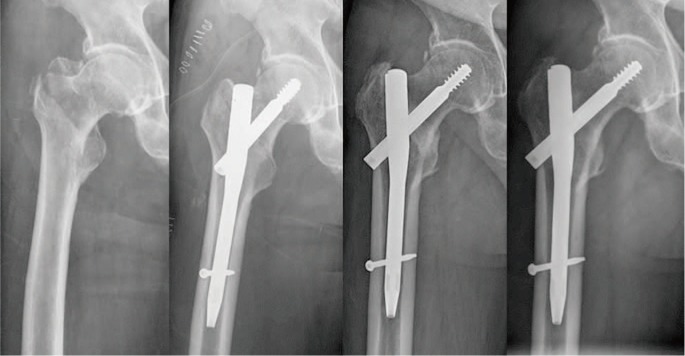
Materials and methods: Two hundreds and eighty four patients (284 hips; 52 males, 232 females) who underwent surgery following osteoporotic intertrochanteric fracture from December 2002 to December 2012 were retrospectively analyzed. The average follow-up period was 68.4 months. The patients were divided into three groups according to the time of bisphosphonate administration after operation: 1 week (group A; n=102), 1 month (group B; n=89), and 3 months (group C; n=93). Koval scores and change of Koval scores 1 year after operation were used for clinical evaluation. For radiologic evaluation, the time of callus appearance across the fracture line on sagittal and coronal radiographs and the time to absence of pain during hip motion was judged as the time of bone union.
Results: Koval scores one year after surgery for groups A, B, and C were 2.44, 2.36, and 2.43 (P=0.895), respectively. The mean time of union was 12.4, 11.9, and 12.3 weeks after operation in the three groups (P=0.883), respectively. There were zero cases of nonunion. There were 3, 5, and 7 cases of fixative displacement in the three groups, respectively, but the distribution showed no significant difference (P>0.472).
Conclusion: The initiating time of bisphosphonate administration following surgery does not affect the clinical outcomes in patients with osteoporotic intertrochanteric fracture.
Keywords: Bisphosphonates; Bone healing; Intertrochanteric fractures; Osteoporotic fractures.
Figures
References
-
- Murakami H, Takahashi N, Sasaki T, et al. A possible mechanism of the specific action of bisphosphonates on osteoclasts: tiludronate preferentially affects polarized osteoclasts having ruffled borders. Bone. 1995;17:137–144. - PubMed
-
- Sato M, Grasser W. Effects of bisphosphonates on isolated rat osteoclasts as examined by reflected light microscopy. J Bone Miner Res. 1990;5:31–40. - PubMed
-
- Bartl R. Update 2004. Osteoporosis--management--current status. Krankenpfl J. 2004;42:232. - PubMed
-
- Shin CS, Choi HJ, Kim MJ, et al. Prevalence and risk factors of osteoporosis in Korea: a community-based cohort study with lumbar spine and hip bone mineral density. Bone. 2010;47:378–387. - PubMed
LinkOut - more resources
Full Text Sources
Other Literature Sources
