


Inflammatory Bowel Disease: Influence and Implications in Reproduction
- PMID: 27537054
- PMCID: PMC5069142
- DOI: 10.1097/MIB.0000000000000884
Inflammatory Bowel Disease: Influence and Implications in Reproduction
Abstract
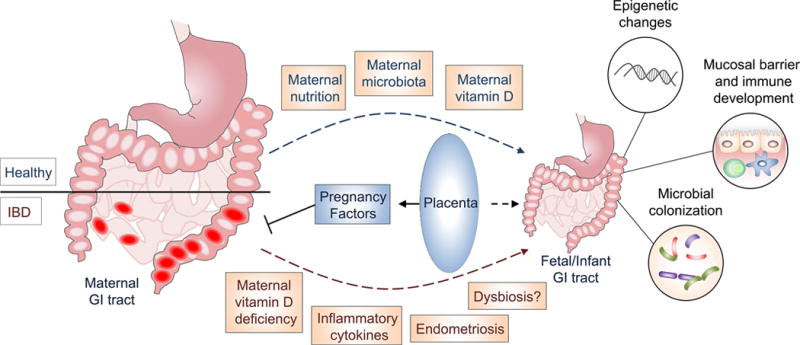
The incidence and prevalence of inflammatory bowel disease (IBD) continues to rise with time, signifying its emergence as a global disease. Clinical onset of IBD, comprising Crohn's disease and ulcerative colitis, typically occurs before or at peak reproductive age. Although active disease in female patients is associated with reduced fertility and adverse obstetric outcomes in pregnancy, the molecular mechanisms underlying this altered reproductive course, and its impact on IBD transmission to offspring, remain poorly understood. Clinical and experimental studies have now begun to elucidate the hormonal, environmental, and microbial factors that modulate immune-reproductive cross talk in IBD and define their impact on maternal health, fetal development, and heritability of disease risk. Evolving insight into maternal-fetal imprinting in IBD has important implications for patient counseling and disease management during pregnancy and may help predict clinical outcomes for both mother and child.
Conflict of interest statement
The authors declare no financial interests in any of the work submitted here.
Figures
Similar articles
-
Inflammatory bowel disease and pregnancy.Ginekol Pol. 2017;88(7):398-403. doi: 10.5603/GP.a2017.0074. Ginekol Pol. 2017. PMID: 28819946
-
Reproduction and Pregnancy in Inflammatory Bowel Disease - Management and Treatment Based on Current Guidelines.J Gynecol Obstet Hum Reprod. 2021 Mar;50(3):101777. doi: 10.1016/j.jogoh.2020.101777. Epub 2020 Apr 18. J Gynecol Obstet Hum Reprod. 2021. PMID: 32315763 Review.
-
Pregnancy and breastfeeding in inflammatory bowel disease.Digestion. 2012;86 Suppl 1:45-54. doi: 10.1159/000341941. Epub 2012 Oct 5. Digestion. 2012. PMID: 23051726 Review.
-
Reproduction in the patient with inflammatory bowel disease.Minerva Gastroenterol Dietol. 2013 Sep;59(3):285-97. Minerva Gastroenterol Dietol. 2013. PMID: 23867948 Review.
-
The Association Between Maternal Chronic Inflammatory Bowel Disease and Long-term Health Outcomes in Children-A Nationwide Cohort Study.Inflamm Bowel Dis. 2017 Aug;23(8):1440-1446. doi: 10.1097/MIB.0000000000001146. Inflamm Bowel Dis. 2017. PMID: 28719543
Cited by
-
The Impact of Inflammatory Bowel Disease on Pregnancy and the Fetus: A Literature Review.Cureus. 2019 Sep 13;11(9):e5648. doi: 10.7759/cureus.5648. Cureus. 2019. PMID: 31700750 Free PMC article. Review.
-
Impact of Obesity on Inflammatory Bowel Disease.Curr Gastroenterol Rep. 2022 Jan;24(1):26-36. doi: 10.1007/s11894-022-00840-x. Epub 2022 Feb 12. Curr Gastroenterol Rep. 2022. PMID: 35150406 Review.
-
Inflammatory bowel disease in pregnancy and breastfeeding.Nat Rev Gastroenterol Hepatol. 2023 Aug;20(8):504-523. doi: 10.1038/s41575-023-00758-3. Epub 2023 Mar 31. Nat Rev Gastroenterol Hepatol. 2023. PMID: 37002407 Review.
-
Dysregulation of the interleukin-17A pathway in endometrial tissue from women with unexplained infertility affects pregnancy outcome following assisted reproductive treatment.Hum Reprod. 2020 Aug 1;35(8):1875-1888. doi: 10.1093/humrep/deaa111. Hum Reprod. 2020. PMID: 32614049 Free PMC article.
-
Fractionated irradiation of right thorax induces abscopal damage on testes leading to decline in fertility.Sci Rep. 2019 Oct 23;9(1):15221. doi: 10.1038/s41598-019-51772-y. Sci Rep. 2019. PMID: 31645625 Free PMC article.
References
-
- Kaplan GG. The global burden of IBD: from 2015 to 2025. Nat Rev Gastroenterol Hepatol. 2015;12:720–7. - PubMed
-
- Nielsen OH, Maxwell C, Hendel J. IBD medications during pregnancy and lactation. Nat Rev Gastroenterol Hepatol. 2014;11:116–27. - PubMed
-
- Broms G, Granath F, Linder M, et al. Birth outcomes in women with inflammatory bowel disease: effects of disease activity and drug exposure. Inflamm Bowel Dis. 2014;20:1091–8. - PubMed
-
- Norgard B, Hundborg HH, Jacobsen BA, et al. Disease activity in pregnant women with Crohn’s disease and birth outcomes: a regional Danish cohort study. Am J Gastroenterol. 2007;102:1947–54. - PubMed
-
- Rajaratnam SG, Eglinton TW, Hider P, et al. Impact of ileal pouch-anal anastomosis on female fertility: meta-analysis and systematic review. Int J Colorectal Dis. 2011;26:1365–74. - PubMed
Publication types
MeSH terms
Grants and funding
LinkOut - more resources
Full Text Sources
Other Literature Sources
Medical
