


Adherence to malaria diagnosis and treatment guidelines among healthcare workers in Ogun State, Nigeria
- PMID: 27538947
- PMCID: PMC4991116
- DOI: 10.1186/s12889-016-3495-x
Adherence to malaria diagnosis and treatment guidelines among healthcare workers in Ogun State, Nigeria
Abstract
Background: Malaria case management remains a vital component of malaria control strategies. Despite the introduction of national malaria treatment guidelines and scale-up of malaria control interventions in Nigeria, anecdotal evidence shows some deviations from the guidelines in malaria case management. This study assessed factors influencing adherence to malaria diagnosis and treatment guidelines among healthcare workers in public and private sectors in Ogun State, Nigeria.
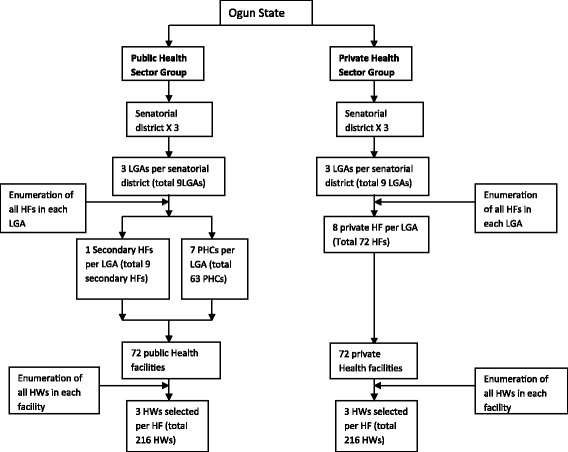
Methods: A comparative cross-sectional study was carried out among 432 (216 public and 216 private) healthcare workers selected from nine Local Government Areas using a multistage sampling technique. A pre-tested interviewer administered questionnaire was used to collect information on availability and use of malaria Rapid Diagnostic Test (mRDT) and artemisinin combination therapy (ACT), for management of uncomplicated malaria. Adherence was defined as when choice of antimalarials for parasitological confirmed malaria cases was restricted to recommended antimalarial medicines. Association between adherence and independent variables were tested using Chi-square at 5 % level of significance.
Results: Malaria RDT was available in 81.9 % of the public health facilities and 19.4 % of the private health facilities (p = 0.001). Its use was higher among public healthcare workers (85.2 %) compared to 32.9 % in private facilities (p = 0.000). Presumptive diagnosis of malaria was higher among private healthcare workers (94.9 %) compared to 22.7 % public facilities (p = <0.0001). The main reason for non-usage of mRDT among private healthcare workers was its perceived unreliability of mRDT (40.9 %). Monotherapy including artesunate (58.3 % vs 12.5 %), amodiaquine (38.9 % vs 8.3 %) and chloroquine (26.4 % vs 4.2 %) were significantly more available in private than public health facilities, respectively. Adherence to guidelines was significantly higher among public healthcare workers (60.6 %) compared to those in private facilities (27.3 %). Availability of antimalarial medicine was the main factor that influenced treatment prescription in both healthcare settings (p = 0.27). However, drug promotion by manufactures (45.8 %) has a major influence on private healthcare workers' prescription practice.
Conclusion: The findings of this study demonstrate significant difference between public and private healthcare workers on adherence to national malaria diagnosis and treatment guidelines. Interventions to improve private sector engagement in implementation of the guidelines, training and supply of recommended antimalarial medicines should be intensified.
Keywords: Healthcare workers’ adherence; Malaria; National treatment guidelines; Nigeria.
Figures
References
-
- WHO . WHO: World malaria report 2013. Geneva: World Health Organization; 2013.
-
- NMCP/FMOH. Federal Ministry of Health, National Malaria Control Programme; A 5-year Strategic Plan: 2006-2010. 2006.
-
- SMOH . Ogun State Ministry of Health. Malaria Control Activities Report. 2012.
-
- WHO . Guidelines for the treatment of malaria, Second Edition. Geneva: World Health Organization; 2010.
MeSH terms
Substances
LinkOut - more resources
Full Text Sources
Other Literature Sources
Medical
