Review
. 2016 Oct;12(10):580-92.
doi: 10.1038/nrrheum.2016.136. Epub 2016 Aug 19.

Low-grade inflammation as a key mediator of the pathogenesis of osteoarthritis

Affiliations
Review

Low-grade inflammation as a key mediator of the pathogenesis of osteoarthritis

William H Robinson et al. Nat Rev Rheumatol. 2016 Oct.

Abstract

Osteoarthritis (OA) has long been viewed as a degenerative disease of cartilage, but accumulating evidence indicates that inflammation has a critical role in its pathogenesis. Furthermore, we now appreciate that OA pathogenesis involves not only breakdown of cartilage, but also remodelling of the underlying bone, formation of ectopic bone, hypertrophy of the joint capsule, and inflammation of the synovial lining. That is, OA is a disorder of the joint as a whole, with inflammation driving many pathologic changes. The inflammation in OA is distinct from that in rheumatoid arthritis and other autoimmune diseases: it is chronic, comparatively low-grade, and mediated primarily by the innate immune system. Current treatments for OA only control the symptoms, and none has been FDA-approved for the prevention or slowing of disease progression. However, increasing insight into the inflammatory underpinnings of OA holds promise for the development of new, disease-modifying therapies. Indeed, several anti-inflammatory therapies have shown promise in animal models of OA. Further work is needed to identify effective inhibitors of the low-grade inflammation in OA, and to determine whether therapies that target this inflammation can prevent or slow the development and progression of the disease.


Conflict of interest statement

Competing interests statement

J.S. is an employee of AbbVie. All other authors declare no competing interests.

Figures
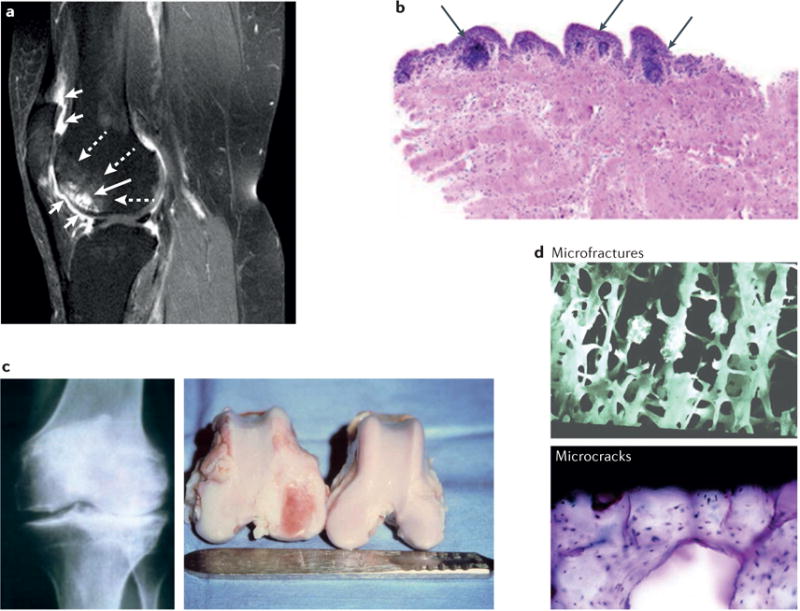
Figure 1
Figure 1. Radiographic and histologic findings in OA: evidence of inflammation and bone remodelling
a | Gadolinium-enhanced MRI (sagittal view) scan of a knee with multiple features typical of OA: synovial inflammation, cartilage degradation, and bone remodelling. Short white arrows indicate marked peripatellar synovitis, dashed white arrows indicate bone marrow lesions, and the long white arrow pointing to bright white structures indicates bone cysts. b | A synovial biopsy specimen obtained during meniscectomy from a patient with knee OA, showing histological evidence of inflammation. Arrows indicate the presence of perivascular mononuclear cell accumulation. Original magnification × 5, haematoxylin and eosin stain. c | Remodelling of the subchondral bone in OA, as detected by radiography of the knee of an individual with OA (left), and by gross examination of distal femurs of a dog (right) that had undergone unilateral anterior cruciate ligament transection. In the destabilized dog knee, full-thickness ulceration of the articular cartilage has developed on the medial femoral condyle, and striking remodelling of the subchondral bone has occurred, with enlargement of the medial femoral condyle. The articular cartilage and bone on the contralateral dog knee appear grossly normal. d | Microfractures and microcracks in subchondral bone of an individual with OA. Part a adapted from Felson, D. T. Developments in the clinical understanding of osteoarthritis. Arthritis Res. Ther. 11, 203 (2009). The original article is an open access article distributed under the terms of the Creative Commons Attribution License (http://creativecommons.org/licenses/by/2.0), which permits unrestricted use, distribution, and reproduction in any medium, provided the original work is properly cited. Part b reproduced from Scanzello, C. R. et al. Synovial inflammation in patients undergoing arthroscopic meniscectomy: molecular characterization and relationship to symptoms. Arthritis Rheum. 63, 391–400 (2011). Parts c, d reproduced from Brandt, K. D., Dieppe, P. & Radin, E. L. Commentary: is it useful to subset “primary” osteoarthritis? A critique based on evidence regarding the etiopathogenesis of osteoarthritis. Semin. Arthritis Rheum. 39, 81–95 (2009).
Figure 2
Figure 2. The pathobiology of OA
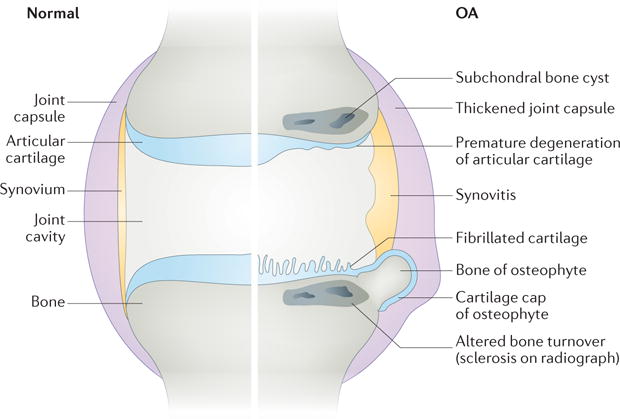
Comparison of the normal joint (left side) and the OA joint (right side), demonstrating that OA is a disease that affects the entire joint structure, including the articular cartilage, synovium, subchondral bone, joint capsule, and other components of the joint.
Figure 3
Figure 3. The molecular mechanisms of low-grade inflammation in OA
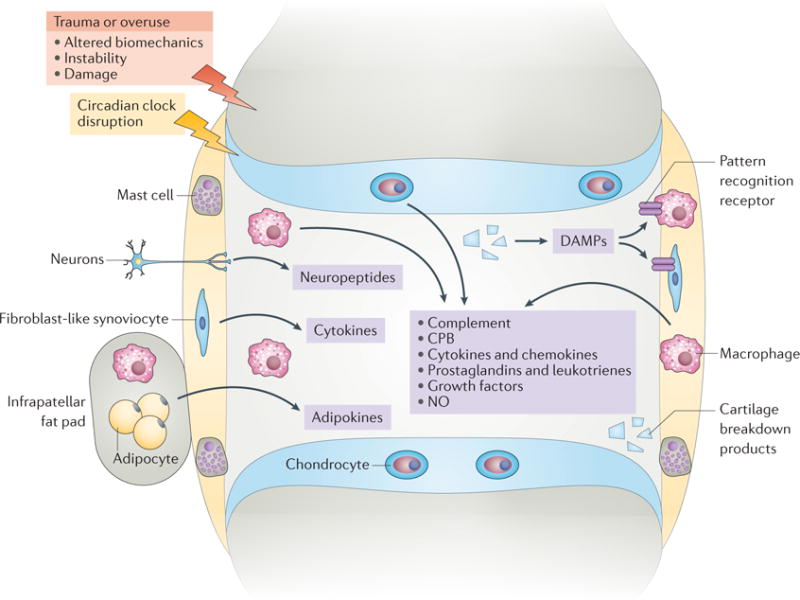
Several inflammatory pathways and mechanisms are likely to contribute to the pathogenesis of OA. In this paradigm, injury or overuse, often in the context of other risk factors, triggers a vicious cycle of local tissue damage, failed tissue repair, and low-grade inflammation involving a number of molecular components and mechanisms in the joint. This low-grade inflammation contributes to or mediates progressive cartilage loss, pain, and joint dysfunction. CPB, carboxypeptidase B; DAMPs, disease-associated molecular patterns; NO, nitric oxide.
Figure 4
Figure 4. Targeting low-grade inflammation in OA
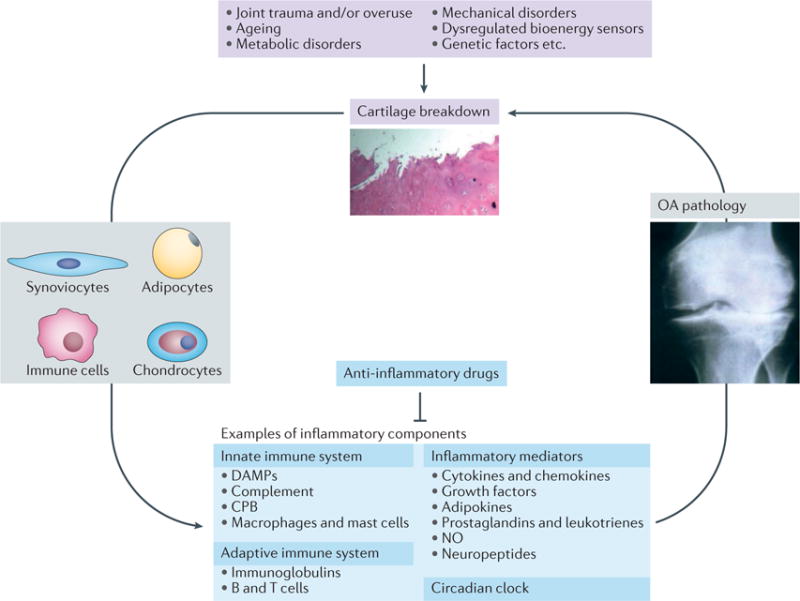
Can abrogating low-grade inflammatory responses break the feed-forward cycle of joint damage and breakdown leading to inflammation that promotes the pathogenesis of OA? Examples of risk factors for OA, cell types involved in its pathogenesis, and molecular components in the inflammatory pathways that are potential therapeutic targets for preventing or treating OA are shown. CPB, carboxypeptidase B; DAMPs, disease-associated molecular patterns; NO, nitric oxide; OA, osteoarthritis.

References

    1. Lawrence RC, et al. Estimates of the prevalence of arthritis and other rheumatic conditions in the United States. Part II. Arthritis Rheum. 2008;58:26–35. - PMC - PubMed
    1. Felson DT. Clinical practice. Osteoarthritis of the knee. N Engl J Med. 2006;354:841–848. - PubMed
    1. Felson DT, et al. Osteoarthritis: new insights. Part 2: treatment approaches. Ann Intern Med. 2000;133:726–737. - PubMed
    1. Blagojevic M, Jinks C, Jeffery A, Jordan K. P Risk factors for onset of osteoarthritis of the knee in older adults: a systematic review and meta-analysis. Osteoarthritis Cartilage. 2010;18:24–33. - PubMed
    1. Zhuo Q, Yang W, Chen J, Wang Y. Metabolic syndrome meets osteoarthritis. Nat Rev Rheumatol. 2012;8:729–737. - PubMed

Publication types