Expanding Access to a New, More Affordable Levonorgestrel Intrauterine System in Kenya: Service Delivery Costs Compared With Other Contraceptive Methods and Perspectives of Key Opinion Leaders
- PMID: 27540128
- PMCID: PMC4990165
- DOI: 10.9745/GHSP-D-15-00327
Expanding Access to a New, More Affordable Levonorgestrel Intrauterine System in Kenya: Service Delivery Costs Compared With Other Contraceptive Methods and Perspectives of Key Opinion Leaders
Abstract
Background: The levonorgestrel intrauterine system (LNG IUS) is one of the most effective forms of contraception and offers important non-contraceptive health benefits. However, it is not widely available in developing countries, largely due to the high price of existing products. Medicines360 plans to introduce its new, more affordable LNG IUS in Kenya. The public-sector transfer price will vary by volume between US$12 to US$16 per unit; for an order of 100,000 units, the public-sector transfer price will be approximately US$15 per unit.
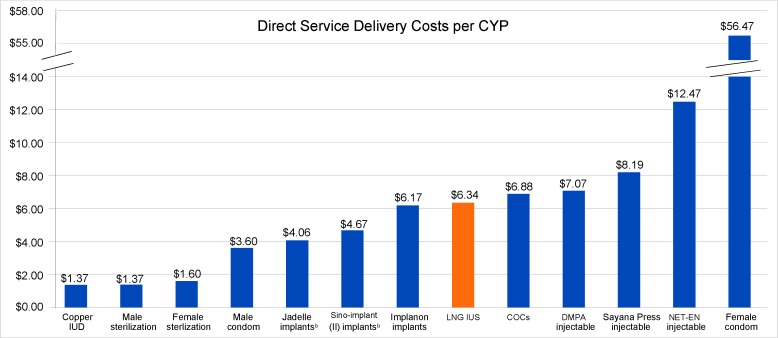
Methods: We calculated the direct service delivery cost per couple-years of protection (CYP) of various family planning methods. The model includes the costs of contraceptive commodities, consumable supplies, instruments per client visit, and direct labor for counseling, insertion, removal, and resupply, if required. The model does not include costs of demand creation or training. We conducted interviews with key opinion leaders in Kenya to identify considerations for scale-up of a new LNG IUS, including strategies to overcome barriers that have contributed to low uptake of the copper intrauterine device.
Results: The direct service delivery cost of Medicines360's LNG IUS per CYP compares favorably with other contraceptive methods commonly procured for public-sector distribution in Kenya. The cost is slightly lower than that of the 3-month contraceptive injectable, which is currently the most popular method in Kenya. Almost all key opinion leaders agreed that introducing a more affordable LNG IUS could increase demand and uptake of the method. They thought that women seeking the product's non-contraceptive health benefits would be a key market segment, and most agreed that the reduced menstrual bleeding associated with the method would likely be viewed as an advantage. The key opinion leaders indicated that myths and misconceptions among providers and clients about IUDs must be addressed, and that demand creation and provider training should be prioritized.
Conclusion: Introducing a new, more affordable LNG IUS product could help expand choice for women in Kenya and increase use of long-acting reversible contraception. Further evaluation is needed to identify the full costs required for introduction-including the cost of demand creation-as well as research among potential and actual LNG IUS users, their partners, and health care providers to help inform scale-up of the method.
© Rademacher et al.
Figures
References
-
- Trussell J. Contraceptive efficacy. : Hatcher R, Trussell J, Nelson A, Cates W, Kowal D, Policar M, Contraceptive technology. 20th rev. ed Atlanta (GA): Ardent Media, Inc; 2011. p. 779–863.
-
- American College of Obstetricians and Gynecologists Committee on Gynecologic Practice; Long-Acting Reversible Contraception Working Group. ACOG Committee Opinion no. 450: increasing use of contraceptive implants and intrauterine devices to reduce unintended pregnancy. Obstet Gynecol. 2009;114(6):1434–1438. 10.1097/AOG.0b013e3181c6f965. - DOI - PubMed
Publication types
MeSH terms
Substances
LinkOut - more resources
Full Text Sources
Other Literature Sources
Medical