. 2016 Nov;101(11):1351-1358.
doi: 10.3324/haematol.2016.148825. Epub 2016 Aug 18.

An operational definition of primary refractory acute myeloid leukemia allowing early identification of patients who may benefit from allogeneic stem cell transplantation

Affiliations

An operational definition of primary refractory acute myeloid leukemia allowing early identification of patients who may benefit from allogeneic stem cell transplantation

Paul Ferguson et al. Haematologica. 2016 Nov.

Abstract

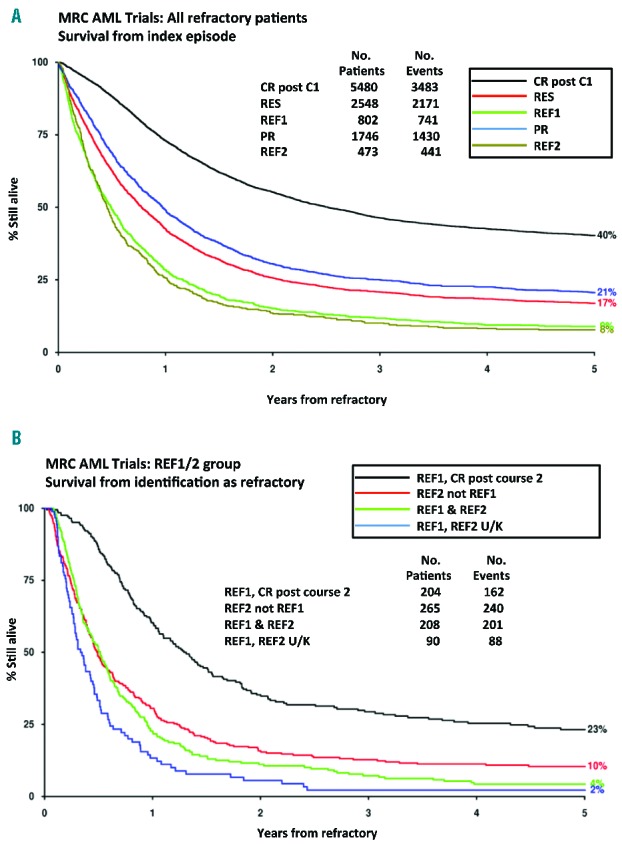
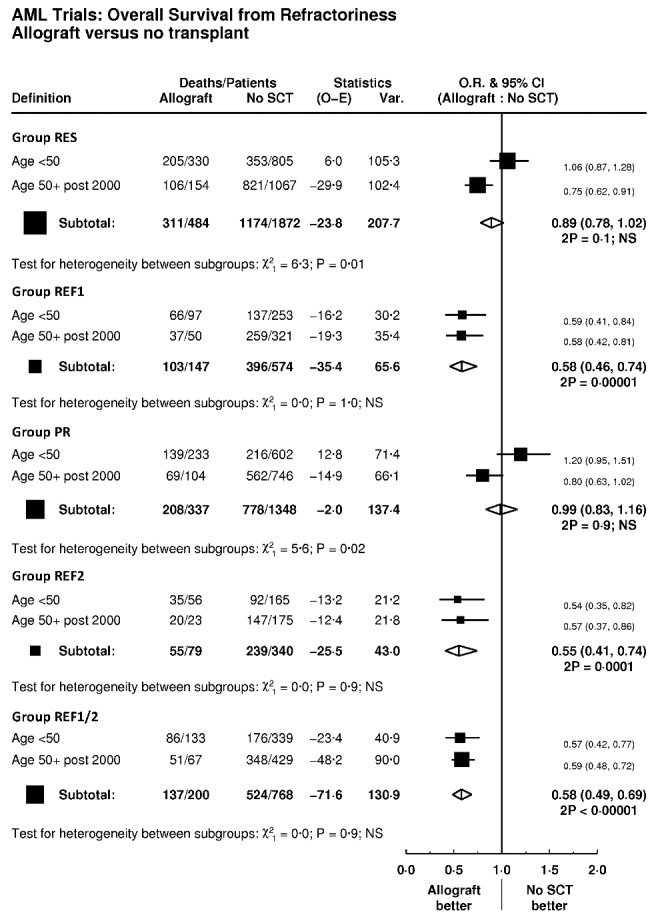
Up to 30% of adults with acute myeloid leukemia fail to achieve a complete remission after induction chemotherapy - termed primary refractory acute myeloid leukemia. There is no universally agreed definition of primary refractory disease, nor have the optimal treatment modalities been defined. We studied 8907 patients with newly diagnosed acute myeloid leukemia, and examined outcomes in patients with refractory disease defined using differing criteria which have previously been proposed. These included failure to achieve complete remission after one cycle of induction chemotherapy (RES), less than a 50% reduction in blast numbers with >15% residual blasts after one cycle of induction chemotherapy (REF1) and failure to achieve complete remission after two courses of induction chemotherapy (REF2). 5-year overall survival was decreased in patients fulfilling any criteria for refractory disease, compared with patients achieving a complete remission after one cycle of induction chemotherapy: 9% and 8% in patients with REF1 and REF2 versus 40% (P<0.0001). Allogeneic stem cell transplantation improved survival in the REF1 (HR 0.58 (0.46-0.74), P=0.00001) and REF2 (HR 0.55 (0.41-0.74), P=0.0001) cohorts. The utilization of REF1 criteria permits the early identification of patients whose outcome after one course of induction chemotherapy is very poor, and informs a novel definition of primary refractory acute myeloid leukemia. Furthermore, these data demonstrate that allogeneic stem cell transplantation represents an effective therapeutic modality in selected patients with primary refractory acute myeloid leukemia.


Figures

Figure 1.
Figure 1.
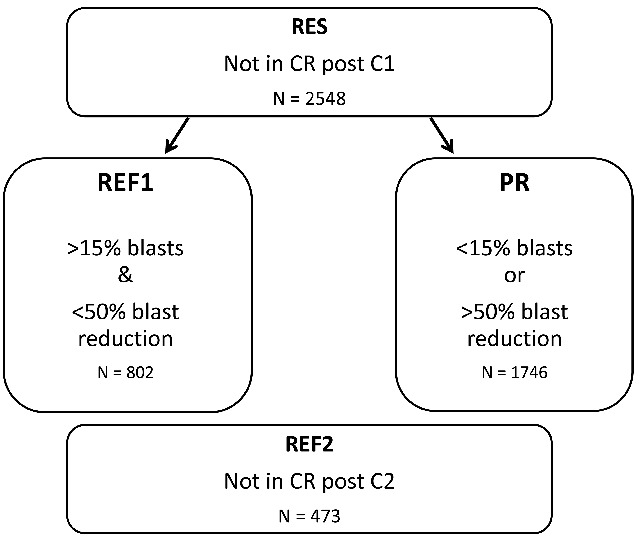
Diagram illustrating the four definitions of refractory AML (acute myeloid leukemia) used in this study. C1: course 1; C2: course 2; CR: complete remission; RES: resistant disease with failure to achieve a complete remission after C1; REF1: those deemed to have had a minor or no response to IC with more than 15% blasts and a less than 50% proportional reduction in blast percentage after C1; REF2: failure to achieve a complete remission after two courses of IC; PR: those deemed to have had a partial response after C1 with fewer than 15% blasts or a greater than 50% proportional reduction in blast percentage.
Figure 2.
Figure 2.
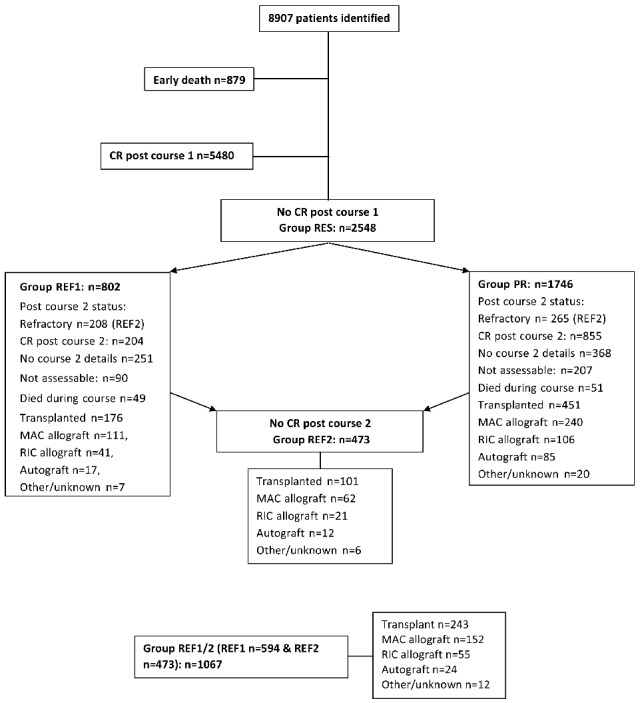
Consort diagram of patient cohorts and treatment outcomes. CR: Complete remission; MAC: myeloablative conditioning; RIC: reduced intensity conditioning; RES: resistant disease with failure to achieve a complete remission after C1; REF1: those deemed to have had a minor or no response to IC with more than 15% blasts and a less than 50% proportional reduction in blast percentage after C1; PR: those deemed to have had a partial response after C1 with fewer than 15% blasts or a greater than 50% proportional reduction in blast percentage; REF2: failure to achieve a complete remission after two courses of IC; REF 1/2; all patients in groups REF1 and REF2.
Figure 3.
Figure 3.
Survival from first being identified as refractory according to the definitions studied or entering complete remission (CR) after one course (C1) of induction chemotherapy a) CR post C1, RES, REF1, PR, REF 2; b) comparison of REF1 patients who achieve CR after course two of IC with REF 2 patients not identified in the REF1 cohort (REF2 not REF1), REF1 patients included in the REF 2 cohort (REF1 & REF2) and REF1 patients whose REF 2 status is unknown (REF1, REF2 U/K). RES: resistant disease with failure to achieve a complete remission after C1; REF1: those deemed to have had a minor or no response to IC with more than 15% blasts and a less than 50% proportional reduction in blast percentage after C1; PR: those deemed to have had a partial response after C1 with fewer than 15% blasts or a greater than 50% proportional reduction in blast percentage; REF2: failure to achieve a complete remission after two courses of IC; REF 1/2; all patients in groups REF1 and REF2.
Figure 4.
Figure 4.
Mantel-Byar analysis of impact of allogeneic transplant on survival according to different definitions of PREF AML (primary refractory acute myeloid leukemia). SCT: stem cell transplant; O.R.: odds ratio; CI: confidence intervals; Var.: variance; 2P: 2-sided P value; NS: non-significant; RES: resistant disease with failure to achieve a complete remission after C1; PR: those deemed to have had a partial response after C1 with fewer than 15% blasts or a greater than 50% proportional reduction in blast percentage; REF1: those deemed to have had a minor or no response to IC with more than 15% blasts and a less than 50% proportional reduction in blast percentage after C1; REF2: failure to achieve a complete remission after two courses of IC; REF 1/2; all patients in groups REF1 and REF2.

References

    1. Burnett AK, Russell NH, Hills RK, et al. Addition of gemtuzumab ozogamicin to induction chemotherapy improves survival in older patients with acute myeloid leukemia. J Clin Oncol. 2012;30(32):3924–3931. - PubMed
    1. Oyekunle AA, Kroger N, Zabelina T, et al. Allogeneic stem-cell transplantation in patients with refractory acute leukemia: a long-term follow-up. Bone Marrow Transplant. 2006;37(1):45–50. - PubMed
    1. Forman SJ, Schmidt GM, Nademanee AP, et al. Allogeneic bone marrow transplantation as therapy for primary induction failure for patients with acute leukemia. J Clin Oncol. 1991;9(9):1570–1574. - PubMed
    1. Mehta J, Powles R, Horton C, et al. Bone marrow transplantation for primary refractory acute leukaemia. Bone Marrow Transplant. 1994;14(3):415–418. - PubMed
    1. Othus M, Appelbaum FR, Petersdorf SH, et al. Fate of patients with newly diagnosed acute myeloid leukemia who fail primary induction therapy. Biol Blood Marrow Transplant. 2015;21(3):559–564. - PMC - PubMed

Publication types