


Factors Influencing Disconnection Hyperprolactinemia and Reversal of Serum Prolactin after Pituitary Surgery in a Non-Functioning Pituitary Macroadenoma
- PMID: 27540328
- PMCID: PMC4975579
Factors Influencing Disconnection Hyperprolactinemia and Reversal of Serum Prolactin after Pituitary Surgery in a Non-Functioning Pituitary Macroadenoma
Abstract
Background: To investigate factors influencing disconnection hyperprolactinemia, including tumour volume, degree of pituitary stalk displacement and extent of tumour growth based on a modified Wilson-Hardy classification in a non-functioning pituitary macroadenoma and to confirm reductions in serum prolactin levels after endoscopic transphenoidal surgery.
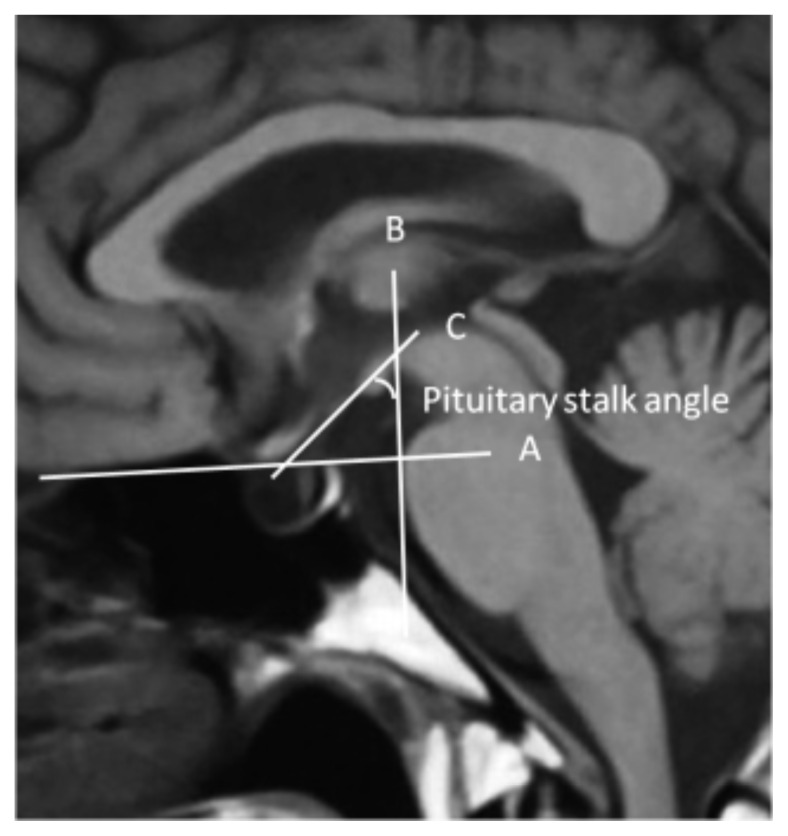
Methods: This prospective, descriptive study was conducted in the Department of Neurosurgery, General Hospital Kuala Lumpur from Jan 1, 2011 to Jan 1, 2013. Forty patients fulfilling the inclusion criteria were enrolled. All patients underwent endoscopic transphenoidal resection of non-functioning pituitary macroadenoma. Pituitary stalk angle, tumour volume and extent of tumour growth were measured from Magnetic Resonance Imaging (MRI) pre- and post-operatively. These variables were compared to serum prolactin levels measured pre and post operatively. SPSS 21 was used to perform statistical analyses.
Results: In 40 patients, the mean tumour volumes were 10.58 cm(3) (SD 7.81) pre-operatively and 3.1 cm(3) (SD 3.45) post-operatively. There was a 70% reduction in tumour volume post-operatively (P < 0.01). The mean serum prolactin was 457 mIU/L (SD 66.93) pre-operatively and 297 mIU/L (SD 6.73) post-operatively. There was a 65% reduction in prolactin serum levels after surgery (P < 0.01). The mean pituitary stalk angles were 93.45 ± 3.89 degrees pre-operatively and 51.45 ± 1.46 degrees post-operatively (P = 0.01). The mean pituitary stalk angle in the control group was 50.4 ± 8.80 degrees. Hence, there was a 98% reduction in pituitary stalk angle after surgery (P < 0.01). This study showed a linear correlation between the pre-operative and post-operative tumour volumes and serum prolactin levels (P = 0.01 pre-and post-operative) and between serum prolactin levels and pituitary stalk angle (P = 0.20 pre-operative; P = 0.01 post-operative).
Conclusion: Tumour volume and pituitary stalk angle displacement have positive predictive values for disconnection hyperprolactinemia in non-functioning pituitary macroadenoma. However, a larger sample size and further objective studies are needed to confirm these findings.
Keywords: disconnection hyperprolactinemia; pituitary macroadenoma; stalk effect.
Figures

References
-
- Arafah BM, Kailani SH, Nekl KE, Gold RS, Selman WR. Immediate recovery of pituitary function following transsphenoidal resection of pituitary macroadenomas. J Clin Endocrinol Metab. 1994;79(2):348–354. doi: http://dx.doi.org/10.1210/jcem.79.2.8045946. - DOI - PubMed
-
- Arafah BM, Nekl KE, Gold RS, Selman WR. Dynamics of prolactin secretion in patients with hypopituitarism and pituitary macroadenomas. J Clin Endocrinol Metab. 1995;80(12):3507–3512. doi: http://dx.doi.org/10.1210/jcem.80.12.8530591. - DOI - PubMed
-
- Albuquerque FC, Hinton DR, Weiss MH. Excessively high prolactin level in a patient with a nonprolactin-secreting adenoma. J Neurosurg. 1998;89(6):1043–1046. - PubMed
-
- Lees PD, Pickard JD. Hyperprolactinemia, intra-sellar pituitary tissue pressure, and the pituitary stalk compression syndrome. J Neurosurg. 1987;67(2):192–196. - PubMed
LinkOut - more resources
Full Text Sources