


Improving Underrepresented Minority Student Persistence in STEM
- PMID: 27543633
- PMCID: PMC5008901
- DOI: 10.1187/cbe.16-01-0038
Improving Underrepresented Minority Student Persistence in STEM
Abstract
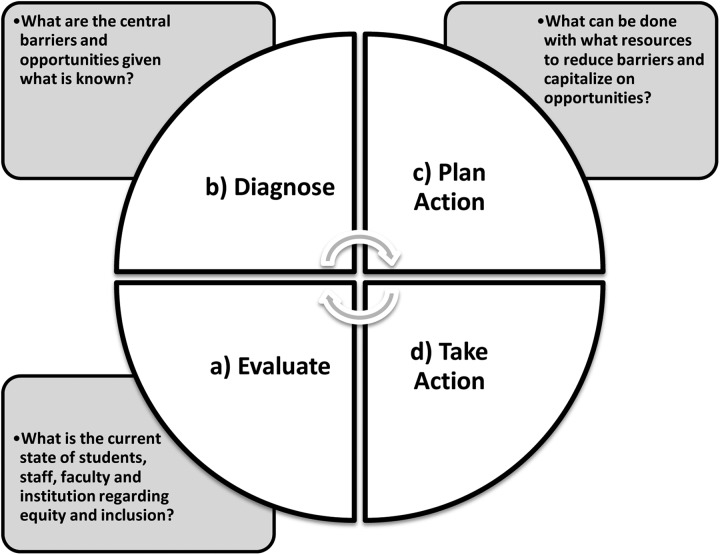
Members of the Joint Working Group on Improving Underrepresented Minorities (URMs) Persistence in Science, Technology, Engineering, and Mathematics (STEM)-convened by the National Institute of General Medical Sciences and the Howard Hughes Medical Institute-review current data and propose deliberation about why the academic "pathways" leak more for URM than white or Asian STEM students. They suggest expanding to include a stronger focus on the institutional barriers that need to be removed and the types of interventions that "lift" students' interests, commitment, and ability to persist in STEM fields. Using Kurt Lewin's planned approach to change, the committee describes five recommendations to increase URM persistence in STEM at the undergraduate level. These recommendations capitalize on known successes, recognize the need for accountability, and are framed to facilitate greater progress in the future. The impact of these recommendations rests upon enacting the first recommendation: to track successes and failures at the institutional level and collect data that help explain the existing trends.
© 2016 M. Estrada et al. CBE—Life Sciences Education © 2016 The American Society for Cell Biology. This article is distributed by The American Society for Cell Biology under license from the author(s). It is available to the public under an Attribution–Noncommercial–Share Alike 3.0 Unported Creative Commons License (http://creativecommons.org/licenses/by-nc-sa/3.0).
Figures
References
-
- Alkaher I, Dolan EL. Integrating research into undergraduate courses: current practices and future directions. In: Sunal D, Sunal C, Zollman D, Mason C, Wright E, editors. Research in Science Education: Research Based Undergraduate Science Teaching. Charlotte, NC: Information Age; 2014.
-
- Anderson WA, Banerjee U, Drennan CL, Elgin SCR, Epstein IR, Handelsman J, Hatfull GF, Losick R, O’Dowd DK, Olivera BM, et al. Changing the culture of science education at research universities. Science. 2011;331:152–153. - PubMed
-
- Austin A. Promoting evidence-based change in undergraduate science education, a paper commissioned by the National Academies National Research Council, Board on Science Education. 2011. www.tidemarkinstitute.org/sites/default/files/documents/Use%20of%20Evide... (accessed 26 July 2016)
Publication types
MeSH terms
Grants and funding
LinkOut - more resources
Full Text Sources
Other Literature Sources
