Community Involvement in Dengue Outbreak Control: An Integrated Rigorous Intervention Strategy
- PMID: 27548481
- PMCID: PMC4993447
- DOI: 10.1371/journal.pntd.0004919
Community Involvement in Dengue Outbreak Control: An Integrated Rigorous Intervention Strategy
Abstract
Background: An explosive outbreak of dengue fever occurred in Guangdong Province, China in 2014. A community-based integrated intervention was applied to control this outbreak in the capital city Guangzhou, where dengue epidemic was mainly caused by imported cases.
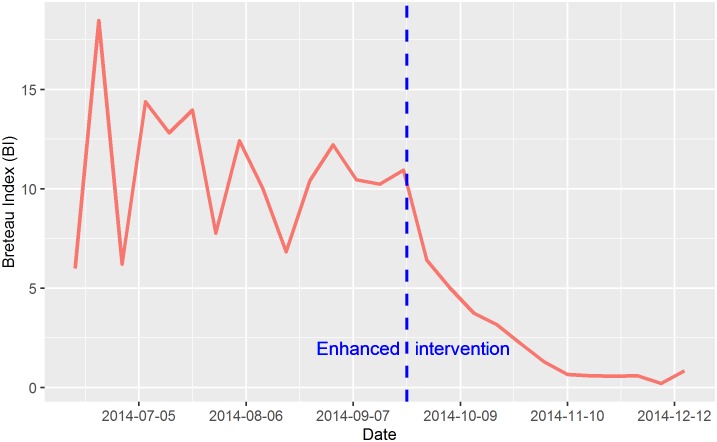
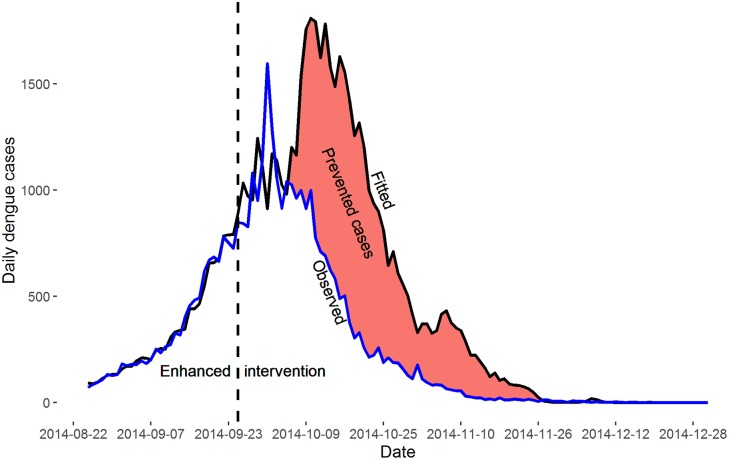
Methodology/principal findings: We used a time series generalized additive model based on meteorological factors to assess the effectiveness of this intervention. The results showed that there was significant reduction in mosquito density following the intervention, and there was a 70.47% (95% confidence interval: 66.07%, 74.88%) reduction in the reported dengue cases compared with the predicted cases after 12 days since the beginning of the intervention, we estimated that a total of 23,302 dengue cases were prevented.
Conclusions: This study suggests that an integrated dengue intervention program has significant effects to control a dengue outbreak in areas where dengue epidemic was mainly caused by imported dengue cases.
Conflict of interest statement
The authors have declared that no competing interests exist.
Figures
References
-
- Finkelman J (2015) Innovative community-based ecosystem management for dengue and Chagas disease prevention in low and middle income countries in Latin America and the Caribbean. Transactions of the Royal Society of Tropical Medicine and Hygiene 109: 89–90. 10.1093/trstmh/tru201 - DOI - PMC - PubMed
-
- Gubler DJ (2002) Epidemic dengue/dengue hemorrhagic fever as a public health, social and economic problem in the 21st century. Trends in microbiology 10: 100–103. - PubMed
Publication types
MeSH terms
LinkOut - more resources
Full Text Sources
Other Literature Sources
Medical