


Anal Human Papillomavirus Infection among HIV-Infected Men in Korea
- PMID: 27548632
- PMCID: PMC4993367
- DOI: 10.1371/journal.pone.0161460
Anal Human Papillomavirus Infection among HIV-Infected Men in Korea
Abstract
Background: Little is known about the epidemiology on human papillomavirus (HPV) infection among HIV-infected men in Korea. The objective of this study was to determine the prevalence, genotype distribution and risk factors associated with anal HPV infection among HIV-infected men in Korea.
Methods: A single-center cross-sectional study was conducted with HIV-infected men in Korea. Participants completed a detailed sexual behavior risk factor questionnaire. Anal samples were collected for cytology and HPV genotyping. Factors associated with anal HPV infection were assessed using multivariable logistic regression, stratifying by sexual behaviour.
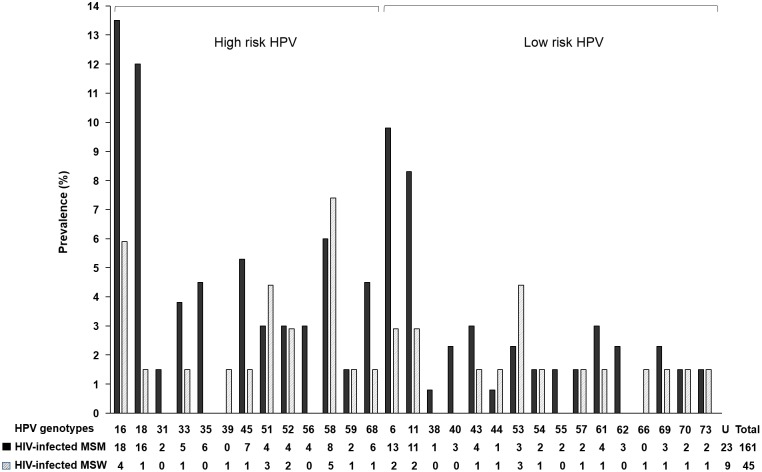
Results: A total of 201 HIV-infected men were included in the study: 133 were from men who have sex with men (MSM) and 68 from men who have sex with women (MSW). Any anal HPV infection was detected in 82.7% of HIV-infected MSM and in 51.5% of HIV- infected MSW (P < 0.001). High-risk HPV (HR-HPV) prevalence was higher among MSM (47.4%) than MSW (25.0%; P = 0.002). The HR-HPV types identified most frequently were HPV 16 (11%), HPV 18 (9.9%), and HPV 58 (5%) in MSM, and HPV 58(11%) and HPV 16 (8.9%) in MSW. Prevalence of any HPV types in 9-valent vaccine types was higher among MSM than MSW (47.4% vs 22.1%. P = 0.001). Abnormal anal cytology was more commonly detected in MSM than MSW (42.9% vs.19.1%, P < 0.001). In HIV-infected MSM, higher number of lifetime male sex partners was significantly associated with any anal HPV infection, but age was a significant risk factor associated with anal HR-HPV infection.
Conclusion: Anal HPV infection was highly prevalent in HIV-infected MSM in Korea, and also commonly found in HIV-infected MSW. In HIV-infected MSM, the significant risk factor for being infected with any HPV infection was lifetime number of male sexual partners, and with anal oncogenic HPV infection was age.
Conflict of interest statement
The authors have declared that no competing interests exist.
Figures
References
-
- Piketty C, Selinger-Leneman H, Grabar S, Duvivier C, Bonmarchand M, Abramowitz L, et al. Marked increase in the incidence of invasive anal cancer among HIV-infected patients despite treatment with combination antiretroviral therapy. AIDS (London, England). 2008;22(10):1203–11. Epub 2008/06/06. 10.1097/QAD.0b013e3283023f78 . - DOI - PubMed
-
- Piketty C, Selinger-Leneman H, Bouvier AM, Belot A, Mary-Krause M, Duvivier C, et al. Incidence of HIV-related anal cancer remains increased despite long-term combined antiretroviral treatment: results from the french hospital database on HIV. Journal of clinical oncology: official journal of the American Society of Clinical Oncology. 2012;30(35):4360–6. Epub 2012/10/24. 10.1200/jco.2012.44.5486 . - DOI - PubMed
-
- Crum-Cianflone NF, Hullsiek KH, Marconi VC, Ganesan A, Weintrob A, Barthel RV, et al. Anal cancers among HIV-infected persons: HAART is not slowing rising incidence. AIDS (London, England). 2010;24(4):535–43. Epub 2009/11/21. 10.1097/QAD.0b013e328331f6e2 ; PubMed Central PMCID: PMCPmc3132114. - DOI - PMC - PubMed
-
- Diamond C, Taylor TH, Aboumrad T, Bringman D, Anton-Culver H. Increased incidence of squamous cell anal cancer among men with AIDS in the era of highly active antiretroviral therapy. Sexually transmitted diseases. 2005;32(5):314–20. Epub 2005/04/26. . - PubMed
MeSH terms
Substances
LinkOut - more resources
Full Text Sources
Other Literature Sources
Medical
