


Use of Wireless Capsule Endoscopy for the Diagnosis and Grading of Esophageal Varices in Patients With Portal Hypertension: A Systematic Review and Meta-Analysis
- PMID: 27548729
- PMCID: PMC5218864
- DOI: 10.1097/MCG.0000000000000589
Use of Wireless Capsule Endoscopy for the Diagnosis and Grading of Esophageal Varices in Patients With Portal Hypertension: A Systematic Review and Meta-Analysis
Abstract
Introduction: Esophageal variceal bleeding is a severe complication of portal hypertension with significant morbidity and mortality. Although traditional screening and grading of esophageal varices has been performed by endogastroduodenoscopy (EGD), wireless video capsule endoscopy provides a minimally invasive alternative that may improve screening and surveillance compliance.
Aim of the study: The aim of the study was to perform a systematic review and structured meta-analysis of all eligible studies to evaluate the efficacy of wireless capsule endoscopy for screening and diagnosis of esophageal varices among patients with portal hypertension.
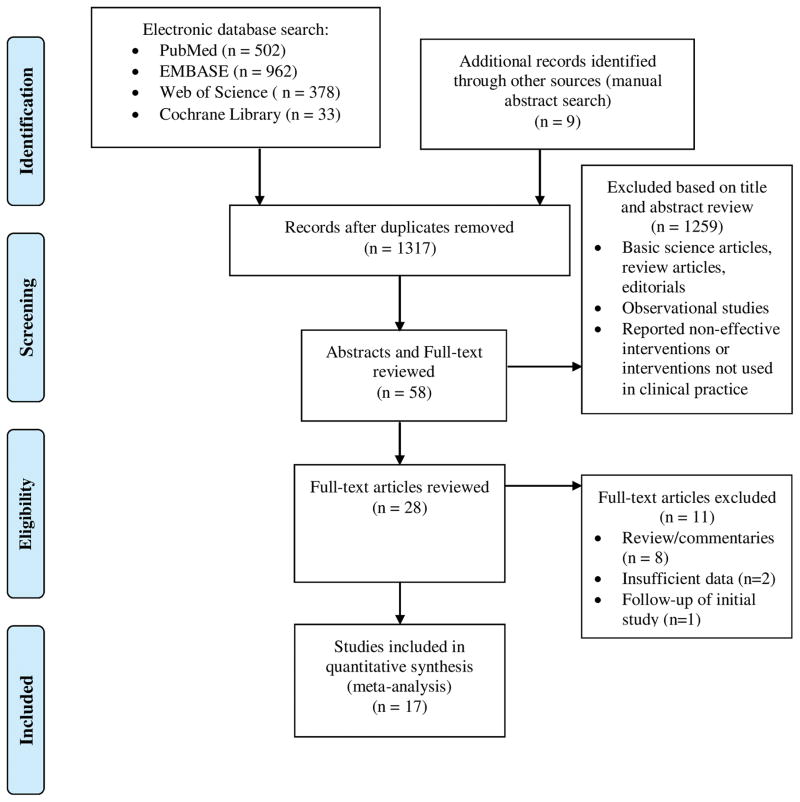
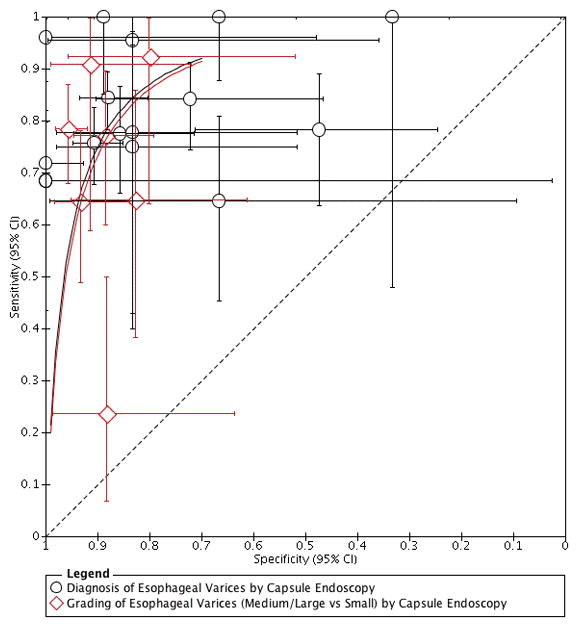
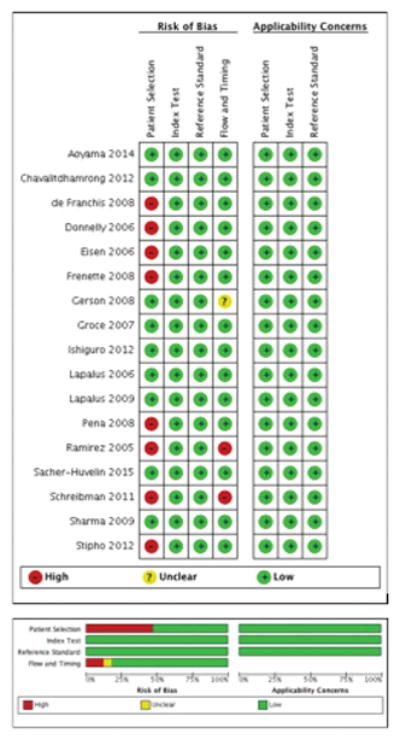
Methods: Searches of PubMed, EMBASE, Web of Science, and the Cochrane Library databases were performed through December 2015. Bivariate and hierarchical models were used to compute the pooled sensitivity and specificity, and to plot the summary receiver operating characteristics curve with summary point and corresponding 95% confidence region. Bias of included studies was assessed using the quality assessment of diagnostic accuracy studies-2.
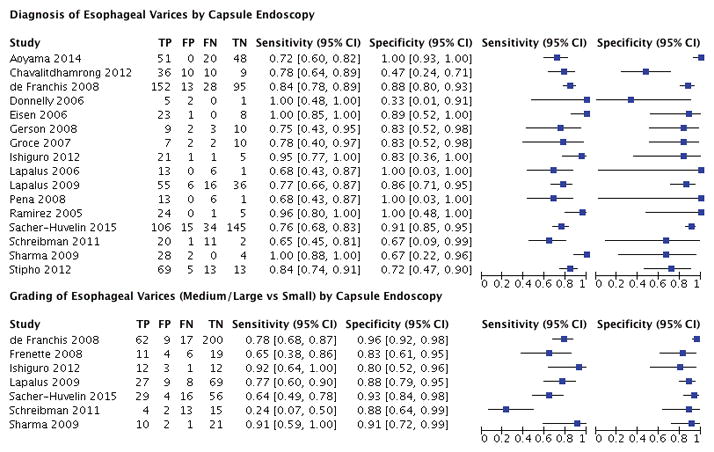
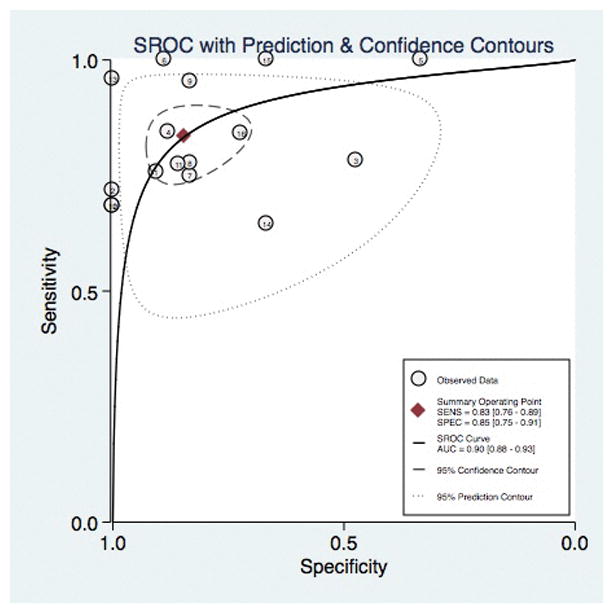
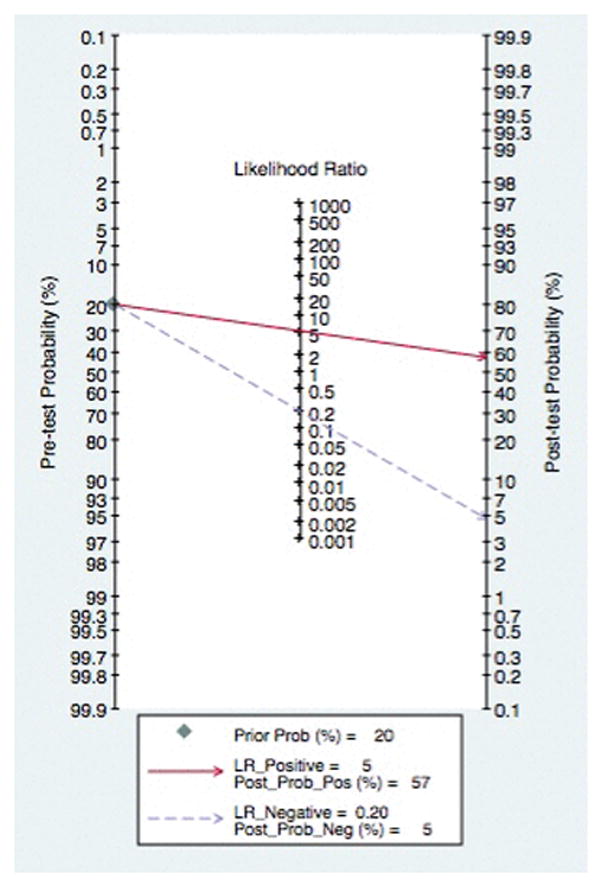
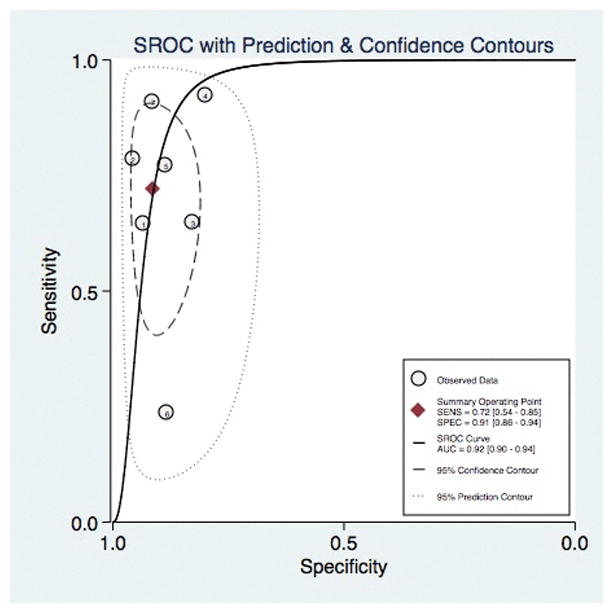
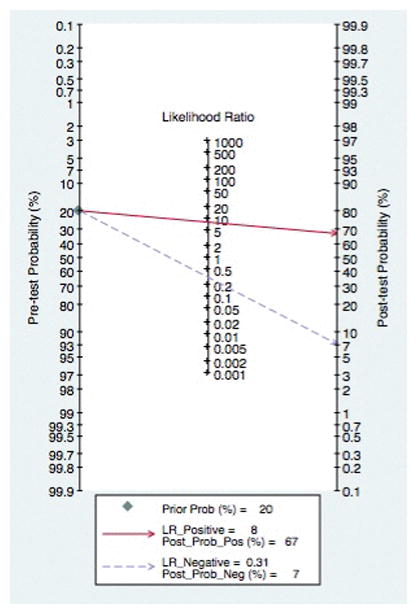
Results: Seventeen studies from 2005 to 2015 were included in this meta-analysis (n=1328). The diagnostic accuracy of wireless capsule endoscopy in the diagnosis of esophageal varices was 90% [95% confidence interval (CI), 0.88-0.93]. The diagnostic pooled sensitivity and specificity were 83% (95% CI, 0.76-0.89) and 85% (95% CI, 0.75-0.91), respectively. The diagnostic accuracy of wireless capsule endoscopy for the grading of medium to large varices was 92% (95% CI, 0.90-0.94). The pooled sensitivity and specificity were 72% (95% CI, 0.54-0.85) and 91% (95% CI, 0.86-0.94), respectively, for the grading of medium to large varices. The use of capsule demonstrated only mild adverse events. A sensitivity analysis limited to only high quality studies revealed similar results.
Discussion: Wireless esophageal capsule endoscopy is well tolerated and safe in patients with liver cirrhosis and suspicion of portal hypertension. The sensitivity of capsule endoscopy is not currently sufficient to replace EGD as a first exploration in these patients, but given its high accuracy, it may have a role in cases of refusal or contraindication to EGD.
Conflict of interest statement
Potential Conflicts of Interest: The authors have no potential conflicts of interest to report.
Figures
References
-
- Fausa O, Schrumpf E, Elgjo K. Relationship of inflammatory bowel disease and primary sclerosing cholangitis. Seminars in liver disease. 1991;11:31–9. - PubMed
-
- Garcia-Tsao G, Sanyal AJ, Grace ND, Carey WD Practice Guidelines Committee of American Association for Study of Liver D, Practice Parameters Committee of American College of G. Prevention and management of gastroesophageal varices and variceal hemorrhage in cirrhosis. The American journal of gastroenterology. 2007;102:2086–102. - PubMed
-
- North Italian Endoscopic Club for the S, Treatment of Esophageal V. Prediction of the first variceal hemorrhage in patients with cirrhosis of the liver and esophageal varices. A prospective multicenter study. The New England journal of medicine. 1988;319:983–9. - PubMed
-
- Christensen E, Fauerholdt L, Schlichting P, Juhl E, Poulsen H, Tygstrup N. Aspects of the natural history of gastrointestinal bleeding in cirrhosis and the effect of prednisone. Gastroenterology. 1981;81:944–52. - PubMed
-
- de Franchis R, Primignani M. Natural history of portal hypertension in patients with cirrhosis. Clinics in liver disease. 2001;5:645–63. - PubMed
Publication types
MeSH terms
Grants and funding
LinkOut - more resources
Full Text Sources
Other Literature Sources
Medical
