


Population cardiovascular health and urban environments: the Heart Healthy Hoods exploratory study in Madrid, Spain
- PMID: 27549991
- PMCID: PMC4994419
- DOI: 10.1186/s12874-016-0213-4
Population cardiovascular health and urban environments: the Heart Healthy Hoods exploratory study in Madrid, Spain
Abstract
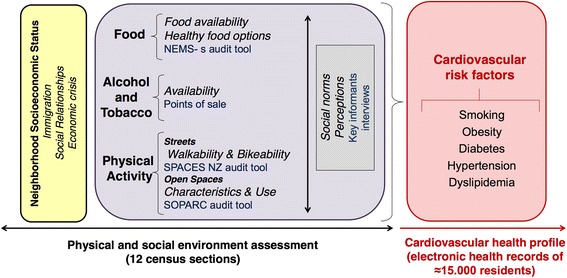
Background: Our aim is to conduct an exploratory study to provide an in-depth characterization of a neighborhood's social and physical environment in relation to cardiovascular health. A mixed-methods approach was used to better understand the food, alcohol, tobacco and physical activity domains of the urban environment.
Methods: We conducted this study in an area of 16,000 residents in Madrid (Spain). We obtained cardiovascular health and risk factors data from all residents aged 45 and above using Electronic Health Records from the Madrid Primary Health Care System. We used several quantitative audit tools to assess: the type and location of food outlets and healthy food availability; tobacco and alcohol points of sale; walkability of all streets and use of parks and public spaces. We also conducted 11 qualitative interviews with key informants to help understanding the relationships between urban environment and cardiovascular behaviors. We integrated quantitative and qualitative data following a mixed-methods merging approach.
Results: Electronic Health Records of the entire population of the area showed similar prevalence of risk factors compared to the rest of Madrid/Spain (prevalence of diabetes: 12 %, hypertension: 34 %, dyslipidemia: 32 %, smoking: 10 %, obesity: 20 %). The food environment was very dense, with many small stores (n = 44) and a large food market with 112 stalls. Residents highlighted the importance of these small stores for buying healthy foods. Alcohol and tobacco environments were also very dense (n = 91 and 64, respectively), dominated by bars and restaurants (n = 53) that also acted as food services. Neighbors emphasized the importance of drinking as a socialization mechanism. Public open spaces were mostly used by seniors that remarked the importance of accessibility to these spaces and the availability of destinations to walk to.
Conclusion: This experience allowed testing and refining measurement tools, drawn from epidemiology, geography, sociology and anthropology, to better understand the urban environment in relation to cardiovascular health.
Keywords: Cardiovascular disease; Mixed methods; Neighborhoods; Residential environment; Spain.
Figures


References
-
- Mozaffarian D, Benjamin EJ, Go AS, Arnett DK, Blaha MJ, Cushman M, Das SR, de Ferranti S, Despres JP, Fullerton HJ, et al. Executive Summary: Heart Disease and Stroke Statistics-2016 Update: A Report From the American Heart Association. Circulation. 2016;133(4):447–454. doi: 10.1161/CIR.0000000000000366. - DOI - PubMed
-
- Eckel RH, Jakicic JM, Ard JD, de Jesus JM, Houston Miller N, Hubbard VS, Lee I-M, Lichtenstein AH, Loria CM, Millen BE, et al. 2013 AHA/ACC Guideline on Lifestyle Management to Reduce Cardiovascular Risk: A Report of the American College of Cardiology/American Heart Association Task Force on Practice Guidelines. Circulation. 2014;129(25 suppl 2):S76–S99. doi: 10.1161/01.cir.0000437740.48606.d1. - DOI - PubMed
MeSH terms
LinkOut - more resources
Full Text Sources
Other Literature Sources
