


Researching Complex and Multi-Level Workplace Factors Affecting Disability and Prolonged Sickness Absence
- PMID: 27550629
- PMCID: PMC5104770
- DOI: 10.1007/s10926-016-9660-3
Researching Complex and Multi-Level Workplace Factors Affecting Disability and Prolonged Sickness Absence
Abstract
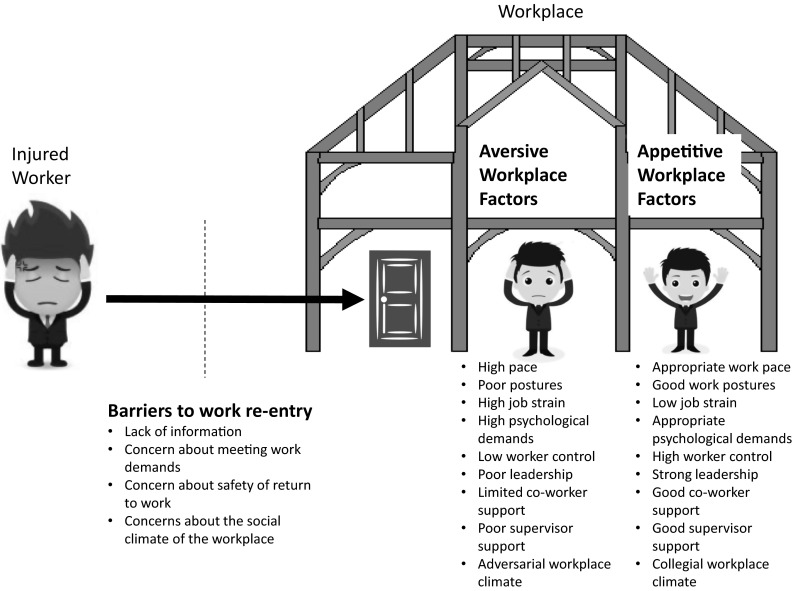
Purpose There is growing research evidence that workplace factors influence disability outcomes, but these variables reflect a variety of stakeholder perspectives, measurement tools, and methodologies. The goal of this article is to summarize existing research of workplace factors in relation to disability, compare this with employer discourse in the grey literature, and recommend future research priorities. Methods The authors participated in a year-long collaboration that ultimately led to an invited 3-day conference, "Improving Research of Employer Practices to Prevent Disability, held October 14-16, 2015, in Hopkinton, Massachusetts, USA. The collaboration included a topical review of the literature, group conference calls to identify key areas and challenges, drafting of initial documents, review of industry publications, and a conference presentation that included feedback from peer researchers and a question/answer session with a special panel of knowledge experts with direct employer experience. Results Predominant factors in the scientific literature were categorized as physical or psychosocial job demands, work organization and support, and workplace beliefs and attitudes. Employees experiencing musculoskeletal disorders in large organizations were the most frequently studied population. Research varied with respect to the basic unit of assessment (e.g., worker, supervisor, policy level) and whether assessments should be based on worker perceptions, written policies, or observable practices. The grey literature suggested that employers focus primarily on defining roles and responsibilities, standardizing management tools and procedures, being prompt and proactive, and attending to the individualized needs of workers. Industry publications reflected a high reliance of employers on a strict biomedical model in contrast to the more psychosocial framework that appears to guide research designs. Conclusion Assessing workplace factors at multiple levels, within small and medium-sized organizations, and at a more granular level may help to clarify generalizable concepts of organizational support that can be translated to specific employer strategies involving personnel, tools, and practices.
Keywords: Disability management; Employer practices; Research priorities; Workplace factors.
Conflict of interest statement
All authors (Kristman, Shaw, Boot, Delclos, Sullivan, and Ehrhart) declare that they have no conflict of interest. Ethical approval This article does not contain any studies with human participants or animals performed by any of the authors.
Figures
References
-
- Meredith WR. Final report on laws relating to the liability of employers. London: Forgotten Books; 1913.
-
- Eckelberry NE. The injured workman: methods of handling to get him back on the job. Ind. Med. 1936;5:557–560.
-
- Shaw W, Kristman VL, Vezina N. Workplace issues. In: Loisel P, Anema JR, editors. Handbook of work disability. New York: Springer; 2013. pp. 163–182.
-
- Waddell GAM. Models of sickness and disability applied to common health problems. London: Royal Society of Medicine Press Ltd; 2010.
Publication types
MeSH terms
Grants and funding
LinkOut - more resources
Full Text Sources
Other Literature Sources
Medical
