Association between resting heart rate and coronary artery disease, stroke, sudden death and noncardiovascular diseases: a meta-analysis
- PMID: 27551034
- PMCID: PMC5056889
- DOI: 10.1503/cmaj.160050
Association between resting heart rate and coronary artery disease, stroke, sudden death and noncardiovascular diseases: a meta-analysis
Abstract
Background: Resting heart rate is linked to risk of coronary artery disease, stroke, sudden death and noncardiovascular diseases. We conducted a meta-analysis to assess these associations in general populations and in populations of patients with hypertension or diabetes mellitus.
Methods: We searched PubMed, Embase and MEDLINE from inception to Mar. 5, 2016. We used a random-effects model to combine study-specific relative risks (RRs). We used restricted cubic splines to assess the dose-response relation.
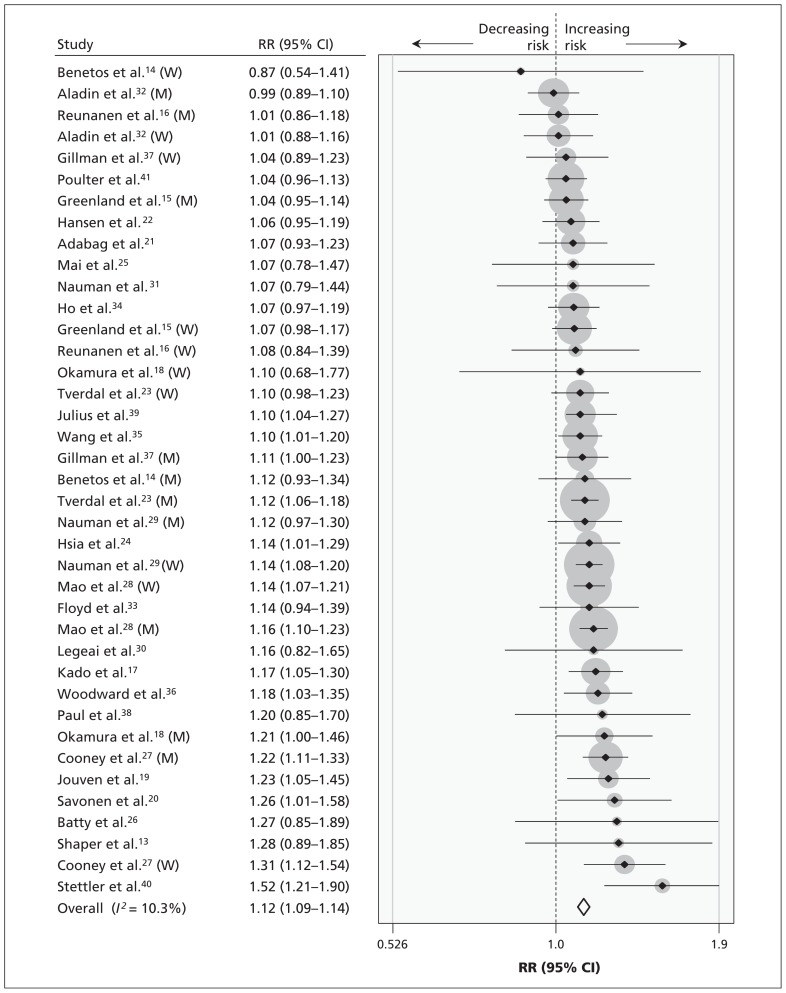
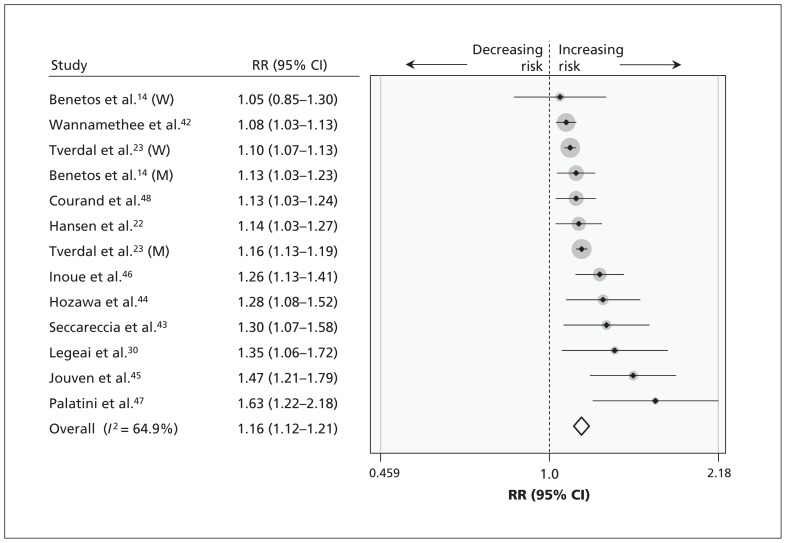
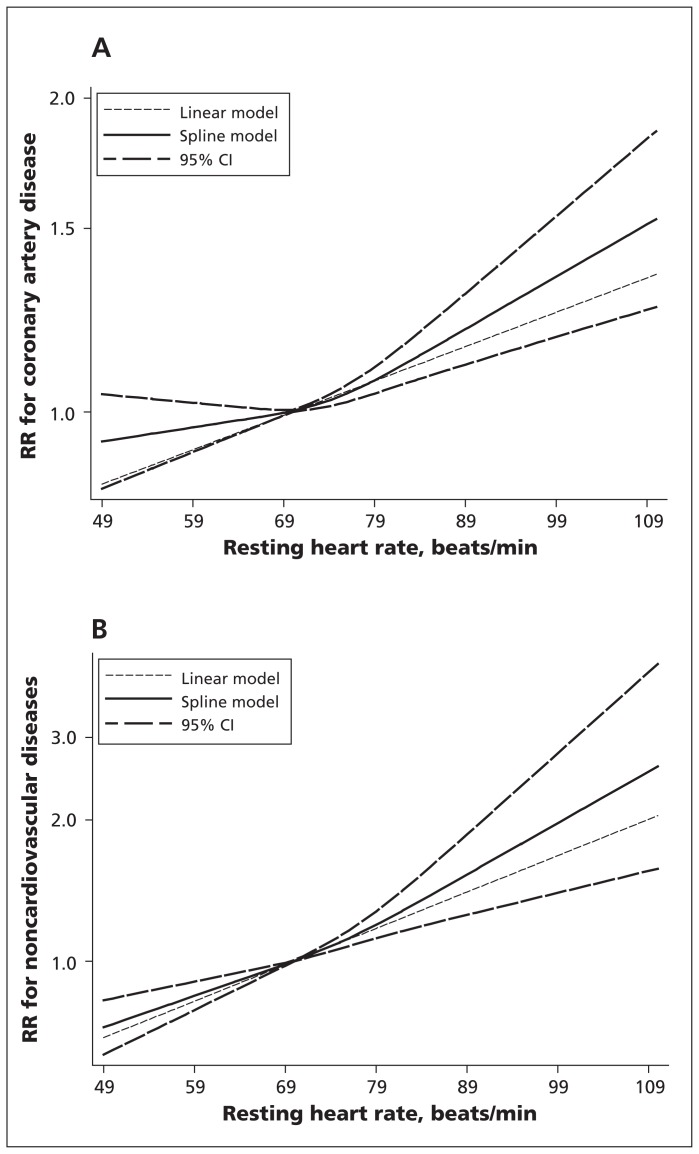
Results: We included 45 nonrandomized prospective cohort studies in the meta-analysis. The multivariable adjusted RR with an increment of 10 beats/min in resting heart rate was 1.12 (95% confidence interval [CI] 1.09-1.14) for coronary artery disease, 1.05 (95% CI 1.01-1.08) for stroke, 1.12 (95% CI 1.02-1.24) for sudden death, 1.16 (95% CI 1.12-1.21) for noncardiovascular diseases, 1.09 (95% CI 1.06-1.12) for all types of cancer and 1.25 (95% CI 1.17-1.34) for noncardiovascular diseases excluding cancer. All of these relations were linear. In an analysis by category of resting heart rate (< 60 [reference], 60-70, 70-80 and > 80 beats/min), the RRs were 0.99 (95% CI 0.93-1.04), 1.08 (95% CI 1.01-1.16) and 1.30 (95% CI 1.19-1.43), respectively, for coronary artery disease; 1.08 (95% CI 0.98-1.19), 1.11 (95% CI 0.98-1.25) and 1.08 (95% CI 0.93-1.25), respectively, for stroke; and 1.17 (95% CI 0.94-1.46), 1.31 (95% CI 1.12-1.54) and 1.57 (95% CI 1.39-1.77), respectively, for noncardiovascular diseases. After excluding studies involving patients with hypertension or diabetes, we obtained similar results for coronary artery disease, stroke and noncardiovascular diseases, but found no association with sudden death.
Interpretation: Resting heart rate was an independent predictor of coronary artery disease, stroke, sudden death and noncardiovascular diseases over all of the studies combined. When the analysis included only studies concerning general populations, resting heart rate was not associated with sudden death.
© 2016 Canadian Medical Association or its licensors.
Figures
References
-
- Valentini M, Parati G. Variables influencing heart rate. Prog Cardiovasc Dis 2009;52:11–9. - PubMed
-
- Palatini P. Heart rate and the cardiometabolic risk. Curr Hypertens Rep 2013;15:253–9. - PubMed
-
- Johansen CD, Olsen RH, Pedersen LR, et al. Resting, night-time, and 24 h heart rate as markers of cardiovascular risk in middle-aged and elderly men and women with no apparent heart disease. Eur Heart J 2013;34:1732–9. - PubMed
-
- Jensen MT, Marott JL, Allin KH, et al. Resting heart rate is associated with cardiovascular and all-cause mortality after adjusting for inflammatory markers: the Copenhagen City Heart Study. Eur J Prev Cardiol 2012;19:102–8. - PubMed
Publication types
MeSH terms
LinkOut - more resources
Full Text Sources
Other Literature Sources
Medical