. 2016 Oct 14;291(42):22327-22337.
doi: 10.1074/jbc.M116.747865. Epub 2016 Aug 22.

Pseudouridine in the Anticodon of Escherichia coli tRNATyr(QΨA) Is Catalyzed by the Dual Specificity Enzyme RluF

Affiliations

Pseudouridine in the Anticodon of Escherichia coli tRNATyr(QΨA) Is Catalyzed by the Dual Specificity Enzyme RluF

Balasubrahmanyam Addepalli et al. J Biol Chem. .

Abstract

Pseudouridine is found in almost all cellular ribonucleic acids (RNAs). Of the multiple characteristics attributed to pseudouridine, making messenger RNAs (mRNAs) highly translatable and non-immunogenic is one such feature that directly implicates this modification in protein synthesis. We report the existence of pseudouridine in the anticodon of Escherichia coli tyrosine transfer RNAs (tRNAs) at position 35. Pseudouridine was verified by multiple detection methods, which include pseudouridine-specific chemical derivatization and gas phase dissociation of RNA during liquid chromatography tandem mass spectrometry (LC-MS/MS). Analysis of total tRNA isolated from E. coli pseudouridine synthase knock-out mutants identified RluF as the enzyme responsible for this modification. Furthermore, the absence of this modification compromises the translational ability of a luciferase reporter gene coding sequence when it is preceded by multiple tyrosine codons. This effect has implications for the translation of mRNAs that are rich in tyrosine codons in bacterial expression systems.

Keywords: CMCT; RNA modification; RluF; acrylonitrile; chemical modification; derivatization; mass spectrometry (MS); pseudouridine; transfer RNA (tRNA); translation.


Figures

FIGURE 1.
FIGURE 1.
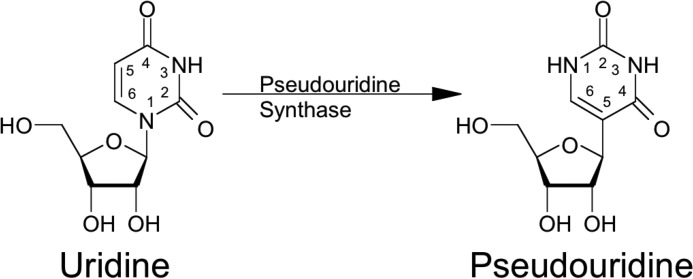
Pseudouridine in RNA. Uridine is isomerized into pseudouridine by pseudouridine synthases through base cleavage from ribose sugar and reattachment to generate C–C glycosidic bond.
FIGURE 2.
FIGURE 2.
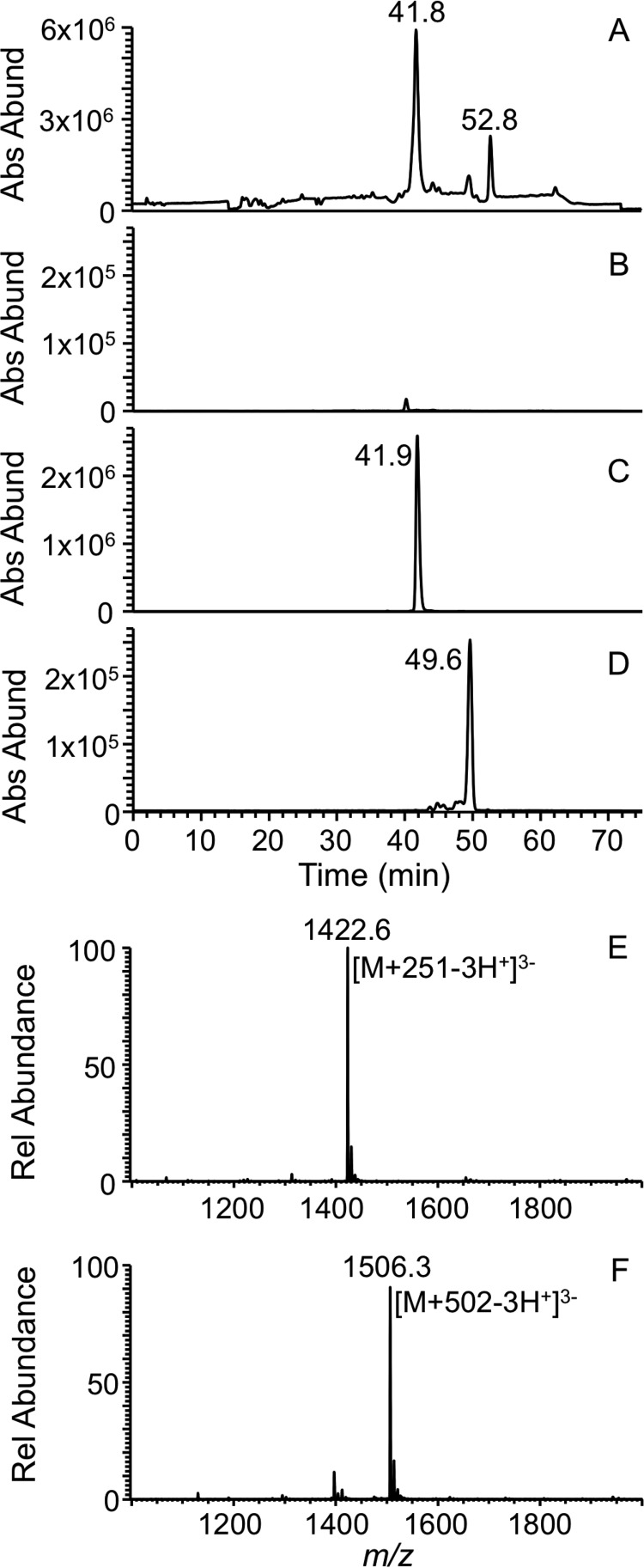
LC-MS analysis of the carbodiimide-tagged RNase T1 digestion product the from anticodon of E. coli tRNATyr(QUA). A, total ion chromatogram representing the elution pattern of all the oligonucleotide digestion products detected as anions. B, XIC for m/z 1338.9 corresponding to the underivatized triply charged oligonucleotide anion (ACU[Q]UA[ms2i6A]A[Ψ]CUG). Note the lower signal intensity for the unreactive product. C, XIC for m/z 1422.7 that corresponds to the digestion product with one carbodiimide unit. D, XIC for m/z 1506.3 that corresponds to the digestion product with two carbodiimide units. E, mass spectrum of the XIC peak (41.2–43.6 min) observed in B where the triply charged oligonucleotide anion with carbodiimide unit is predominantly present. F, mass spectrum of the XIC peak (49–50.3 min) observed in C where the triply charged oligonucleotide anion with two carbodiimide units is predominantly present. Rel, relative; Abs Abund, absolute abundance.
FIGURE 3.
FIGURE 3.
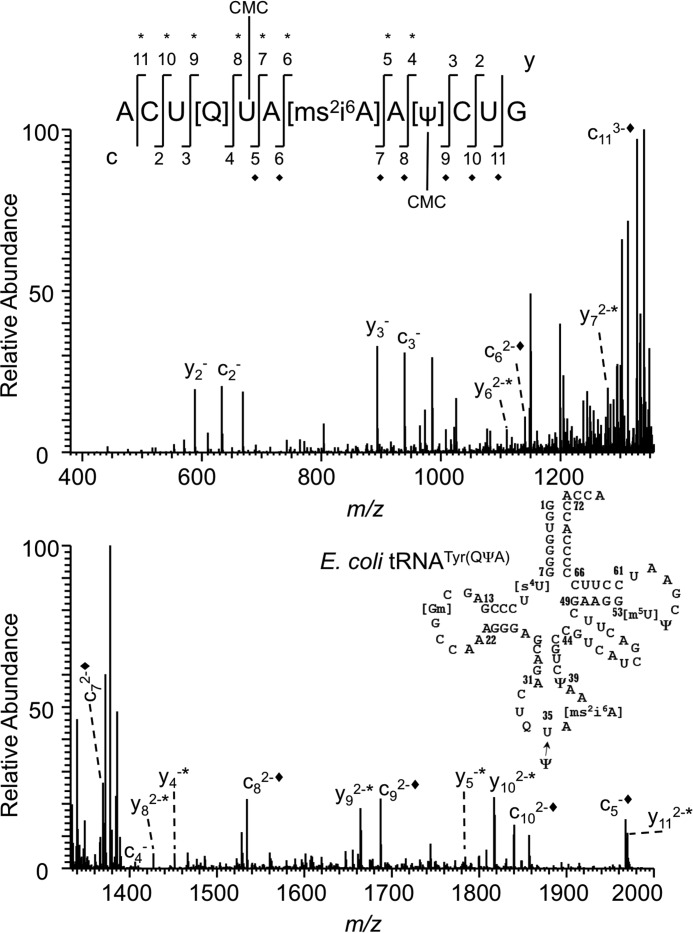
CID-based sequencing of the single carbodiimide-tagged RNase T1 digestion product the from anticodon of E. coli tRNATyr(QUA). Shown is the CID MS/MS spectrum of ACU[Q]UA[ms2i6A]AΨCUG with one carbodiimide (m/z 1422.8) tagged at either one of two different locations. The appearance of unique product ions with the additional carbodiimide mass from c5 (m/z 1967.5) and y4 (m/z 1451.4) defines the region for pseudouridines in the oligonucleotide. Each addition of carbodiimide (+251) is denoted with * for the y product ion series and ♦ for the c product ion series. The secondary structure of E. coli tRNATyr along with the observed pseudouridine modification at position 35 and other previously reported modifications is illustrated.
FIGURE 4.
FIGURE 4.
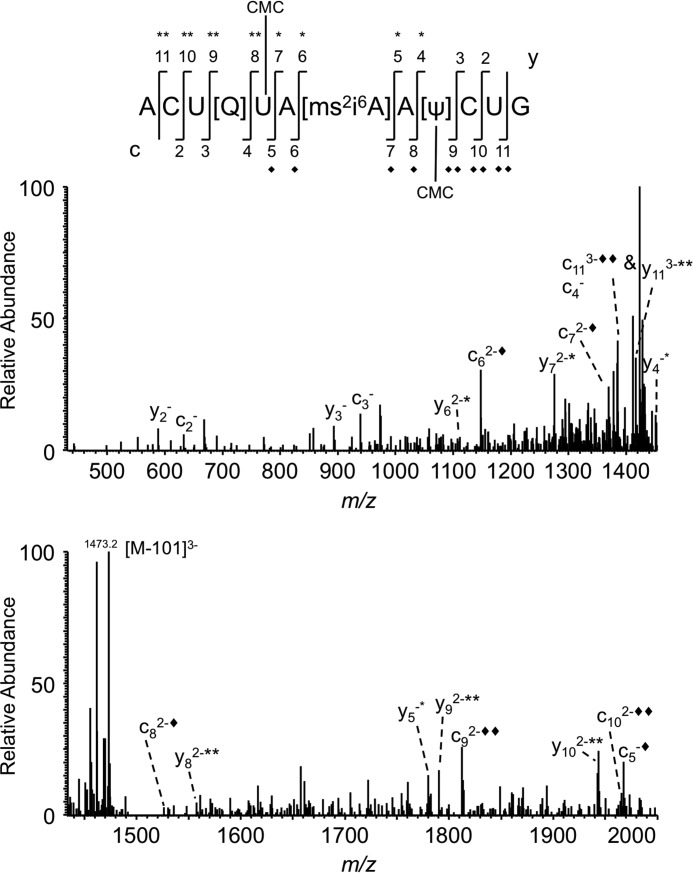
CID-based sequencing of the double carbodiimide-tagged RNase T1 digestion product from the anticodon of E. coli tRNATyr(QUA). Shown is the CID MS/MS spectrum of ACU[Q]UA[ms2i6A]AΨCUG with two carbodiimide units (+502 Da, m/z 1506.6). The appearance of unique product ions with two carbodiimide adducts, c9 and y8, defines the location of two pseudouridines in the oligonucleotide. Each addition of carbodiimide (+251) is denoted with * for the y product ion series and ♦ for the c product ion series.
FIGURE 5.
FIGURE 5.
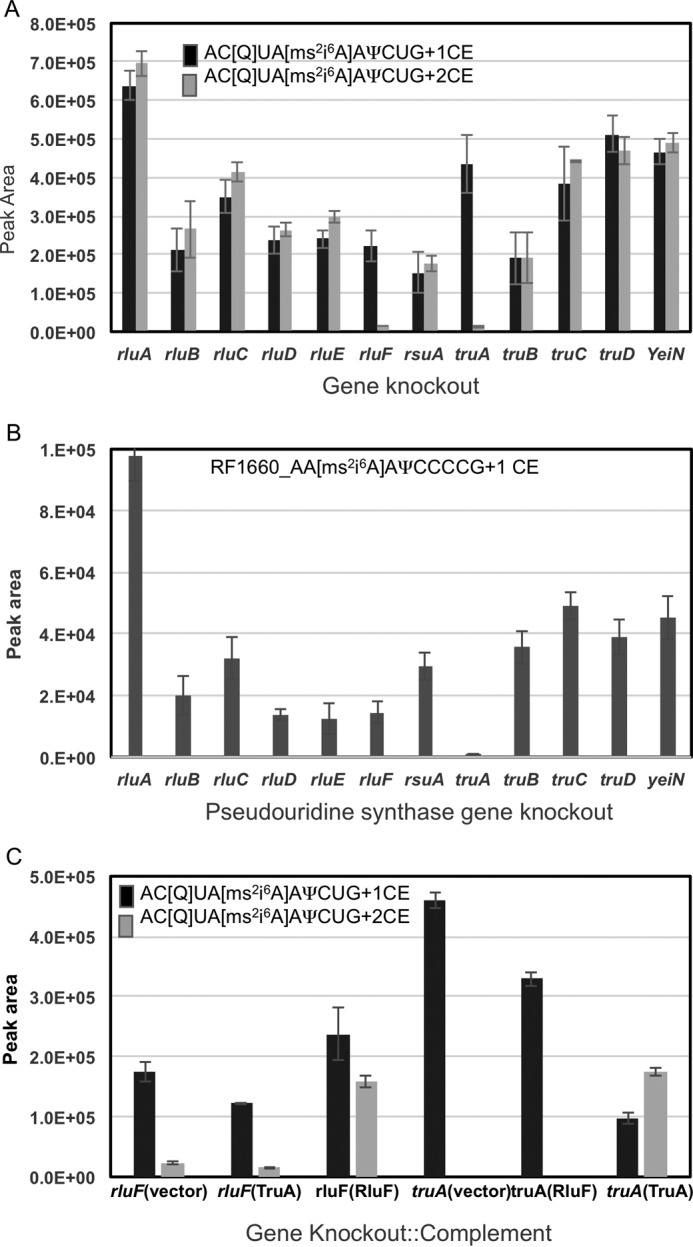
Identification of synthase gene responsible for pseudouridine modification at position 35 of E. coli tRNATyr(QUA). Four micrograms of tRNA isolated from each of the pseudouridine synthase knock-out mutant cell lines (three to five biological replicates) were digested with RNase T1 and BAP before treating with acrylonitrile. The derivatized RNA was subjected to LC-MS. A, peak areas corresponding to one and two cyanoethylation groups on AC[Q]UA[ms2i6A]A[Ψ]CUG of tRNATyr were plotted against each synthase gene. The truA and rluF gene knock-out tRNA samples reveal a significant decrease in cyanoethylation. B, peak areas corresponding to one cyanoethylation group for AA[ms2i6A]A[Ψ]CCCCG from tRNAPhe were plotted against each synthase gene. Only truA exhibited a dramatic decrease in peak area, whereas the mutation in the other genes including rluF strain had no adverse impact on the peak area. C, complementation effects of TruA or RluF gene under truA or rluF genetic background on pseudouridine modification at position 35 of tRNATyr. Note that the complementation ability of the wild type genes is possible only under the respective knock-out mutation background, i.e. rluF::RluF and truA::TruA, but not in the cases of rluF::TruA and truA::RluF. Error bars represent S.D. of replicate measurements.
FIGURE 6.
FIGURE 6.
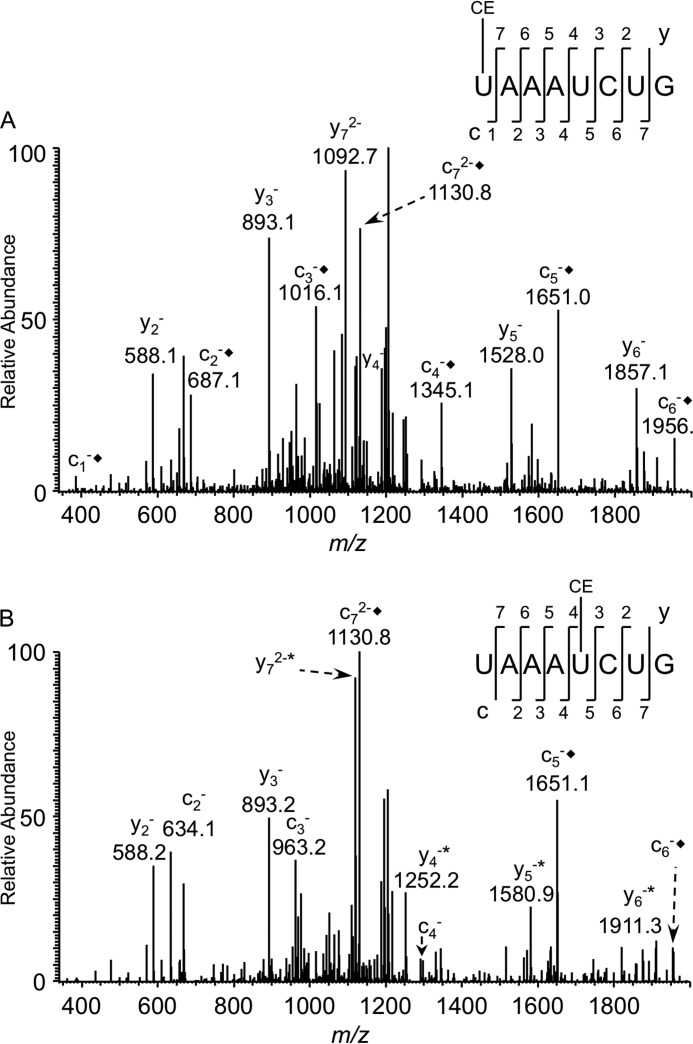
CID-based sequencing of the acrylonitrile-tagged RNase T1 digestion product the from anticodon of E. coli tDNATyr transcript. A, MS/MS spectrum of the doubly charged oligonucleotide ion originating from tDNATyr transcript treated with recombinant RluF and acrylonitrile (m/z 1272.4). The cn product ion series is consistent with cyanoethylation (CE), whereas no such addition was significantly observed for the yn product ion series. B, MS/MS spectrum of the doubly charged oligonucleotide ion originating from tDNATyr transcript treated with recombinant TruA and acrylonitrile (m/z 1272.4). Cyanoethylation was observed at y4 and c5 through y7 and c7. Each addition of cyanoethylation (+53) is denoted with * for the y product ion series and ♦ for the c product ion series.
FIGURE 7.
FIGURE 7.
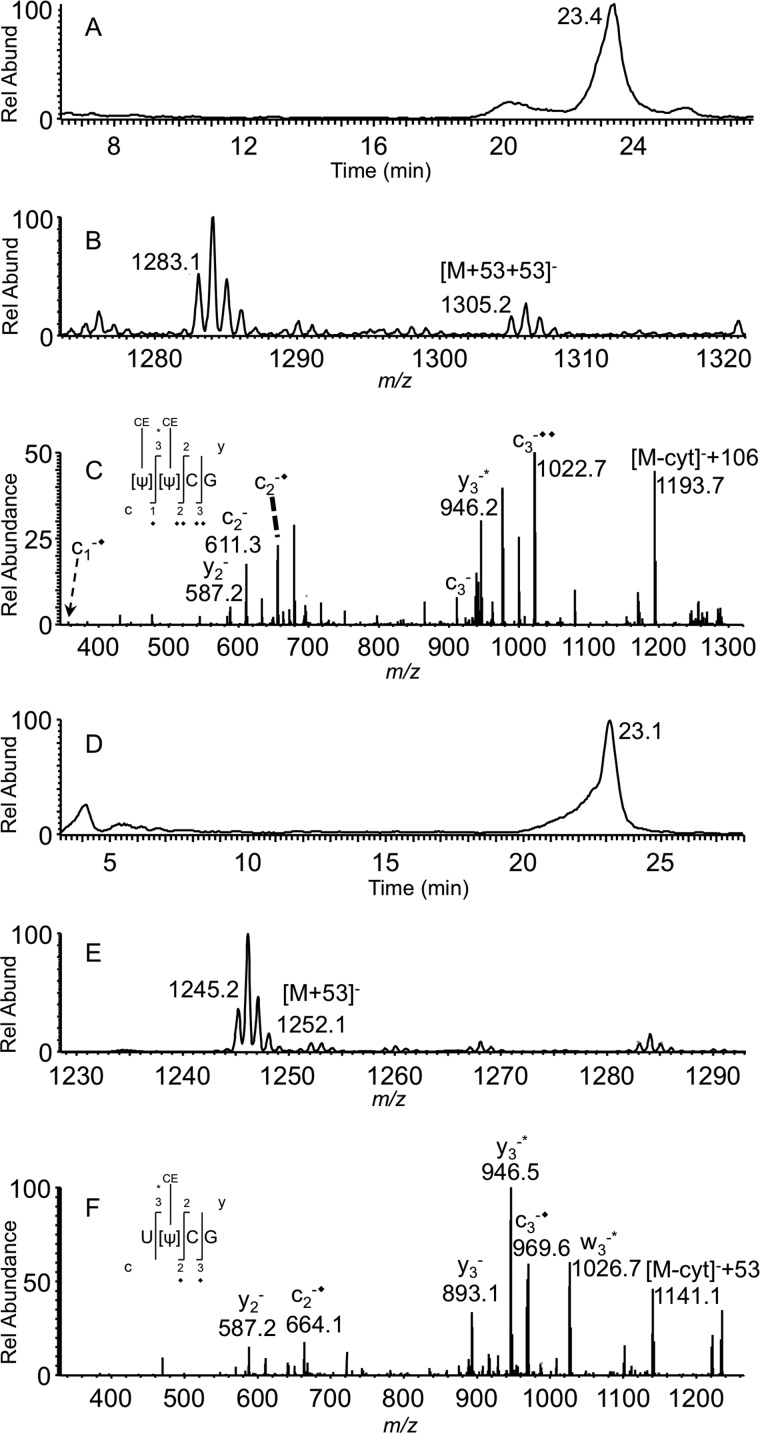
LC-MS analysis of acrylonitrile-derivatized RNase T1/BAP digests of E. coli 23S rRNA. A, XIC for m/z 1305.2 corresponding to [Ψ][Ψ]CG with two cyanoethylations. B, mass spectrum corresponding to XIC peak at 23.4 min showing the presence of singly charged oligonucleotide [Ψ][Ψ]CG anion with two cyanoethylations. C, MS/MS spectrum of m/z 1305.2. D, XIC for m/z 1252.6 corresponding to [U][Ψ]CG with one cyanoethylation. E, mass spectrum corresponding to XIC peak at 23.1 min showing the presence of singly charged oligonucleotide [U][Ψ]CG anion with one cyanoethylation. F, MS/MS spectrum of m/z 1252.6. Each addition of cyanoethylation (+53) is denoted with * for the w and y product ion series and ♦ for the c product ion series. Rel Abund, relative abundance.
FIGURE 8.
FIGURE 8.
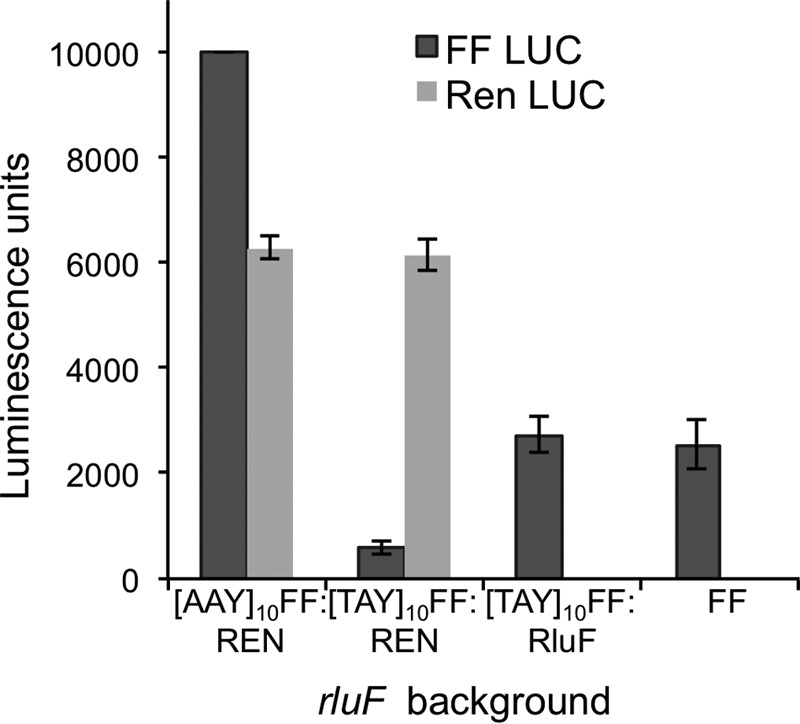
Luciferase assay measuring decreased gene expression under rluF gene knock-out background when the coding sequence is preceded by multiple tyrosine codons. A recombinant firefly luciferase gene was constructed with a set of 10 tyrosine codons ((TAY)10-FF) or 10 asparagine codons ((AAY)10-FF) preceding the firefly luciferase open reading frame. Expression of the luciferase gene in combination with either Renilla luciferase or RluF gene in the rluF gene knock-out background was conducted using a pETDuet vector. The type of recombinant construct used in the luciferase assay is denoted on the x axis. At least four to five biological replicates were tested for each construct. Error bars represent S.D. of replicate measurements.

References

    1. Machnicka M. A., Milanowska K., Osman Oglou O., Purta E., Kurkowska M., Olchowik A., Januszewski W., Kalinowski S., Dunin-Horkawicz S., Rother K. M., Helm M., Bujnicki J. M., and Grosjean H. (2013) MODOMICS: a database of RNA modification pathways—2013 update. Nucleic Acids Res. 41, D262–D267 - PMC - PubMed
    1. Limbach P. A., Crain P. F., and McCloskey J. A. (1994) Summary: the modified nucleosides of RNA. Nucleic Acids Res. 22, 2183–2196 - PMC - PubMed
    1. Cohn W. E., and Volkin E. (1951) Nucleoside-5′-phosphates from ribonucleic acid. Nature 167, 483–484
    1. Spenkuch F., Motorin Y., and Helm M. (2014) Pseudouridine: still mysterious, but never a fake (uridine)! RNA Biol. 11, 1540–1554 - PMC - PubMed
    1. Charette M., and Gray M. W. (2000) Pseudouridine in RNA: what, where, how, and why. IUBMB Life 49, 341–351 - PubMed

MeSH terms

LinkOut - more resources