Review
. 2016 Apr 4:2:16019.
doi: 10.1038/cddiscovery.2016.19. eCollection 2016.

Questions and controversies in innate immune research: what is the physiological role of NLRP3?

Affiliations
Review

Questions and controversies in innate immune research: what is the physiological role of NLRP3?

R C Coll et al. Cell Death Discov. .

Abstract

The NLRP3 inflammasome is a key component of the innate immune system that induces pro-inflammatory cytokine production and cell death. Although NLRP3 is activated by many pathogens, it only appears to be critical for host defense for a limited number of specific infections. NLRP3 is however strongly associated with the initiation and pathology of many inflammatory diseases. If NLRP3 function is largely redundant for host defense, but drives a number of inflammatory diseases, this raises the important question of why evolution has elected to maintain NLRP3 function. We propose that the primary physiological functions of NLRP3 in health are to engage pathways to clear noxious substances (e.g. protein aggregates and crystals), and to regulate metabolism. We discuss the newly identified functions for NLRP3 in metabolic homeostasis, and how NLRP3 beneficial functions in homeostasis may become detrimental during the onset of inflammatory and metabolic diseases. A common feature of most NLRP3-driven diseases is that they are associated with ageing or metabolic excess, and indeed, Nlrp3 deficiency promotes 'healthspan' in ageing mice. This suggests that beneficial functions of NLRP3 in youth may become increasingly countered by NLRP3-dependent pathology as an individual ages, and we propose a general model by which ageing or nutrient excess may provide a tipping point to switch NLRP3 function from beneficial to pathological. The physiological role of NLRP3 in healthy individuals remains incompletely understood and future research will need to address this if NLRP3 is to become a successful therapeutic target for the clinical management of inflammatory diseases.


Figures
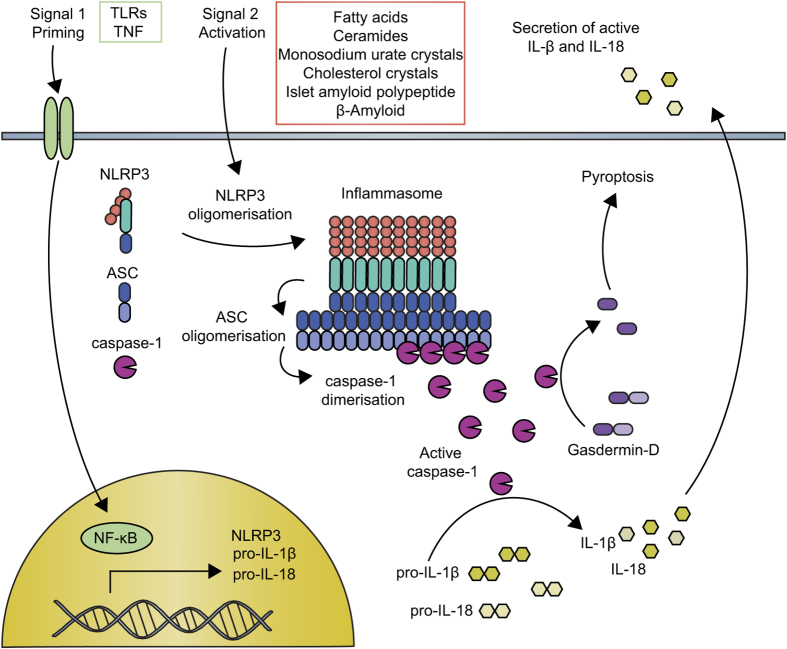
Figure 1
Figure 1
The NLRP3 inflammasome signaling pathway. NLRP3 inflammasome activation requires an initial ‘signal 1’, such as toll-like receptor or TNF receptor activation, that activates NF-κB. This priming signal induces the transcription of NLRP3 and pro-IL-1β and also results in post-translational modification of the NLRP3 protein, which is required for activation. A second NLRP3-specific activation signal (‘signal 2’, such as the metabolic substances indicated) triggers conformational changes resulting in the oligomerization of NLRP3. The adapter molecule ASC is recruited through Pyrin domain interactions with NLRP3 and forms large prion-like oligomers. The ASC CARD domain interacts with caspase-1 and ASC oligomers provide a scaffold for caspase-1 dimerization, autocatalytic processing and the generation of active caspase-1. Active caspase-1 processes pro-IL-1β and pro-IL-18 to their active mature forms, which are secreted. Caspase-1 also cleaves Gasdermin-D resulting in inflammatory cell death (pyroptosis).
Figure 2
Figure 2
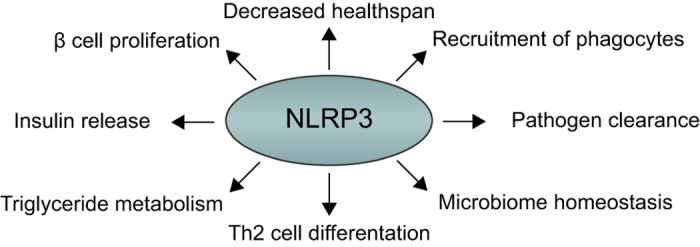
Positive regulatory functions for NLRP3 in homeostasis. NLRP3 has a number of functions in metabolism such as regulating insulin release, β-cell proliferation and triglyceride levels. New IL-1β-independent functions of NLRP3 have been identified in regulating ageing, intestinal microbiota and during transcription in Th2 cells. NLRP3 is required for the sensing of pathogens such as Candida and in the recruitment of phagocytes to clear infections and noxious protein aggregates and crystals.
Figure 3
Figure 3
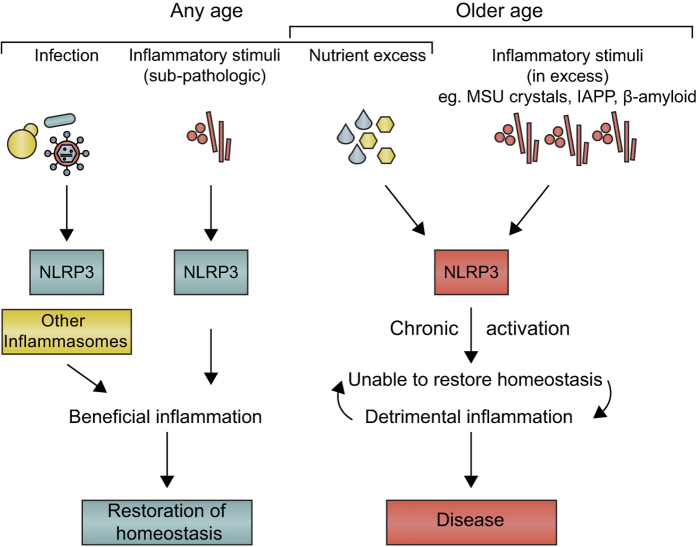
Model of the physiological role of NLRP3. NLRP3 function may be largely redundant during infection, with other inflammasomes also able to provide defense. NLRP3-dependent inflammation contributes to the restoration of homeostasis when the provoking stimuli (e.g. products of damaged tissue, including crystals) are present at low levels. In cases of excess (e.g. in response to nutrients in a high-fat diet, or high levels of deposition of noxious stimuli such as MSU crystals, or protein aggregates such as β-amyloid or IAPP), however, NLRP3 drives chronic inflammation, which is pathological. These events are more likely to occur with ageing, which is associated with the accumulation of such substances. Such a pathological function for NLRP3 would likely not be influenced by negative selection during evolution, as reproductive success would not be sufficiently affected. The issue in essence may therefore be one of dose—NLRP3 sensing low dose in youth being beneficial, high dose in age being detrimental.

References

    1. Hoffman HM , Mueller JL , Broide DH , Wanderer AA , Kolodner RD . Mutation of a new gene encoding a putative pyrin-like protein causes familial cold autoinflammatory syndrome and Muckle-Wells syndrome. Nat Genet 2001; 29: 301–305. - PMC - PubMed
    1. Schroder K , Tschopp J . The inflammasomes. Cell 2010; 140: 821–832. - PubMed
    1. Jo EK , Kim JK , Shin DM , Sasakawa C . Molecular mechanisms regulating NLRP3 inflammasome activation. Cell Mol Immunol 2015; e-pub ahead of print 9 November 201510.1038/cmi.2015.95. - PMC - PubMed
    1. Chen KW , Schroder K . Antimicrobial functions of inflammasomes. Curr Opin Microbiol 2013; 16: 311–318. - PubMed
    1. Clay GM , Sutterwala FS , Wilson ME . NLR proteins and parasitic disease. Immunol Res 2014; 59: 142–152. - PMC - PubMed

LinkOut - more resources