Determining If Sex Bias Exists in Human Surgical Clinical Research
- PMID: 27551816
- PMCID: PMC5142632
- DOI: 10.1001/jamasurg.2016.2032
Determining If Sex Bias Exists in Human Surgical Clinical Research
Abstract
Importance: Sex is a variable that is poorly controlled for in clinical research.
Objectives: To determine if sex bias exists in human surgical clinical research, to determine if data are reported and analyzed using sex as an independent variable, and to identify specialties in which the greatest and least sex biases exist.
Design, setting, and participants: For this bibliometric analysis, data were abstracted from 1303 original peer-reviewed articles published from January 1, 2011, through December 31, 2012, in 5 surgery journals.
Main outcomes and measures: Study type, location, number and sex of participants, degree of sex matching of included participants, and inclusion of sex-based reporting, statistical analysis, and discussion of data.
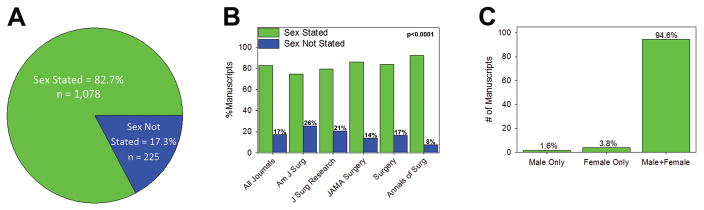
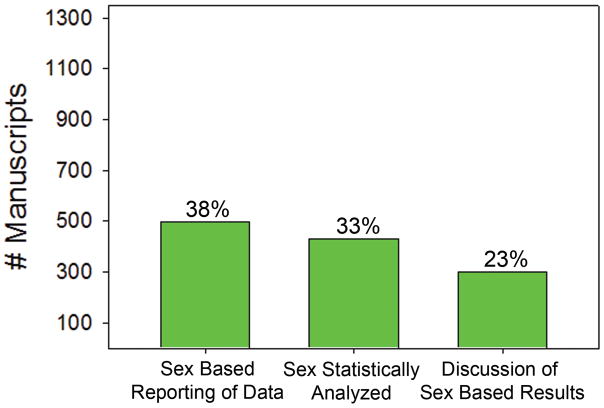
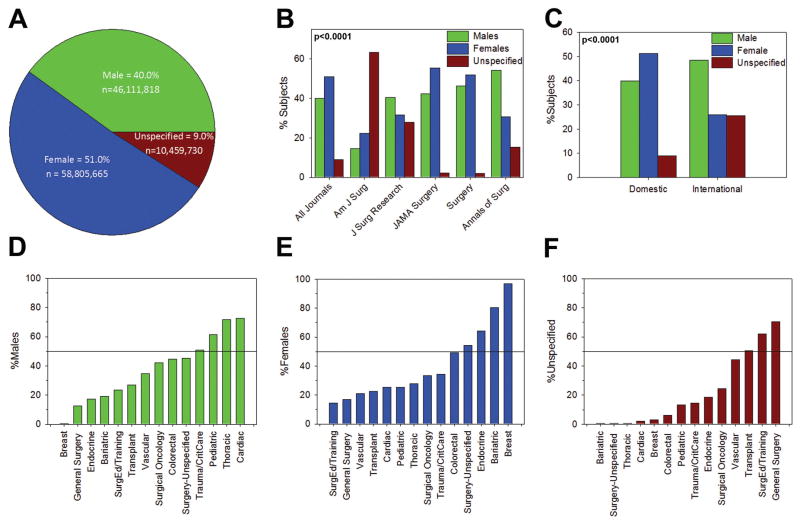
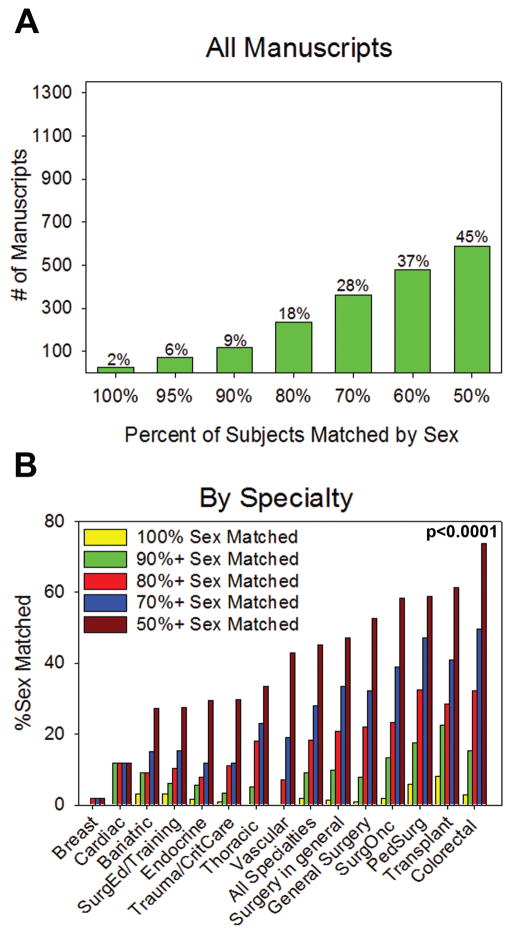
Results: Of 2347 articles reviewed, 1668 (71.1%) included human participants. After excluding 365 articles, 1303 remained: 17 (1.3%) included males only, 41 (3.1%) included females only, 1020 (78.3%) included males and females, and 225 (17.3%) did not document the sex of the participants. Although female participants represent more than 50% (n = 57 688 606) of the total number (115 377 213) included, considerable variability existed with the number of male (46 111 818), female (58 805 665), and unspecified (10 459 730) participants included among the journals, between US domestic and international studies, and between single vs multicenter studies. For articles included in the study, 38.1% (497 of 1303) reported these data by sex, 33.2% (432 of 1303) analyzed these data by sex, and 22.9% (299 of 1303) included a discussion of sex-based results. Sex matching of the included participants in the research overall was poor, with 45.2% (589 of 1303) of the studies matching the inclusion of both sexes by 50%. During analysis of the different surgical specialties, a wide variation in sex-based inclusion, matching, and data reporting existed, with colorectal surgery having the best matching of male and female participants and cardiac surgery having the worst.
Conclusions and relevance: Sex bias exists in human surgical clinical research. Few studies included men and women equally, less than one-third performed data analysis by sex, and there was wide variation in inclusion and matching of the sexes among the specialties and the journals reviewed. Because clinical research is the foundation for evidence-based medicine, it is imperative that this disparity be addressed so that therapies benefit both sexes.
Figures
Comment in
-
Precision Health Outcomes Require Precise Patient Identification.JAMA Surg. 2016 Nov 1;151(11):1030-1031. doi: 10.1001/jamasurg.2016.2078. JAMA Surg. 2016. PMID: 27851861 No abstract available.
References
-
- U.S. Department of Health Education and Welfare. General considerations for the clinical evaluation of Drugs. 1977. (Publication No. (FDA) 77-3040)
-
- Kim AM, Tingen CM, Woodruff TK. Sex bias in trials and treatment must end. Nature. 2010;465(7299):688–689. - PubMed
-
- Mogil JS, Chanda ML. The case for the inclusion of female subjects in basic science studies of pain. Pain. 2005;117(1–2):1–5. - PubMed
Publication types
MeSH terms
Grants and funding
LinkOut - more resources
Full Text Sources
Other Literature Sources
Medical