


Non-contrast 3D black blood MRI for abdominal aortic aneurysm surveillance: comparison with CT angiography
- PMID: 27553926
- PMCID: PMC5323367
- DOI: 10.1007/s00330-016-4559-0
Non-contrast 3D black blood MRI for abdominal aortic aneurysm surveillance: comparison with CT angiography
Abstract
Objectives: Management of abdominal aortic aneurysms (AAAs) is based on diameter. CT angiography (CTA) is commonly used, but requires radiation and iodinated contrast. Non-contrast MRI is an appealing alternative that may allow better characterization of intraluminal thrombus (ILT). This study aims to 1) validate non-contrast MRI for measuring AAA diameter, and 2) to assess ILT with CTA and MRI.
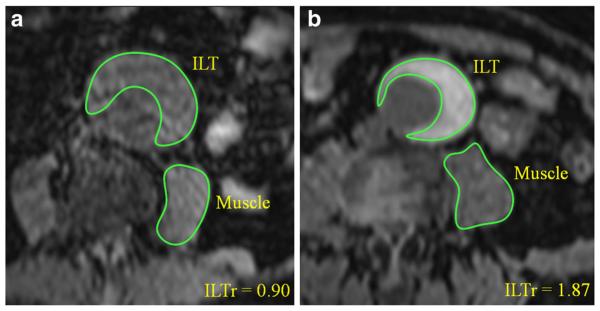
Method: 28 patients with AAAs (diameter 50.7 ± 12.3 mm) underwent CTA and non-contrast MRI. MRI was acquired at 3 T using 1) a conventional 3D gradient echo (GRE) sequence and 2) a 3D T1-weighted black blood fast-spin-echo sequence. Two radiologists independently measured the AAA diameter. The ratio of signal of ILT and adjacent psoas muscle (ILTr = signalILT/signalMuscle) was quantified.
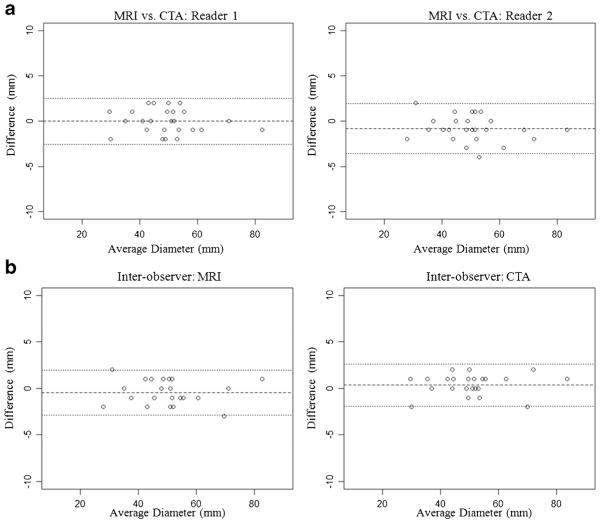
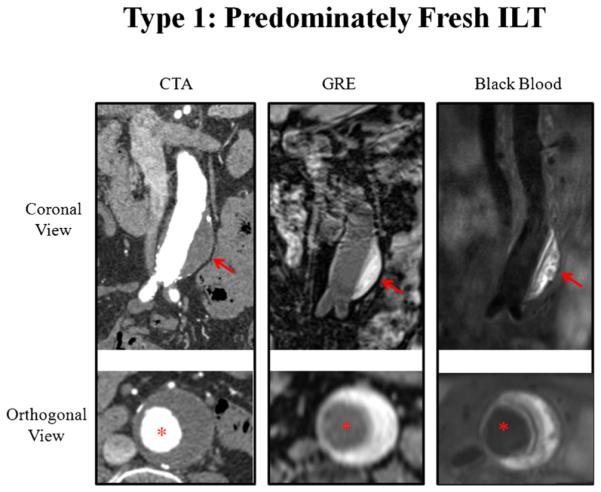
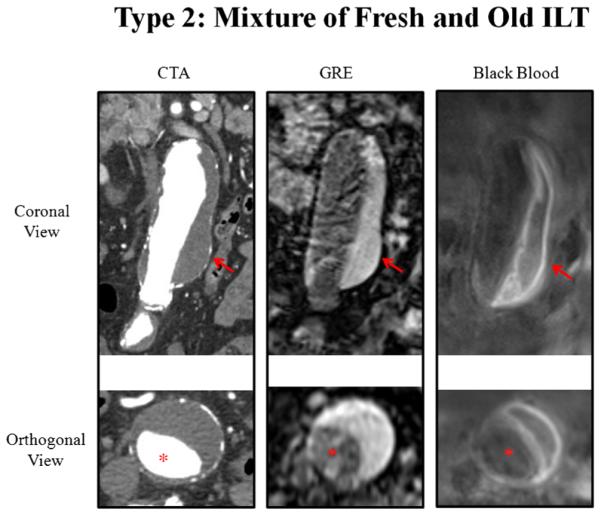
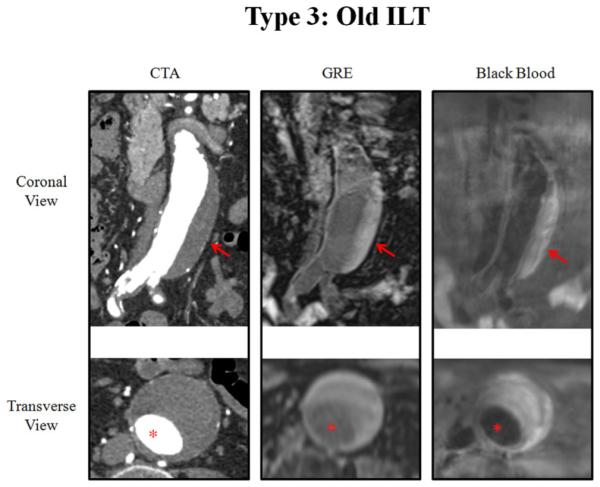
Results: Strong agreement between CTA and non-contrast MRI was shown for AAA diameter (intra-class coefficient > 0.99). Both approaches had excellent inter-observer reproducibility (ICC > 0.99). ILT appeared homogenous on CTA, whereas MRI revealed compositional variations. Patients with AAAs ≥5.5 cm and <5.5 cm had a variety of distributions of old/fresh ILT types.
Conclusions: Non-contrast 3D black blood MRI provides accurate and reproducible AAA diameter measurements as validated by CTA. It also provides unique information about ILT composition, which may be linked with elevated risk for disease progression.
Key points: • Non-contrast MRI is an appealing alternative to CTA for AAA management. • Non-contrast MRI can accurately measure AAA diameters compared to CTA. • MRI affords unique characterization of intraluminal thrombus composition.
Keywords: Abdominal aortic aneurysm surveillance; CT angiography; Diameter measurement; Intraluminal thrombus composition; Non-contrast MRI.
Figures
References
-
- Kent KC, Zwolak RM, Egorova NN, et al. Analysis of risk factors for abdominal aortic aneurysm in a cohort of more than 3 million individuals. J Vasc Surg. 2010;52:539–548. - PubMed
-
- Derubertis BG, Trocciola SM, Ryer EJ, et al. Abdominal aortic aneurysm in women: prevalence, risk factors, and implications for screening. J Vasc Surg. 2007;46:630–635. - PubMed
-
- LeFevre ML. Screening for abdominal aortic aneurysm: U.S. Preventive Services Task Force recommendation statement. Ann Intern Med. 2014;161:281–290. - PubMed
-
- Beales L, Wolstenhulme S, Evans JA, West R, Scott DJ. Reproducibility of ultrasound measurement of the abdominal aorta. Br J Surg. 2011;98:1517–1525. - PubMed
-
- Nguyen VL, Leiner T, Hellenthal FA, et al. Abdominal aortic aneurysms with high thrombus signal intensity on magnetic resonance imaging are associated with high growth rate. Eur J Vasc Endovasc Surg. 2014;48:676–684. - PubMed
Publication types
MeSH terms
Substances
Grants and funding
LinkOut - more resources
Full Text Sources
Other Literature Sources
Medical
