Review
. 2016 Aug 22;38(4):333-44.
doi: 10.1016/j.devcel.2016.07.026.

Hedgehog Signal Transduction: Key Players, Oncogenic Drivers, and Cancer Therapy

Affiliations
Review

Hedgehog Signal Transduction: Key Players, Oncogenic Drivers, and Cancer Therapy

Ekaterina Pak et al. Dev Cell. .

Abstract

The Hedgehog (Hh) signaling pathway governs complex developmental processes, including proliferation and patterning within diverse tissues. These activities rely on a tightly regulated transduction system that converts graded Hh input signals into specific levels of pathway activity. Uncontrolled activation of Hh signaling drives tumor initiation and maintenance. However, recent entry of pathway-specific inhibitors into the clinic reveals mixed patient responses and thus prompts further exploration of pathway activation and inhibition. In this review, we share emerging insights into regulated and oncogenic Hh signaling, supplemented with updates on the development and use of Hh pathway-targeted therapies.


Figures

Figure 1
Figure 1. The evolving complexity of Hedgehog (Hh) signal transduction
A simplistic view of Hh signal transduction is portrayed in the upper panels. Recent updates on Hh signaling are depicted in the lower panels. (A) In the absence of Hh ligand, Ptch1 inhibits Smo activation and ciliary localization. Low levels of Kif7, Sufu, and full-length Gli (GliFL) enter the primary cilium (PC), which promotes GliFL processing into a repressor form (GliR) after phosphorylation by PKA, GSK3, and CK1. GliR blocks transcription of Hh target genes. (B) When Hh ligand binds Ptch1, both ligand and receptor are internalized and degraded. Smo is phosphorylated by CK1 and GRK2, assumes an active conformation, and moves into the primary cilium (PC). Kif7, Sufu, and Gli also accumulate in the PC, where activated Smo promotes Sufu-Gli dissociation and activation of Gli (GliA). GliA shuttles into the nucleus and induces target gene transcription. (C) The PC-localized phosphatase, Inpp5e, maintains a PC lipid composition enriched with the phosphoinositide PI(4)P, which regulates ciliary localization of Hh pathway modulators such as the orphan GPCR, Gpr161. In the absence of Hh ligand, Gpr161 localizes to the PC and promotes production of cAMP, likely via Gαs-mediated activation of adenylyl cyclase, thereby repressing Hh signaling. In the nucleus, the PRC2 complex maintains repressive H3K27me3 to block target gene expression. (D) Hh ligand binding to Ptch1 promotes Smurf-mediated ubiquitination, endocytosis, and degradation of Ptch1. Smo becomes activated and its activity can be enhanced by lipid-based modulators, such as oxysterols, which bind to an extracellular domain in Smo. Activated Smo translocates to the PC and can localize at a specialized compartment called the EvC zone; from here Smo transmits signals to activate Gli. Hh stimulation also promotes the formation of a Kif7 complex with the scaffolding protein PPFIA1 and the phosphatase PP2A, resulting in Kif7 dephosphorylation and translocation to the tip of the PC. In the nucleus, Hh activation recruits Jmjd3, which activates target genes by displacing PRC2, enzymatically removing H3K27me3, and recruiting the Set1/MLL H3K4 methyltransferase complex. Also, active Hh signaling induces Eya1/Six1-mediated transcription of Nrp. The Nrp ligand Sema3 promotes recruitment of the phosphodiesterase PDE4D to the Nrp cytoplasmic domain, where it degrades cAMP and therefore reduces PKA levels.
Figure 2
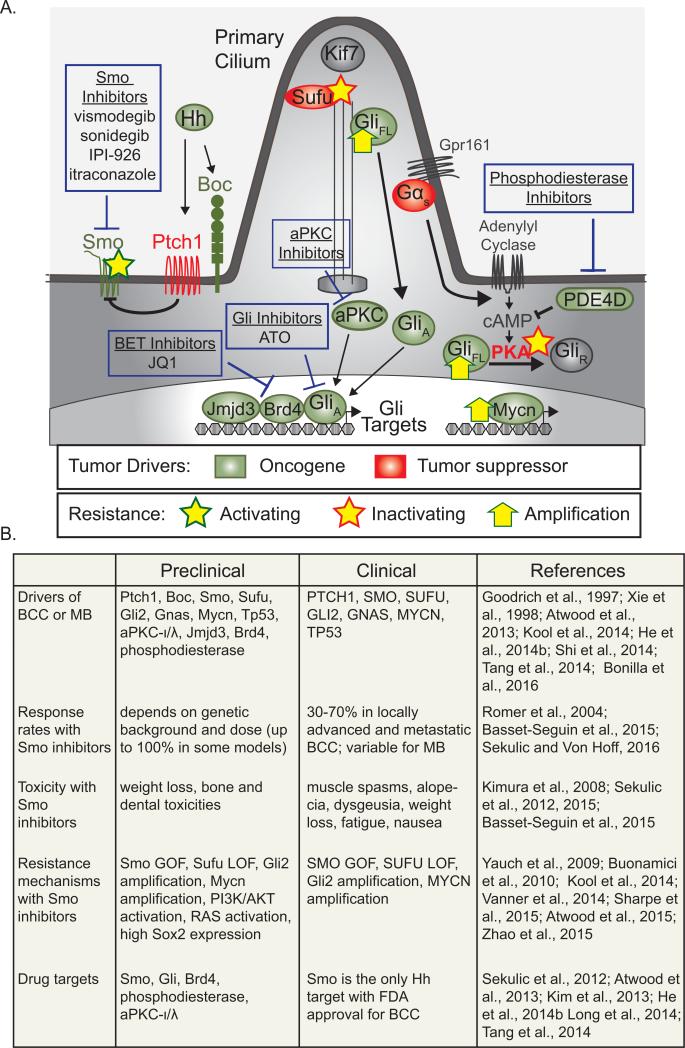
Figure 2. Drivers, drug targets, and resistance mechanisms in oncogenic Hh signaling
(A) Tumor suppressors (red) and oncogenes (green) that have been reported in preclinical and some clinical settings to cause or maintain basal cell carcinoma (BCC) and medulloblastoma (MB) are shown. Stars (activating or inactivating mutations) and arrows (genomic amplifications) indicate pathway components implicated in resistance to Smo inhibitors. Examples of Hh pathway-targeted therapies described in this review are indicated in white boxes. (B) Summary of preclinical and clinical evidence for Hh pathway oncogenic drivers in BCC and MB; Smo inhibitor efficacy, toxicity, and resistance; and alternate drug targets under development. GOF, gain-of-function; LOF, loss-of-function. References are an abridged selection (see text for a more comprehensive list of references).

References

    1. Ahlfeld J, Favaro R, Pagella P, Kretzschmar HA, Nicolis S, Schuller U. Sox2 requirement in sonic hedgehog-associated medulloblastoma. Cancer Res. 2013;73:3796–3807. - PubMed
    1. Amakye D, Jagani Z, Dorsch M. Unraveling the therapeutic potential of the Hedgehog pathway in cancer. Nat Med. 2013;19:1410–1422. - PubMed
    1. Arensdorf AM, Marada S, Ogden SK. Smoothened Regulation: A Tale of Two Signals. Trends Pharmacol Sci. 2016;37:62–72. - PMC - PubMed
    1. Atwood SX, Li M, Lee A, Tang JY, Oro AE. GLI activation by atypical protein kinase C iota/lambda regulates the growth of basal cell carcinomas. Nature. 2013;494:484–488. - PMC - PubMed
    1. Atwood SX, Sarin KY, Whitson RJ, Li JR, Kim G, Rezaee M, Ally MS, Kim J, Yao C, Chang AL, et al. Smoothened variants explain the majority of drug resistance in basal cell carcinoma. Cancer Cell. 2015;27:342–353. - PMC - PubMed

Publication types