


Modulation of Alloimmunity by Heat Shock Proteins
- PMID: 27555846
- PMCID: PMC4977877
- DOI: 10.3389/fimmu.2016.00303
Modulation of Alloimmunity by Heat Shock Proteins
Abstract
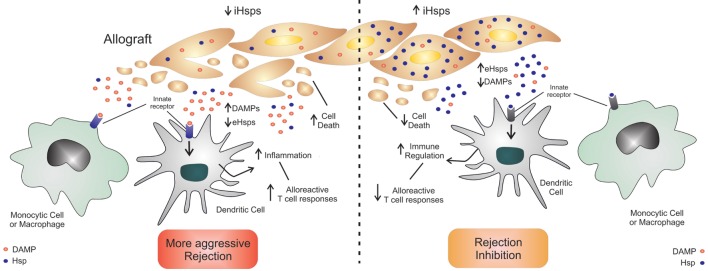
The immunological mechanisms that evolved for host defense against pathogens and injury are also responsible for transplant rejection. Host rejection of foreign tissue was originally thought to be mediated mainly by T cell recognition of foreign MHC alleles. Management of solid organ transplant rejection has thus focused mainly on inhibition of T cell function and matching MHC alleles between donor and host. Recently, however, it has been demonstrated that the magnitude of the initial innate immune responses upon transplantation has a decisive impact on rejection. The exact mechanisms underlying this phenomenon have yet to be characterized. Ischemic cell death and inflammation that occur upon transplantation are synonymous with extracellular release of various heat shock proteins (Hsps), many of which have been shown to have immune-modulatory properties. Here, we review the impact of Hsps upon alloimmunity and discuss the potential use of Hsps as accessory agents to improve solid organ transplant outcomes.
Keywords: Hsps; alloimmunity; dendritic cells; immune regulation; transplantation.
Figures
References
Publication types
LinkOut - more resources
Full Text Sources
Other Literature Sources
Research Materials
