. 2016 Oct 11;7(41):66679-66688.
doi: 10.18632/oncotarget.11439.

Common housekeeping proteins are upregulated in colorectal adenocarcinoma and hepatocellular carcinoma, making the total protein a better "housekeeper"

Affiliations

Common housekeeping proteins are upregulated in colorectal adenocarcinoma and hepatocellular carcinoma, making the total protein a better "housekeeper"

Xiaowen Hu et al. Oncotarget. .

Abstract

Housekeeping proteins are essential endogenous controls for normalization as they are expected to be stably expressed. However, the stability of the expression level of housekeeping proteins needs to be assessed considering various experimental conditions. Our study evaluated the degree of variability of 7 commonly used housekeeping proteins with regard to their potential utility as normalizers in 56 pairs of matched colorectal adenocarcinoma (CRC) tissue samples and 6 pairs of hepatocellular carcinoma (HCC) tissue samples using multiple reaction monitoring (MRM) and Western blot analyses. A comprehensive experimental design and strict statistical analysis revealed that the expression levels of these 7 housekeeping proteins were not as stable as expected and they all exhibited upregulations to varying degrees in both the CRC and the HCC tissue samples. Consequently, we verified that using the amount of total protein instead of that of an individual protein can serve as a preferable control for studies of protein expression that require normalization.

Keywords: endogenous control; housekeeping protein; normalization; total protein amount; tumor.


Conflict of interest statement

CONFLICTS OF INTEREST

The authors declare no conflicts of interest.

Figures
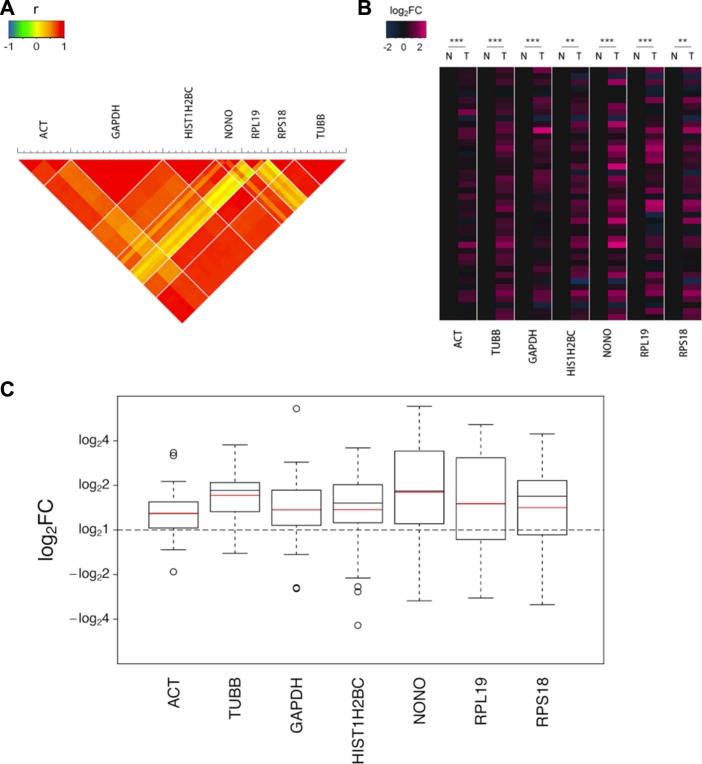
Figure 1
Figure 1. The upregulations of the 7 candidate housekeeping proteins in tumor tissues of the discovery sample set (CRC) quantified using the MRM assay
(A) The correlation (Pearson's test) in a set of monitored transitions fragmented from peptides that were enzymatically digested from the same protein. (B) The heat map of the log2FCs of the 42 pairs of valid data. The values for the non-cancerous tissues were assigned as zeros to obviously identify the trends in the changes in the tumor tissues. The statistical significance: **p < 0.01; ***p < 0.001. (C) The boxplots of the log2FCs of the 42 pairs of valid data. The boxes and whiskers indicate the minimum value, the 25th percentile, the mean (red), the median (black), the 75th percentile and the maximum value.
Figure 2
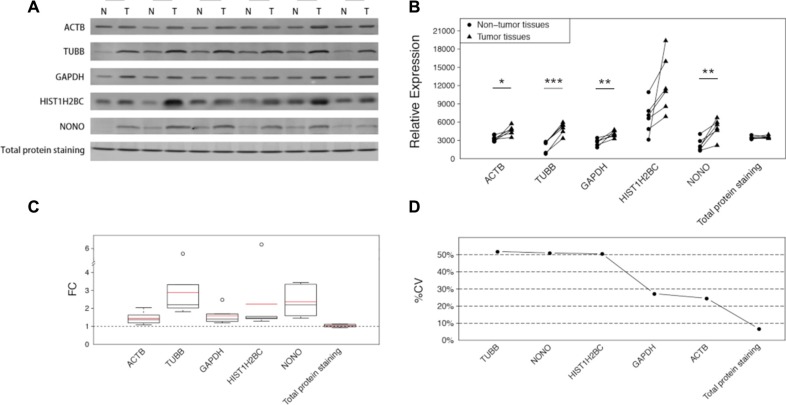
Figure 2. The differences of the 5 candidate housekeeping proteins and total protein staining between tumor and non-cancerous tissues in the validation sample set (CRC)
(A) Western blot analyses of ACTB, TUBB, GAPDH, HIST1H2BC, and NONO, and the total protein staining with SYPRO Ruby in an SDS-PAGE stacking gel. (B) The intensities of the bands in (A) quantified using ImageJ software. The statistical significance: *p < 0.05; **p < 0.01; ***p < 0.001. (C) The fold changes of the 5 candidate housekeeping proteins and the total protein staining. The boxes and whiskers indicate the minimum value, the 25th percentile, the mean (red), the median (black), the 75th percentile and the maximum value. (D) The coefficients of variation of the 5 candidate housekeeping proteins and total protein staining.
Figure 3
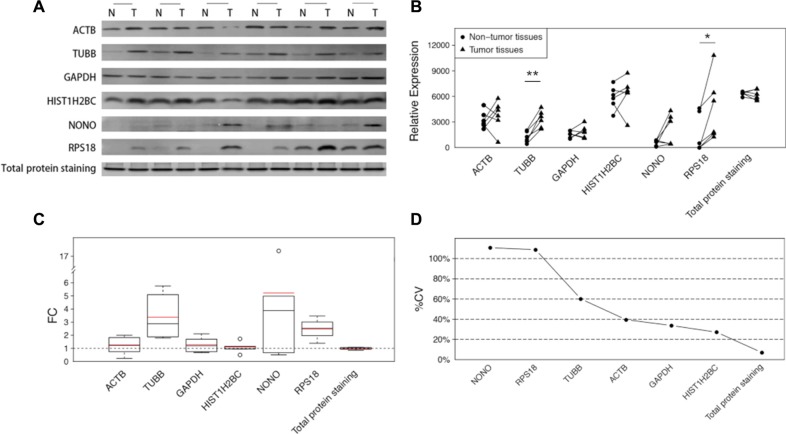
Figure 3. The differences of the 6 candidate housekeeping proteins and total protein staining between tumor and non-cancerous tissues in the extension sample set (HCC)
(A) Western blot analyses of ACTB, TUBB, GAPDH, HIST1H2BC, NONO, and RPS18, and the total protein staining with SYPRO Ruby in an SDS-PAGE stacking gel. (B) The intensities of the bands in (A) quantified using ImageJ software. The statistical significance: *p < 0.05; **p < 0.01. (C) The fold changes in 6 candidate housekeeping proteins and total protein staining. The boxes and whiskers indicate the minimum value, the 25th percentile, the mean (red), the median (black), the 75th percentile and the maximum value. (D) The coefficients of variation of 6 candidate housekeeping proteins and total protein staining.
Figure 4
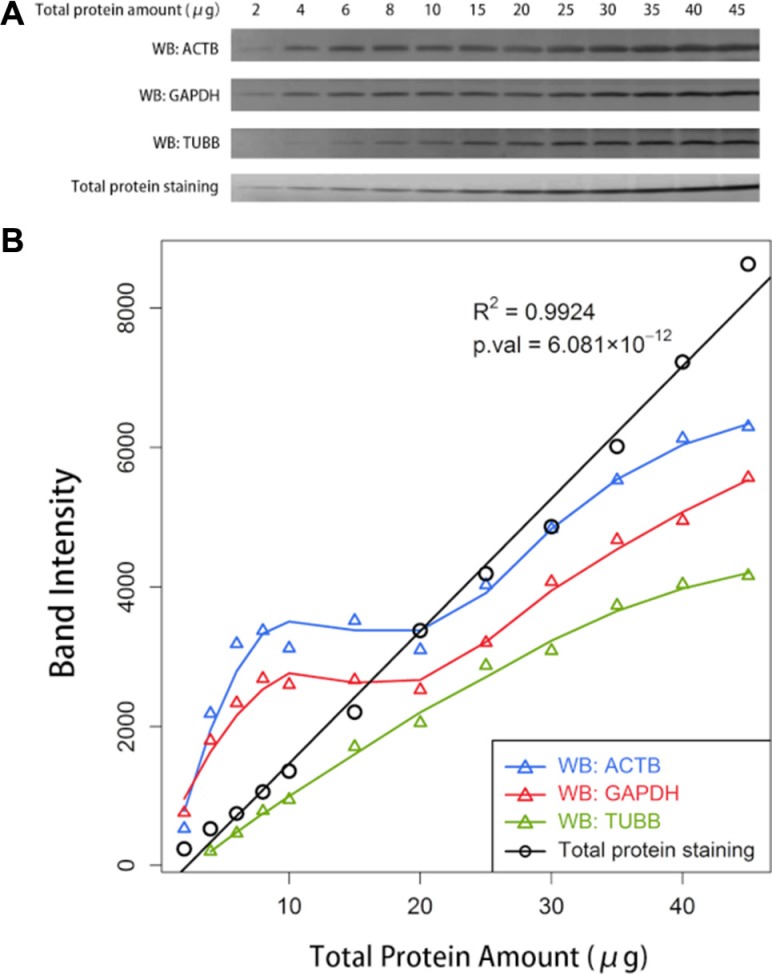
Figure 4. The comparison between the Western blot analysis of an individual protein and the total protein staining
(A) Western blot (WB) analyses of ACTB, GAPDH, TUBB, and the total protein staining with SYPRO Ruby with serial gradient amounts of total protein loaded on the gels. (B) The relationship between the quantified band intensities and the actual amounts of the total protein loaded on the gels. The band intensities were quantified using ImageJ software.

References

    1. Kok JBd, Roelofs RW, Giesendorf BA, Pennings JL, Waas ET, Feuth T, Swinkels DW, Span PN. Normalization of gene expression measurements in tumor tissues: comparison of 13 endogenous control genes. Lab Invest. 2005;85:154–159. - PubMed
    1. Huang X, Gao Y, Jiang B, Zhou Z, Zhan A. Reference gene selection for quantitative gene expression studies during biological invasions: A test on multiple genes and tissues in a model ascidian Ciona savignyi. Gene. 2015;576:79–87. - PubMed
    1. Silver N, Best S, Jiang J, Thein SL. Selection of housekeeping genes for gene expression studies in human reticulocytes using real-time PCR. BMC Mol Biol. 2006;7:33. - PMC - PubMed
    1. Silver N, Cotroneo E, Proctor G, Osailan S, Paterson KL, Carpenter GH. Selection of housekeeping genes for gene expression studies in the adult rat submandibular gland under normal, inflamed, atrophic and regenerative states. BMC Mol Biol. 2008;9:64. - PMC - PubMed
    1. Guo Y, Chen JX, Yang S, Fu XP, Zhang Z, Chen KH, Huang Y, Li Y, Xie Y, Mao YM. Selection of reliable reference genes for gene expression study in nasopharyngeal carcinoma. Acta Pharmacol Sin. 2010;31:1487–1494. - PMC - PubMed

MeSH terms