


Influenza epidemiology and influenza vaccine effectiveness during the 2014-2015 season: annual report from the Global Influenza Hospital Surveillance Network
- PMID: 27556802
- PMCID: PMC5001209
- DOI: 10.1186/s12889-016-3378-1
Influenza epidemiology and influenza vaccine effectiveness during the 2014-2015 season: annual report from the Global Influenza Hospital Surveillance Network
Abstract
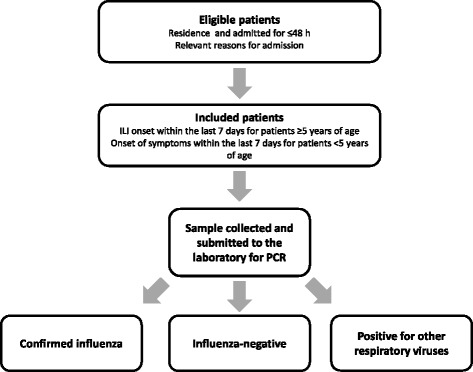
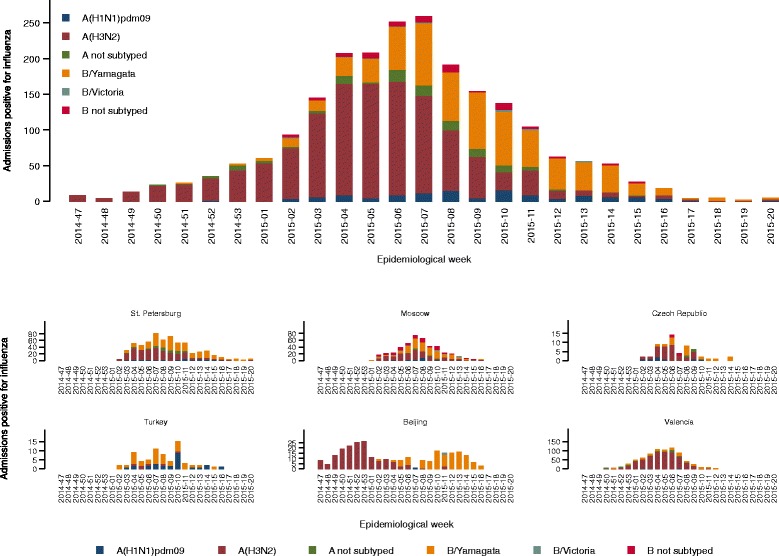
The Global Influenza Hospital Surveillance Network (GIHSN) has established a prospective, active surveillance, hospital-based epidemiological study to collect epidemiological and virological data for the Northern and Southern Hemispheres over several consecutive seasons. It focuses exclusively on severe cases of influenza requiring hospitalization. A standard protocol is shared between sites allowing comparison and pooling of results. During the 2014-2015 influenza season, the GIHSN included seven coordinating sites from six countries (St. Petersburg and Moscow, Russian Federation; Prague, Czech Republic; Istanbul, Turkey; Beijing, China; Valencia, Spain; and Rio de Janeiro, Brazil). Here, we present the detailed epidemiological and influenza vaccine effectiveness findings for the Northern Hemisphere 2014-2015 influenza season.
Keywords: Epidemiological study; Hospitalization; Influenza; Surveillance; Vaccine; Virus.
Figures
References
-
- Jernigan DB, Cox NJ. Human influenza: One health, one world. In: Webster RG, Monto AS, Braciale TJ, Lamb RA, editors. Textbook of influenza. Chichester, West Sussex: Wiley Blackwell; 2013. pp. 3–19.
-
- World Health Organization Vaccines against influenza WHO position paper - November 2012. Wkly Epidemiol Rec. 2012;87:461–76. - PubMed
MeSH terms
Substances
LinkOut - more resources
Full Text Sources
Other Literature Sources
Medical
