Review
. 2017 May;63(2):187-193.
doi: 10.1007/s00294-016-0642-y. Epub 2016 Aug 24.

A conserved role of the RSC chromatin remodeler in the establishment of nucleosome-depleted regions

Affiliations
Review

A conserved role of the RSC chromatin remodeler in the establishment of nucleosome-depleted regions

Carlo Yague-Sanz et al. Curr Genet. 2017 May.

Abstract

The occupancy of nucleosomes governs access to the eukaryotic genomes and results from a combination of biophysical features and the effect of ATP-dependent remodelling complexes. Most promoter regions show a conserved pattern characterized by a nucleosome-depleted region (NDR) flanked by nucleosomal arrays. The conserved RSC remodeler was reported to be critical to establish NDR in vivo in budding yeast but other evidences suggested that this activity may not be conserved in fission yeast. By reanalysing and expanding previously published data, we propose that NDR formation requires, at least partially, RSC in both yeast species. We also discuss the most prominent biological role of RSC and the possibility that non-essential subunits do not define alternate versions of the complex.

Keywords: Chromatin; Mitosis; Nucleosome; RSC; Yeast.


Conflict of interest statement

Conflict of interest

The authors declare that they have no conflict of interest.

Ethical approval

This article does not contain any studies with human participants or animals performed by any of the authors.

Figures
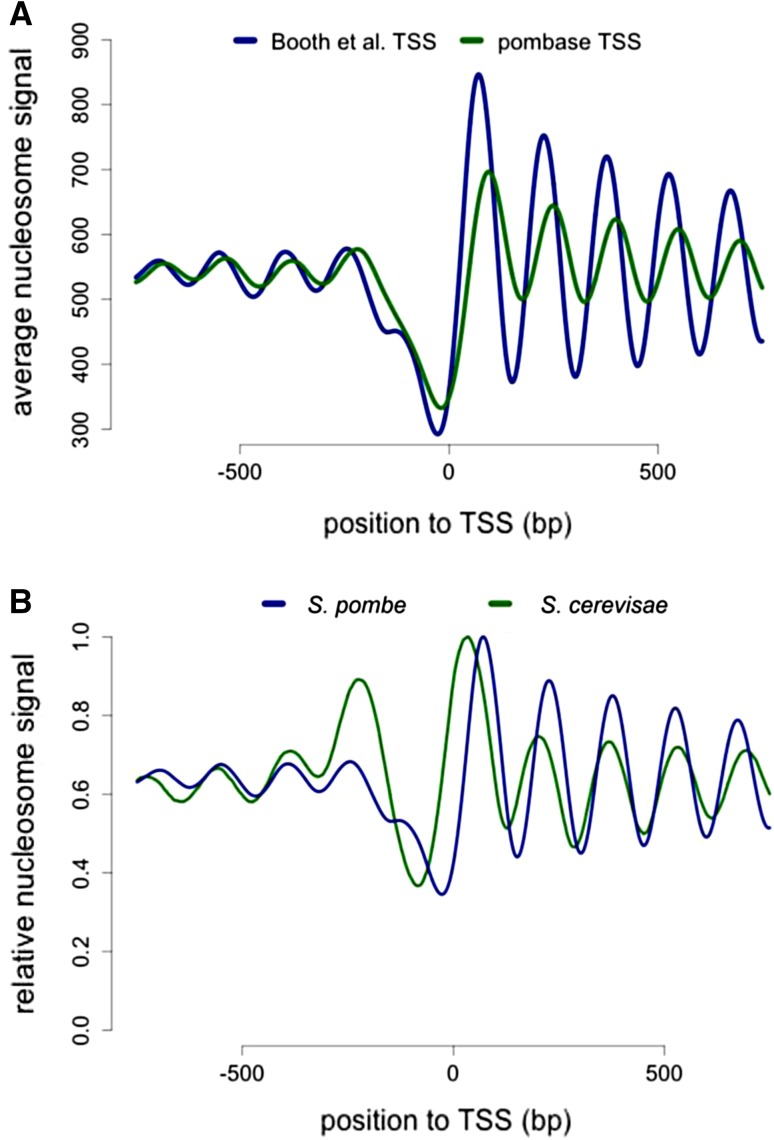
Fig. 1
Fig. 1
Average nucleosome occupancy nearby the TSS in fission and budding yeasts. a Average nucleosome signals centered on two different fission yeast TSS annotations. b Average nucleosome signals centered on TSS in fission yeast and budding yeasts
Fig. 2
Fig. 2
Defects in the RSC remodeler affects NDR formation in both budding yeast and fission yeast. a The profile of nucleosome occupancy ratios between budding yeast sth1 degron (sth1 deg) and control strains is presented as an heatmap, where blue represents a gain in nucleosome occupancy and red represents a loss within a region ranging from −750 bp to +750 bp around the TSS at single nucleotide resolution. Rows represent genes and are organized into five groups by k-means clustering. b Same as in a, except that the fission yeast rsc1 deletion mutant (rsc1Δ) and control strains are presented
Fig. 3
Fig. 3
Comparison of the fission yeast rsc1 deletion mutant and the snf21 switch-off strains. a The profile of nucleosome occupancy ratios between fission yeast rsc1 deletion mutant (rsc1Δ) and control strains on the left panel (note that this panel is identical to Fig. 2b and repeated here for clarity), and between the fission yeast snf21 switch-off mutant [tetO-snf21, 3 h of inhibition, (Materne et al. 2015)] and control strains on the right panel are presented as a heatmap, where blue represents a gain in nucleosome occupancy and red represents a loss within a region ranging from −750 bp to +750 bp around the TSS at single nucleotide resolution. Rows represent genes and are organized into five groups by k-means clustering. b Box plot representing the difference in NDR length between the rsc1Δ and tetO-snf21 strains and the corresponding wt strains. Statistical significance was calculated by a one-sample Wilcoxon test (pval <0.01). c Frequency of genes downregulated (log2 fold change < −0.5, based on (Monahan et al. 2008) in rsc1Δ strain sorted by cluster. Cluster 3 includes the ste11 gene and is enriched (Fisher’s exact test P value <0.05) for genes whose expression is downregulated in the rsc1Δ strain

References

    1. Anandhakumar J, Fauquenoy S, Materne P, Migeot V, Hermand D. Regulation of entry into gametogenesis by Ste11: the endless game. Biochem Soc Trans. 2013;41:1673–1678. doi: 10.1042/BST20130225. - DOI - PubMed
    1. Anuchin AM, Goncharenko AV, Demidenok OI, Kaprel’iants AS. Histone-like proteins of bacteria (review) Prikl Biokhim Mikrobiol. 2011;47:635–641. - PubMed
    1. Badis G, Chan ET, van Bakel H, Pena-Castillo L, Tillo D, Tsui K, Carlson CD, Gossett AJ, Hasinoff MJ, Warren CL, et al. A library of yeast transcription factor motifs reveals a widespread function for Rsc3 in targeting nucleosome exclusion at promoters. Mol Cell. 2008;32:878–887. doi: 10.1016/j.molcel.2008.11.020. - DOI - PMC - PubMed
    1. Bauer F, Hermand D. A coordinated codon-dependent regulation of translation by Elongator. Cell Cycle. 2012;11:4524–4529. doi: 10.4161/cc.22689. - DOI - PMC - PubMed
    1. Booth GT, Wang IX, Cheung VG, Lis JT. Divergence of a conserved elongation factor and transcription regulation in budding and fission yeast. Genome Res. 2016;26:799–811. doi: 10.1101/gr.204578.116. - DOI - PMC - PubMed

MeSH terms

Substances
