


A 15-step synthesis of (+)-ryanodol
- PMID: 27563092
- PMCID: PMC5505075
- DOI: 10.1126/science.aag1028
A 15-step synthesis of (+)-ryanodol
Abstract
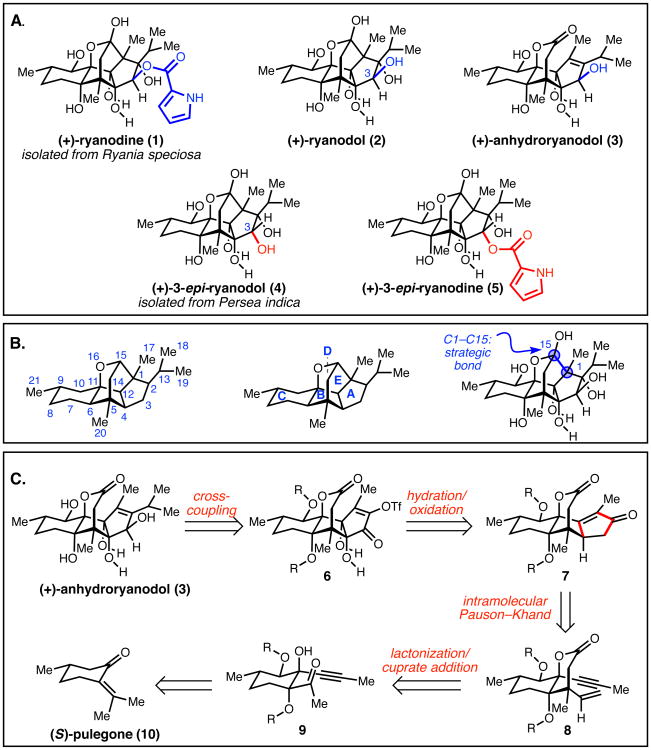
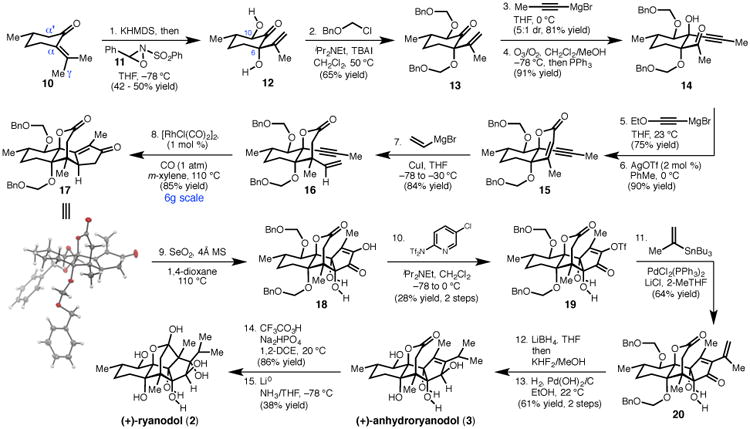
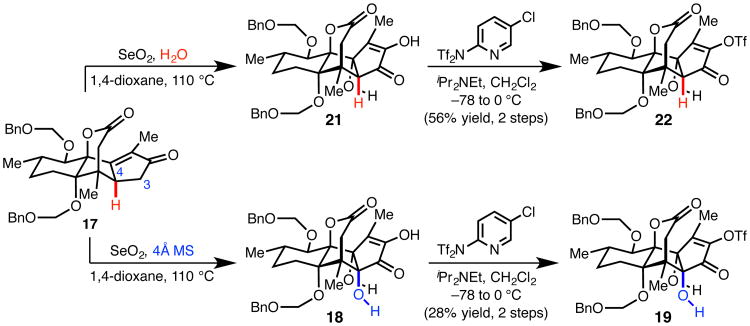
(+)-Ryanodine and (+)-ryanodol are complex diterpenoids that modulate intracellular calcium-ion release at ryanodine receptors, ion channels critical for skeletal and cardiac muscle excitation-contraction coupling and synaptic transmission. Chemical derivatization of these diterpenoids has demonstrated that certain peripheral structural modifications can alter binding affinity and selectivity among ryanodine receptor isoforms. Here, we report a short chemical synthesis of (+)-ryanodol that proceeds in only 15 steps from the commercially available terpene (S)-pulegone. The efficiency of the synthesis derives from the use of a Pauson-Khand reaction to rapidly build the carbon framework and a SeO2-mediated oxidation to install three oxygen atoms in a single step. This work highlights how strategic C-O bond constructions can streamline the synthesis of polyhydroxylated terpenes by minimizing protecting group and redox adjustments.
Copyright © 2016, American Association for the Advancement of Science.
Figures
References
-
- Breitmaier E. Terpenes: Flavors, Fragrances, Pharmaca, Pheromones. Wiley; Weinheim, Germany: 2006.
-
- Koehn FE, Carter GT. Nat Rev Drug Discov. 2005;4:206–220. - PubMed
-
- Jørgensen L, McKerrall SJ, Kuttruff CA, Ungehuer F, Felding J, Baran PS. Science. 2013;341:878–882. - PubMed
-
- Lu HH, Martinez MD, Shenvi RA. Nature Chem. 2015;7:604–607. - PubMed
Publication types
MeSH terms
Substances
Grants and funding
LinkOut - more resources
Full Text Sources
Other Literature Sources
