. 2016 Jun 22;7(8):774-9.
doi: 10.1021/acsmedchemlett.6b00163. eCollection 2016 Aug 11.

Selective AKR1C3 Inhibitors Potentiate Chemotherapeutic Activity in Multiple Acute Myeloid Leukemia (AML) Cell Lines

Affiliations

Selective AKR1C3 Inhibitors Potentiate Chemotherapeutic Activity in Multiple Acute Myeloid Leukemia (AML) Cell Lines

Kshitij Verma et al. ACS Med Chem Lett. .

Abstract

We report the design, synthesis, and evaluation of potent and selective inhibitors of aldo-keto reductase 1C3 (AKR1C3), an important enzyme in the regulatory pathway controlling proliferation, differentiation, and apoptosis in myeloid cells. Combination treatment with the nontoxic AKR1C3 inhibitors and etoposide or daunorubicin in acute myeloid leukemia cell lines, elicits a potent adjuvant effect, potentiating the cytotoxicity of etoposide by up to 6.25-fold and the cytotoxicity of daunorubicin by >10-fold. The results validate AKR1C3 inhibition as a common adjuvant target across multiple AML subtypes. These compounds in coadministration with chemotherapeutics in clinical use enhance therapeutic index and may avail chemotherapy as a treatment option to the pediatric and geriatric population currently unable to tolerate the side effects of cancer drug regimens.

Keywords: AKR1C3 Inhibitor; acute myeloid leukemia; adjuvant; daunorubicin; etoposide; synergism.


Conflict of interest statement

The authors declare no competing financial interest.

Figures
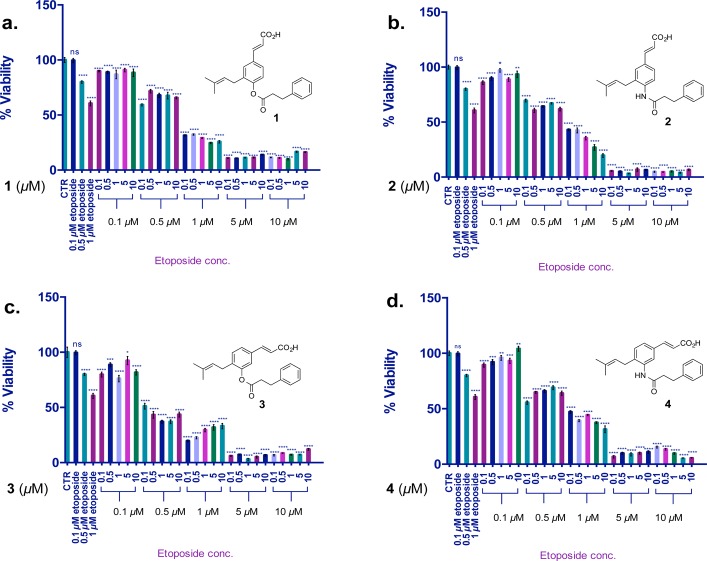
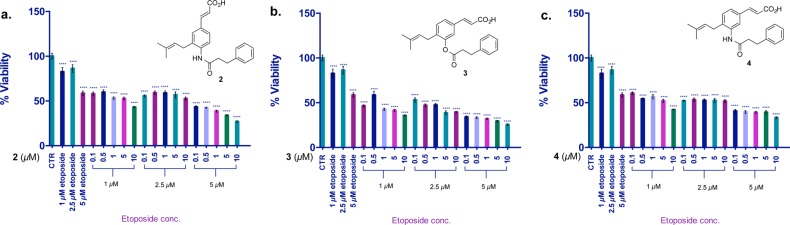
Figure 1
Figure 1
Synergistic activity of AKR1C3 inhibitors with etoposide in HL-60 cells following 72 h coincubation. Values are the mean ± SD (n = 6). The two-tailed t test analysis was used to compare the statistical difference between control and treatments; ns, not significant; *p < 0.01, **p < 0.05, ***p < 0.001, ****p < 0.0001.
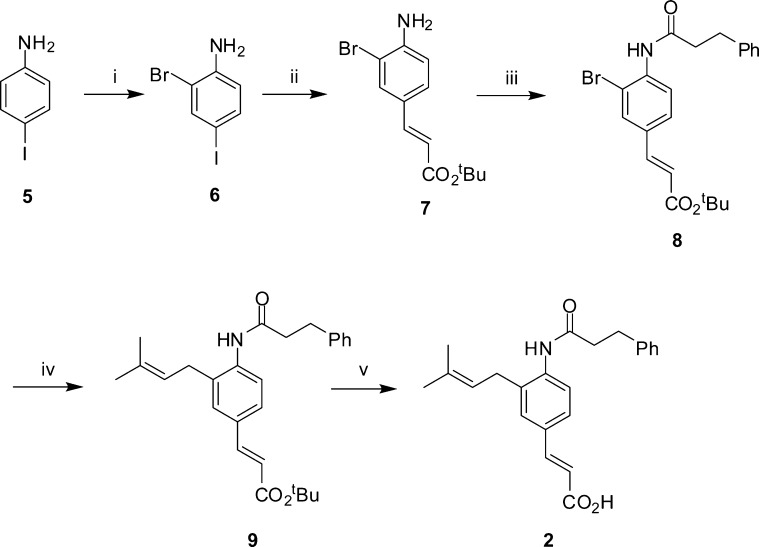
Scheme 1
Scheme 1. Synthesis of para-Amide Derivative 2
Reagents and conditions: (i) Br2, AcOH, 44%; (ii) tert-butyl acrylate, NEt3, P(Ph)3, Pd(OAc)2, PhMe, reflux, 64%; (iii) 3-phenylpropanoyl chloride, NEt3, DMAP, DCM, 70 °C, 10%; (iv) prenylboronic acid pinacol ester, Pd(dppf)Cl2, Cs2CO3, DMF, 90 °C, 44%; (v) SiO2, PhMe, reflux, 50%.
Scheme 2
Scheme 2. Synthesis of meta-Ester Derivative 3
Reagents and conditions: (i) MeOH, H2SO4, reflux, 93%; ii Br2, AcOH, RT, 35%; (iii) prenylboronic acid pinacol ester, Pd(dppf)Cl2, Cs2CO3, DMF, 90 °C, 27%; (iv) NaOH, H2O, reflux, 99%; (v) 3-phenylpropanoyl chloride, DMAP, NEt3, DCM, RT, 82%.
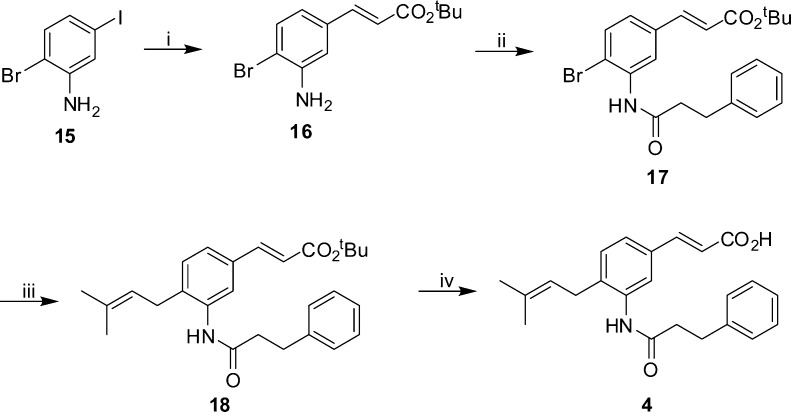
Scheme 3
Scheme 3. Synthesis of meta-Amide Derivative 4
Reagents and conditions: (i) tert-butyl acrylate, Pd(OAc)2, P(Ph)3, NEt3, PhMe, 110 °C, 64%; (ii) 3-phenylpropanoyl chloride, DMAP, NEt3, DCM, 70 °C, 88%; (iii) prenylboronlc acid pinacol ester, Pd(dppf)Cl2, Cs2CO3, DMF, 90 °C, 42%; (iv) SiO2, PhMe, reflux, 27%.
Figure 2
Figure 2
Synergistic activity of AKR1C3 inhibitors with etoposide in KG1a cells. Seventy-two hours of coincubation with etoposide. Values are the mean ± SD (n = 6). The two-tailed t test analysis was used to compare the statistical difference between control and treatments; ns, not significant; *p < 0.01, **p < 0.05, ***p < 0.001, ****p < 0.0001.
Figure 3
Figure 3
Synergistic activity of AKR1C3 inhibitors with etoposide in HL-60 cells (pretreatment). (a–d) Twenty-four hours of pretreatment of AKR1C3 inhibitor followed by 72 h exposure to etoposide. Values are the mean ± SD (n = 6). The two-tailed t test analysis was used to compare statistical difference between control and treatment; ns, not significant; **p < 0.05, ***p < 0.001, ****p < 0.0001. (e) Quantification of synergistic activity.

References

    1. Rizner T. L.; Penning T. M. Role of aldo-keto reductase family 1 (AKR1) enzymes in human steroid metabolism. Steroids 2014, 79, 49–63. 10.1016/j.steroids.2013.10.012. - DOI - PMC - PubMed
    1. Matsuura K.; Shiraishi H.; Hara A.; Sato K.; Deyashiki Y.; Ninomiya M.; Sakai S. Identification of a principal mRNA species for human 3 alpha-hydroxysteroid dehydrogenase isoform (AKR1C3) that exhibits high prostaglandin D-2 11-ketoreductase activity. J. Biochem. 1998, 124, 940–946. 10.1093/oxfordjournals.jbchem.a022211. - DOI - PubMed
    1. Reginato M. J.; Krakow S. L.; Bailey S. T.; Lazar M. K. Prostaglandins promote and block adipogenesis through opposing effects on peroxisome proliferator-activated receptor gamma. J. Biol. Chem. 1998, 273, 1855–1858. 10.1074/jbc.273.4.1855. - DOI - PubMed
    1. Adeniji A. O.; Chen M.; Penning T. M. AKR1C3 as a target in castrate resistant prostate cancer. J. Steroid Biochem. Mol. Biol. 2013, 137, 136–149. 10.1016/j.jsbmb.2013.05.012. - DOI - PMC - PubMed
    1. Straus D. S.; Glass C. K. Cyclopentenone prostaglandins: New insights on biological activities and cellular targets. Med. Res. Rev. 2001, 21, 185–210. 10.1002/med.1006. - DOI - PubMed