. 2016 Jun 23;7(8):807-12.
doi: 10.1021/acsmedchemlett.6b00223. eCollection 2016 Aug 11.

Mitochondrial-Targeting MET Kinase Inhibitor Kills Erlotinib-Resistant Lung Cancer Cells

Affiliations

Mitochondrial-Targeting MET Kinase Inhibitor Kills Erlotinib-Resistant Lung Cancer Cells

Tianming Yang et al. ACS Med Chem Lett. .

Abstract

Lung cancer cells harboring activating EGFR mutations acquire resistance to EGFR tyrosine kinase inhibitors (TKIs) by activating several bypass mechanisms, including MET amplification and overexpression. We show that a significant proportion of activated MET protein in EGFR TKI-resistant HCC827 lung cancer cells resides within the mitochondria. Targeting the total complement of MET in the plasma membrane and mitochondria should render these cells more susceptible to cell death and hence provide a means of circumventing drug resistance. Herein, the mitochondrial targeting triphenylphosphonium (TPP) moiety was introduced to the selective MET kinase inhibitor PHA665752. The resulting TPP analogue rapidly localized to the mitochondria of MET-overexpressing erlotinib-resistant HCC827 cells, partially suppressed the phosphorylation (Y1234/Y1235) of MET in the mitochondrial inner membrane and was as cytotoxic and apoptogenic as the parent compound. These findings provide support for the targeting of mitochondrial MET with a TPP-TKI conjugate as a means of restoring responsiveness to chemotherapy.

Keywords: MET kinase; Mitochondrial targeting; PHA665752; drug resistance; nonsmall cell lung cancer; triphenylphosphonium conjugate.


Conflict of interest statement

The authors declare no competing financial interest.

Figures
Scheme 1
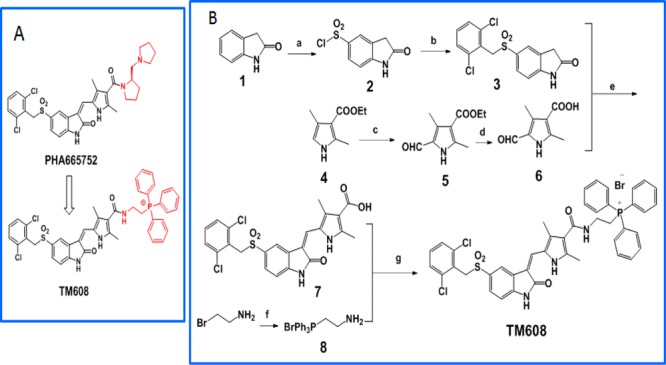
Scheme 1. (A) Modification of PHA665752 To Give TM608; (B) Synthesis of TM608
Reagents and conditions: (a) chlorosulfonic acid; (b) 2,6-dichlorobenzyl bromide, NaH2PO4, Na2SO3, 30–60 °C, acetone; (c) POCl3, DMF; (d) NaOH reflux; (e) piperidine, ethanol, 60 °C; (f) PPh3, 80 °C; (g) EDCI, DMAP, DMF, rt.
Figure 1
Figure 1
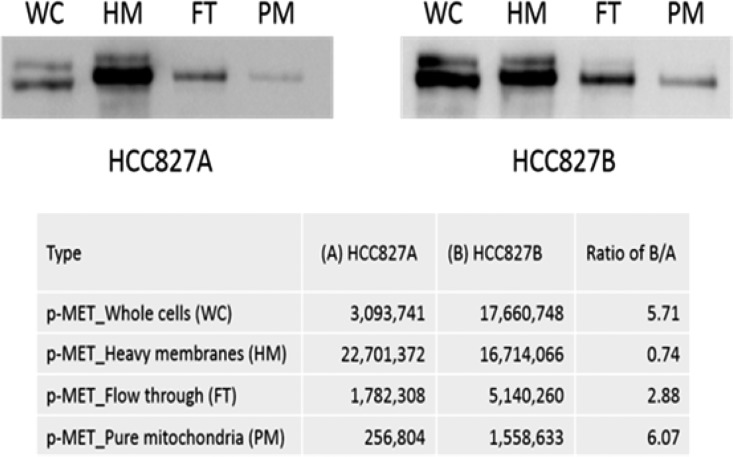
Expression of activated MET protein (phospho-Y1234/1235) in whole cells, heavy membranes, flow-through fraction and pure mitochondria derived from HCC827A and HCC827B cells. B/A ratios report the extent to which HCC827B cells or fractions were enriched in p-MET (Y1234/Y1235) compared to the corresponding HCC827A cells/fractions.
Figure 2
Figure 2
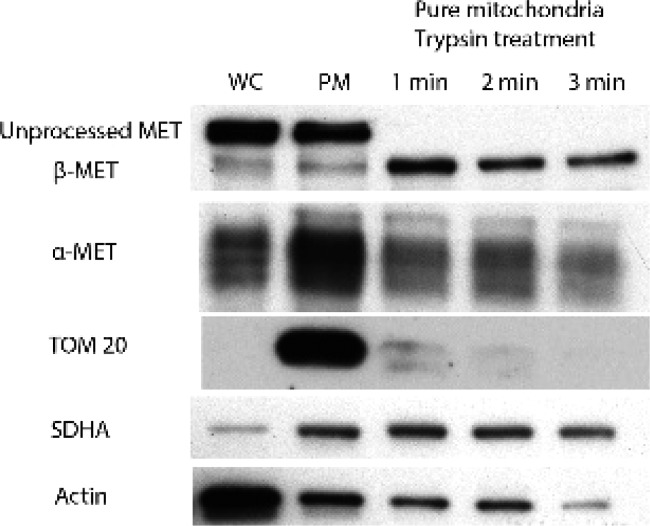
Detection of MET and mitochondrial membrane proteins (TOM20, SDHA) in intact whole cells WC (Lane 1), intact pure mitochondria PM (Lane 2), and time-controlled trypsinized mitochondrial fractions from HCC827B cells (Lanes 3–5).
Figure 3
Figure 3
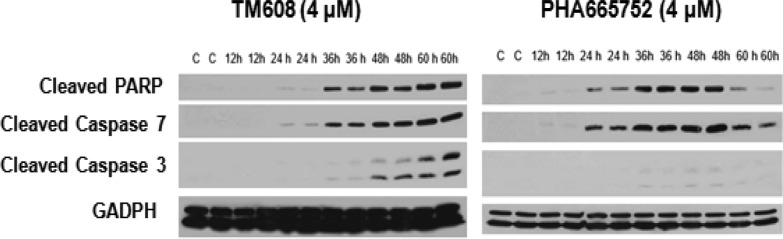
Immunoblots of apoptotic markers (cleaved PARP, cleaved caspases 3 and 7) in whole cell lysates of HCC827B cells treated with 4 μM TM608 or 4 μM PHA665752 at 12, 24, 36, 48, and 60 h time points. Controls (C) were untreated cells at 0 h under similar conditions. GADPH was the loading control.
Figure 4
Figure 4
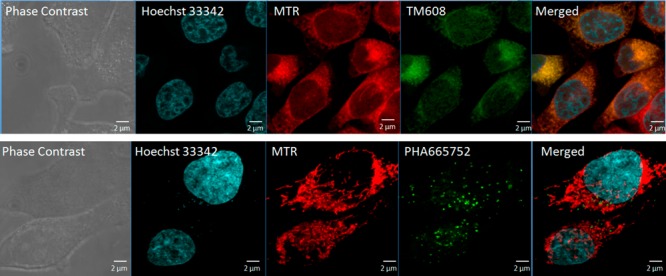
Confocal microscopy images of HeLa cells treated with 4 μM TM608 (1st row) and 4 μM PHA665752 (2nd row) for 3 h and stained with MitoTracker Red and Hoechst 33342 for visualization of mitochondria and nuclei, respectively. PHA665752 and TM608 are fluorescent (Ex 460 nm, Em 520 nm). Overlap of the fluorescence of TM608 (green) and MTR (red) is evident from the Merged Panel.
Figure 5
Figure 5
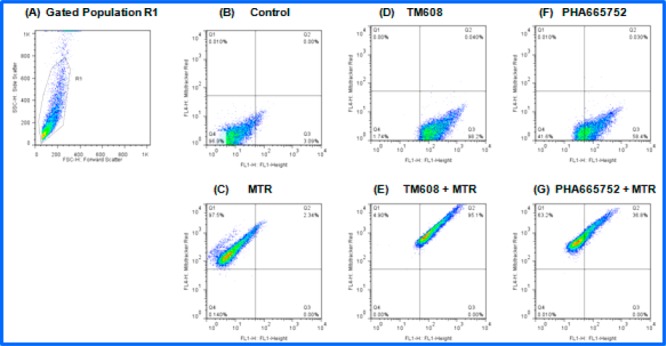
Representative flow cytometry dot plots from double staining experiments using MTR and test compounds (TM608/PHA665752) in purified mitochondria of HCC827B cells. (A) Selection of mitochondria based on forward scatter (x-axis) and side scatter (y-axis) plot. Events within the gate R1 were selected for analysis. (B) Unstained control sample (DMSO). (C–G) Fluorescence of samples stained with MTR, TM608, PHA665752, MTR + TM608, and MTR + PHA665752 for events within R1.
Figure 6
Figure 6
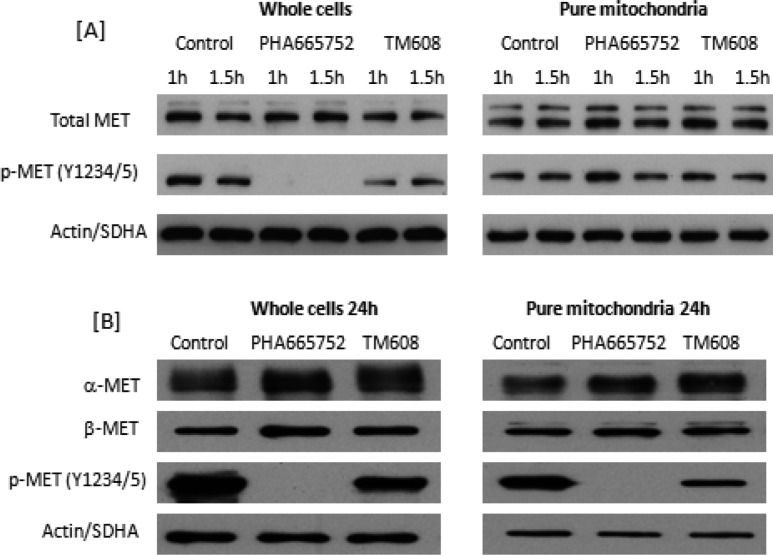
Immunoblots of MET and phospho-MET (Y1234/Y1235) in whole cell lysates and purified mitochondrial proteins of MET-overexpressing HCC827B cells. (A) Cells and pure mitochondria isolated from cells were separately treated with PHA665752 or TM608 (4 μM) for 1 and 1.5 h. (B) Cells were treated with PHA665752 or TM608 (4 μM) for 24 h, after which whole cell lysates and mitochondria were isolated from treated cells and probed for phospho-MET. In both (A) and (B), 10 μg of protein was loaded in each lane. SDHA and actin were loading controls for mitochondria and whole cells, respectively.

References

    1. Yamamoto H.; Toyoka S.; Mitsudomi T. Impact of EGFR mutation analysis in non-small cell lung cancer. Lung Cancer 2009, 63, 315–321. 10.1016/j.lungcan.2008.06.021. - DOI - PubMed
    1. Gazdar A. F. Activating and resistance mutations of EGFR in non-small cell lung cancer: role in clinical response to EGFR tyrosine kinase inhibitors. Oncogene 2009, 28, S24–S31. 10.1038/onc.2009.198. - DOI - PMC - PubMed
    1. Yun C. H.; Mengwasser K. E.; Toms A. V.; Woo M. S.; Greulich H.; Wong K. K.; Meyerson M.; Eck M. J. The T790M mutation in EGFR kinase causes drug resistance by increasing the affinity for ATP. Proc. Natl. Acad. Sci. U. S. A. 2008, 105, 2070–2075. 10.1073/pnas.0709662105. - DOI - PMC - PubMed
    1. Engelman J. A.; Settleman J. Acquired resistance to tyrosine kinase inhibitors during cancer therapy. Curr. Opin. Genet. Dev. 2008, 18, 73–79. 10.1016/j.gde.2008.01.004. - DOI - PubMed
    1. Wilson T. R.; Fridlyand J.; Yan Y.; Penuel E.; Burton L.; Chan E.; Peng J.; Lin E.; Wang Y.; Sosman J.; Ribas A.; Li J.; Moffat J.; Sutherlin D. P.; Koeppen H.; Merchant M.; Neve R.; Settleman J. Widespread potential for growth-factor-driven resistance to anticancer kinase inhibitors. Nature 2012, 487, 505–509. 10.1038/nature11249. - DOI - PMC - PubMed