


Potential Effects on Cardiorespiratory and Metabolic Status After a Concurrent Strength and Endurance Training Program in Diabetes Patients - a Randomized Controlled Trial
- PMID: 27563535
- PMCID: PMC4981628
- DOI: 10.1186/s40798-016-0052-1
Potential Effects on Cardiorespiratory and Metabolic Status After a Concurrent Strength and Endurance Training Program in Diabetes Patients - a Randomized Controlled Trial
Abstract
Background: Concurrent aerobic and resistance training (CART) programs have been widely recommended as an important strategy to improve physiologic and functional performance in patients with chronic diseases. However, the impact of a personalized CART program in patients with type 2 diabetes (T2D) requires investigation. Therefore, the primary aim of the current study is to investigate the impact of CART programs on metabolic profile, glycemic control, and exercise capacity in patients with diabetes.
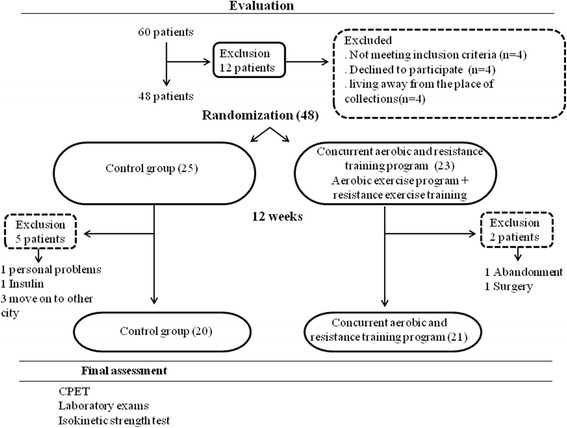
Methods: We evaluated 41 subjects with T2D (15 females and 19 males, 50.8 ± 7 years); subjects were randomized into two groups; sedentary (SG) and CART (CART-G). CART was performed over 1.10-h sessions (30-min aerobic and 30-min resistance exercises) three times/week for 12 weeks. Body composition, biochemical analyses, peripheral muscular strength, and cardiopulmonary exercise testing were primary measurements.
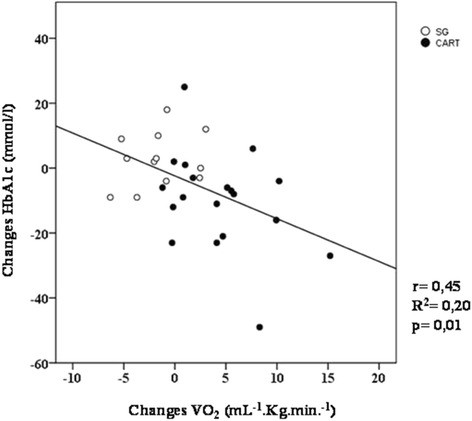
Results: The glycated hemoglobin HbA1c (65.4 ± 17.9 to 55.9 ± 12.7 mmol/mol), cholesterol (198.38.1 ± 50.3 to 186.8 ± 35.1 mg/dl), and homeostasis model assessment insulin resistance (HOMA-IR) (6.4 ± 6.8 to 5.0 ± 1.4) decreased in the CART-G compared to the SG. Although body weight did not significantly change after training, skinfold measurement indicated decreased body fat in the CART-G only. CART significantly enhanced muscle strength compared to the SG (p < 0.05). CART was also associated with significant increase in peak oxygen uptake and maximal workload compared to the SG (p < 0.05).
Conclusions: These data support CART as an important strategy in the treatment of patients with T2D, producing both physiologic and functional improvements.
Trial registration: Ensaiosclinicos.gov.br, RBR492q8z.
Keywords: Concurrent training program; Diabetes mellitus; HbA1c; Metabolic profile; Oxygen uptake.
Figures
References
-
- Colberg SR, Sigal RJ, Fernhall B, Regensteiner JG, Blissmer BJ, Rubin RR, et al. Exercise and type 2 diabetes: the American College of Sports Medicine and the American Diabetes Association: joint position statement executive summary. Diabetes Care. 2010;33:2692–6. doi: 10.2337/dc10-1548. - DOI - PMC - PubMed
LinkOut - more resources
Full Text Sources
Other Literature Sources
Medical
