Angiotensin II type I receptor (AT1R) is an independent prognosticator of esophageal squamous cell carcinoma and promotes cells proliferation via mTOR activation
- PMID: 27564102
- PMCID: PMC5341864
- DOI: 10.18632/oncotarget.11567
Angiotensin II type I receptor (AT1R) is an independent prognosticator of esophageal squamous cell carcinoma and promotes cells proliferation via mTOR activation
Abstract
Background: The aim of this study was to investigate the effects of the angiotensin II/ angiotensin II type I receptor (AT1R) and angiotensin II type II receptor (AT2R) signaling pathway in esophageal squamous cell carcinoma (ESCC).
Methods: Immunohistochemistry was performed to evaluate the expression levels of AT1R and AT2R in tissues from 152 surgically resected ESCC patients, and those expression levels were then correlated with treatment outcomes. The angiotensin II/AT1R/AT2R signaling pathway and its biological effects in the context of ESCC were investigated in vitro and in vivo.
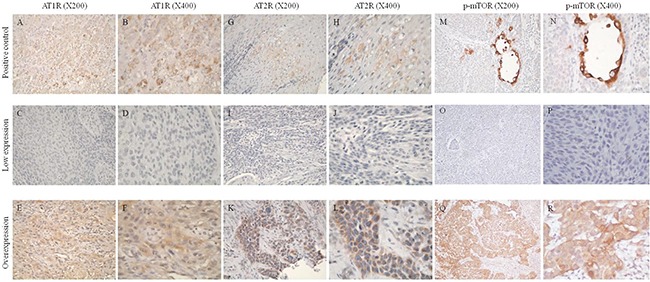
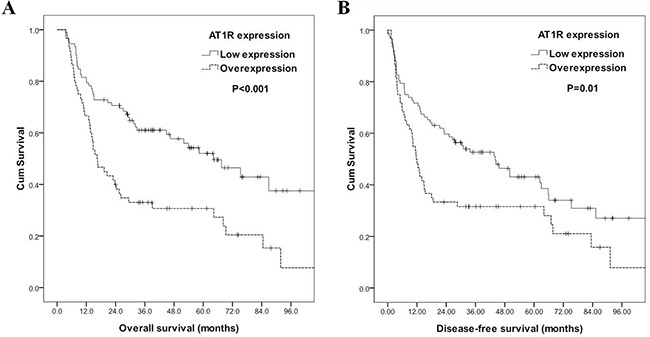
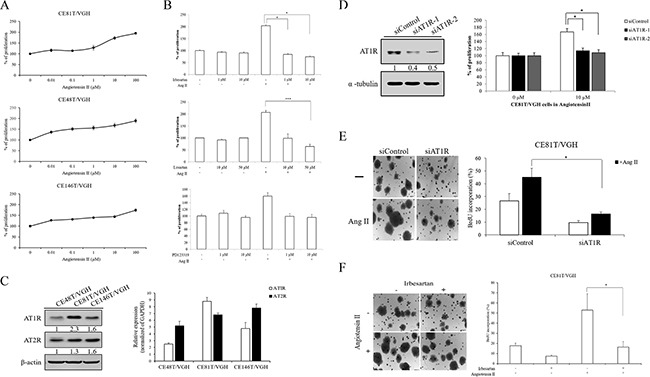
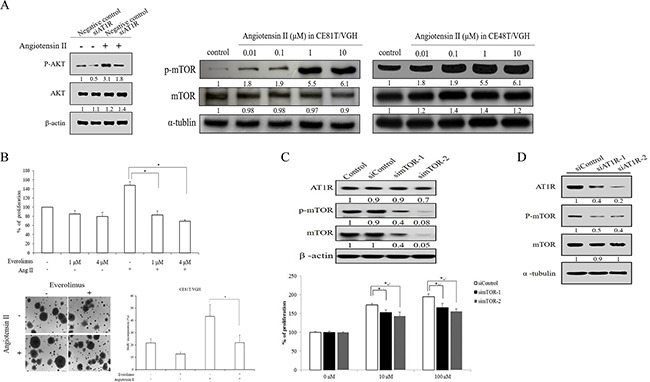
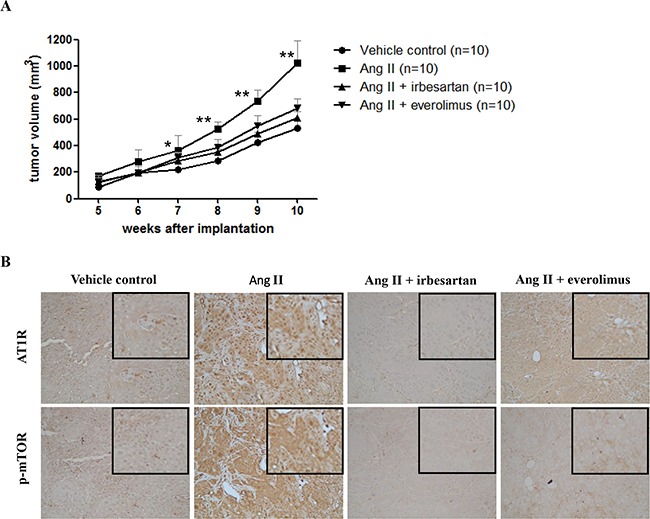
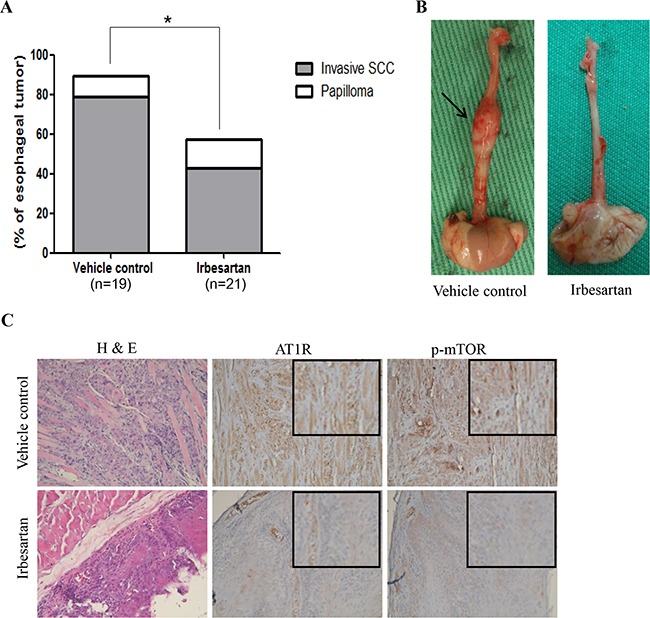
Results: In human samples, AT1R overexpression was univariately associated with inferior overall survival and remained multivariately independent (hazard ratio=1.812). In vitro, angiotensin II stimulated the growth of ESCC cells in a dose-dependent manner. Treatment with irbesartan or AT1R-RNAi knockdown but not treatment with PD123319 significantly decreased the level of angiotensin II-induced ESCC cell proliferation. Angiotensin II also caused mTOR activation in a dose-dependent manner, and everolimus or mTOR-RNAi knockdown significantly suppressed the level of angiotensin II-induced ESCC cell proliferation. Furthermore, AT1R-RNAi knockdown suppressed the activation of mTOR. Clinically, AT1R expression was also correlated with phosphorylated mTOR expression. In a xenograft model, local angiotensin II injection enhanced tumor growth, and this effect could be decreased by treatment with irbesartan or everolimus. In a 4-NQO-induced-ESCC murine model, irbesartan significantly decreased the incidence of esophageal tumor.
Conclusions: These findings suggest that AT1R overexpression is an independent adverse prognosticator for patients with ESCC and that angiotensin II/AT1R signaling stimulates ESCC growth, in part through mTOR activation.
Keywords: AT1R; angiotensin II; esophageal cancer; mTOR; squamous cell carcinoma.
Conflict of interest statement
The authors declare no conflict of interest.
Figures
References
-
- National Department of Health. Taiwan, Republic of China Cancer Registry Annual Report 1972-2011
-
- Li SH, Rau KM, Lu HI, Wang YM, Tien WY, Liang JL, Lin WC. Pre-treatment maximal oesophageal wall thickness is independently associated with response to chemoradiotherapy in patients with T3-4 oesophageal squamous cell carcinoma. Eur J Cardiothorac Surg. 2012 - PubMed
-
- Lee PC, Mirza FM, Port JL, Stiles BM, Paul S, Christos P, Altorki NK. Predictors of recurrence and disease-free survival in patients with completely resected esophageal carcinoma. J Thorac Cardiovasc Surg. 2011;141:1196–1206. - PubMed
-
- Arrieta O, Pineda-Olvera B, Guevara-Salazar P, Hernandez-Pedro N, Morales-Espinosa D, Ceron-Lizarraga TL, Gonzalez-De la Rosa CH, Rembao D, Segura-Pacheco B, Sotelo J. Expression of AT1 and AT2 angiotensin receptors in astrocytomas is associated with poor prognosis. Br J Cancer. 2008;99:160–166. - PMC - PubMed
MeSH terms
Substances
LinkOut - more resources
Full Text Sources
Other Literature Sources
Medical
Miscellaneous