


Polygenic Causes of Congenital Diaphragmatic Hernia Produce Common Lung Pathologies
- PMID: 27565037
- PMCID: PMC5222980
- DOI: 10.1016/j.ajpath.2016.07.006
Polygenic Causes of Congenital Diaphragmatic Hernia Produce Common Lung Pathologies
Abstract
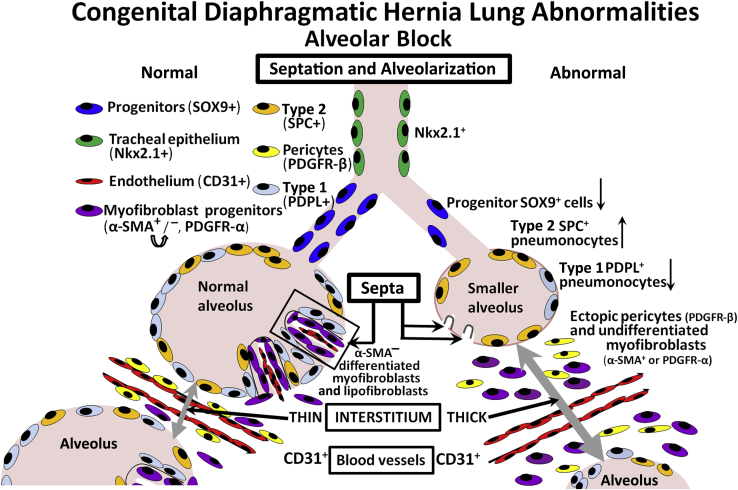
Congenital diaphragmatic hernia (CDH) is one of the most common and lethal congenital anomalies, and significant evidence is available in support of a genetic contribution to its etiology, including single-gene knockout mice associated with diaphragmatic defects, rare monogenetic disorders in humans, familial aggregation, and association of CDH with chromosomal abnormalities. Structural lung defects in the form of lung hypoplasia are almost invariably seen in patients with CDH and frequently in animal models of this condition. Better understanding of the mechanisms of pulmonary defects in CDH has the potential for creating targeted therapies, particularly in postnatal stages, when therapeutics can have maximum clinical impact on the surviving cohorts. Successful treatment of CDH is dependent on the integration of human genomic and genetic data with developmental expression profiling, mouse knockouts, and gene network and pathway modeling, which have generated a large number of candidate genes and pathways for follow-up studies. In particular, defective alveolarization appears to be a common and potentially actionable phenotype in both patients and animal models.
Copyright © 2016 American Society for Investigative Pathology. Published by Elsevier Inc. All rights reserved.
Figures

References
-
- Stolar C.J., Dillon P.W. ed 7. Mosby; Philadelphia: 2012. Congenital Diaphragmatic Hernia and Eventration; pp. 809–824. Pediatric Surgery.
-
- Beaumier C.K., Beres A.L., Puligandla P.S., Skarsgard E.D., Canadian Pediatric Surgery Network Clinical characteristics and outcomes of patients with right congenital diaphragmatic hernia: a population-based study. J Pediatr Surg. 2015;50:731–733. - PubMed
-
- Garcia A.V., Thirumoorthi A.S., Stolar C.J.H. ed 6. Saunders/Elsevier; London, New York: 2014. Extracorporeal membrane oxygenation. Ashcraft's Pediatric Surgery; pp. 83–93.
Publication types
MeSH terms
Grants and funding
LinkOut - more resources
Full Text Sources
Other Literature Sources
Molecular Biology Databases
