. 2016 Nov:47:74-82.
doi: 10.1016/j.neurobiolaging.2016.07.007. Epub 2016 Jul 15.

White matter integrity as a marker for cognitive plasticity in aging

Affiliations

White matter integrity as a marker for cognitive plasticity in aging

Ann-Marie Glasø de Lange et al. Neurobiol Aging. 2016 Nov.

Abstract

Age-related differences in white matter (WM) integrity are substantial, but it is unknown whether between-subject variability in WM integrity influences the capacity for cognitive improvement. We investigated the effects of memory training related to active and passive control conditions in older adults and tested whether WM integrity at baseline was predictive of training benefits. We hypothesized that (1) memory improvement would be restricted to the training group, (2) widespread areas would show greater mean diffusivity (MD) and lower fractional anisotropy in older adults relative to young adults, and (3) within these areas, variability in WM microstructure in the older group would be predictive of training gains. The results showed that only the group receiving training improved their memory. Significant age differences in MD and fractional anisotropy were found in widespread areas. Within these areas, voxelwise analyses showed a negative relationship between MD and memory improvement in 3 clusters, indicating that WM integrity could serve as a marker for the ability to adapt in response to cognitive challenges in aging.

Keywords: Aging; Cognitive training; Diffusion tensor imaging; Memory; Plasticity; White matter.


Figures

Fig. 6
Fig. 6
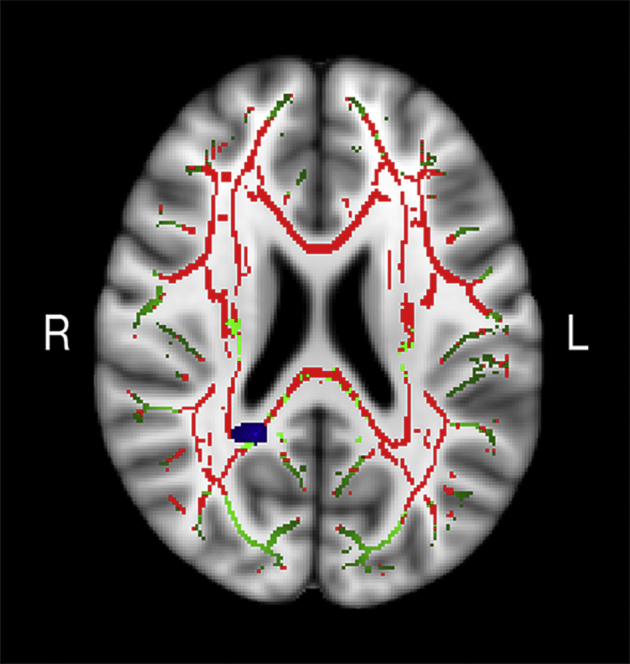
AD cluster related to memory improvement. AD Cluster (21 voxels) shown in blue. Axial view of Talairach coordinates x = 90, y = 137, and z = 94, overlaid on the conjunction mask (in red), the mean FA skeleton (in green) and the standard MNI152 T1 1-mm3 brain template. The results are thresholded at p < 0.05 and corrected for multiple comparisons. Significant areas are dilated for illustrative purposes. Abbreviations: AD, axial diffusivity; FA, fractional anisotropy.
Fig. 7
Fig. 7
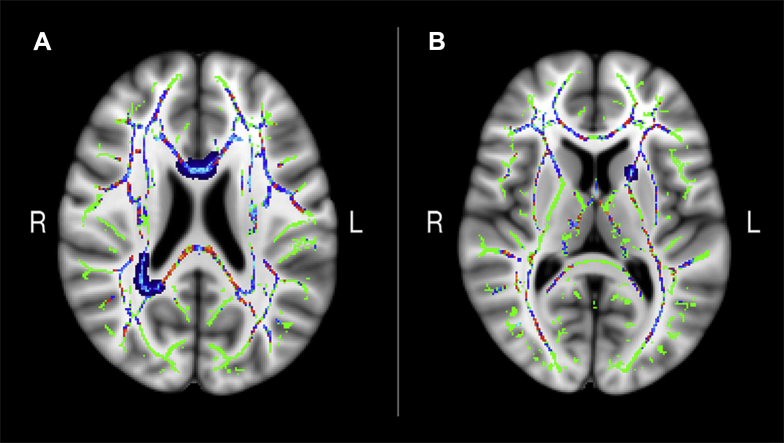
WM integrity and memory performance—general versus specific effects. (A) Cluster 1 and cluster 2 shown in blue. Axial view of Talairach coordinates x = 90, y = 137, and z = 94. (B) Cluster 3 shown in blue, axial view of Talairach coordinates x = 109, y = 136, and z = 82. The clusters are overlaid on the standard MNI152 T1 1-mm3 brain template and shown on top of the t-statistics to illustrate general effects below the significance threshold (p < 0.05). The blue–lighter blue color map represents areas showing a negative relationship between MD and memory improvement. Lighter blue represents t-values closer to the significant level (p < 0.05, t > 2.2). Areas showing a positive relationship between MD and memory improvement is shown in a red-yellow color map where yellow represents t-values closer to the significant level (p < 0.05, t > 2.2). Abbreviations: MD, mean diffusivity; WM, white matter.
Fig. 8
Fig. 8
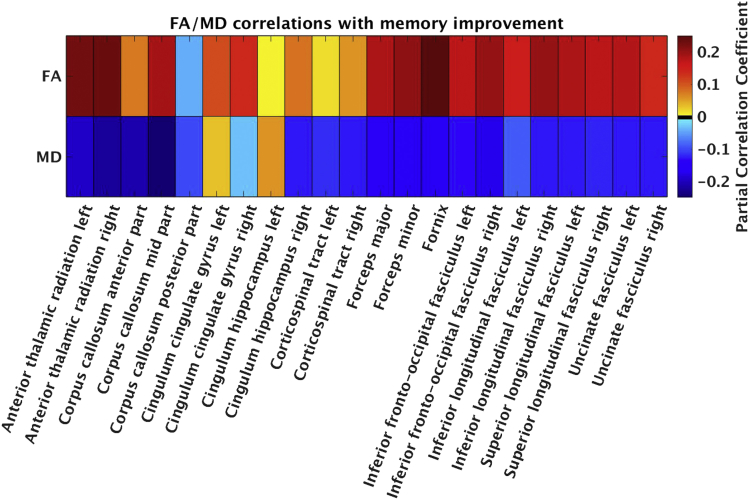
WM integrity and memory performance—individual tracts. Abbreviation: FA, fractional anisotropy; MD, mean diffusivity; WM, white matter.
Fig. 9
Fig. 9
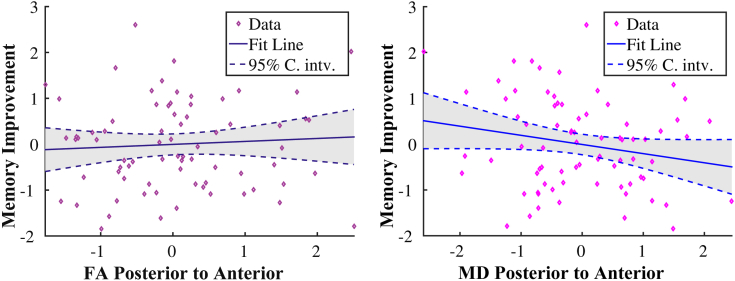
Posterior–anterior slopes and training outcome. Abbreviation: FA, fractional anisotropy; MD, mean diffusivity.
Fig. 1
Fig. 1
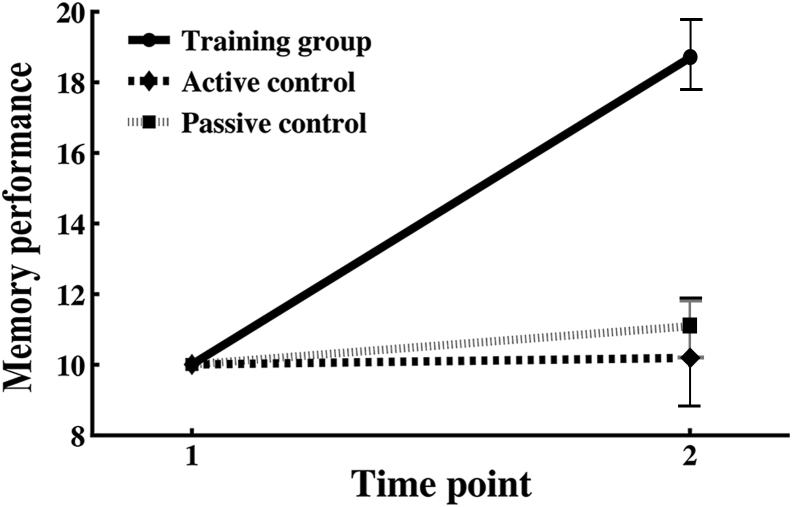
Group differences in memory improvement. Memory scores showed at y-axis. Repeated measures analysis of covariance (Greenhouse-Geisser corrected) with age, sex, and memory performance at baseline as covariates.
Fig. 2
Fig. 2
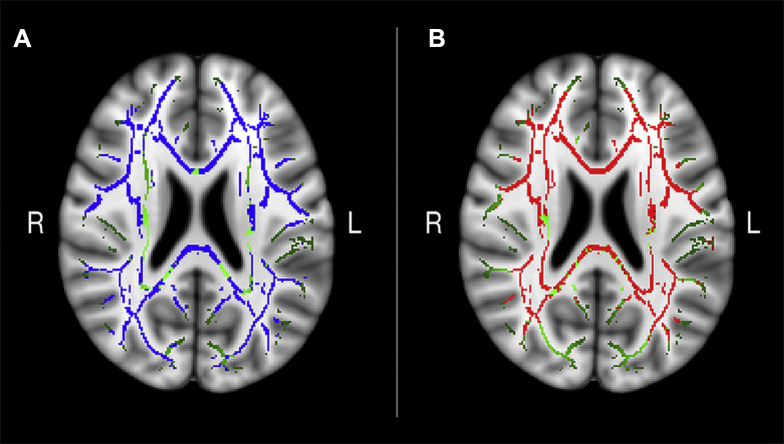
Age differences in WM microstructure. (A) Age differences in FA (blue). (B) Age differences in MD (red). Axial views of Talairach coordinates x = 104, y = 130, and z = 94 overlaid on the mean FA skeleton (green) and the standard MNI152 T1 1-mm3 brain template. The results are thresholded at p < 0.05 and corrected for multiple comparisons. Abbreviations: WM, white matter; FA, fractional anisotropy; MD, mean diffusivity.
Fig. 3
Fig. 3
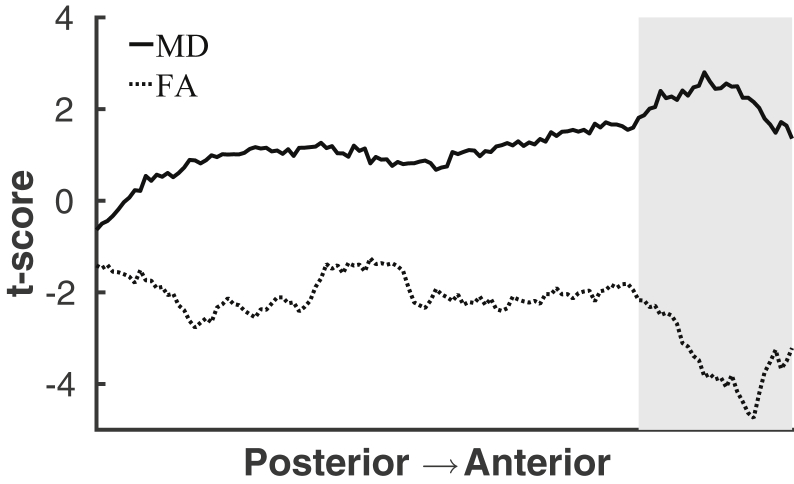
Posterior to anterior gradient of age differences. MD: R2 = 0.733, p < 0.01, confidence interval [0.0139–0.0172]. FA: R2 = 0.385, p < 0.01, confidence interval [−0.0155 to −0.0098]. Abbreviations: FA, fractional anisotropy; MD, mean diffusivity.
Fig. 4
Fig. 4
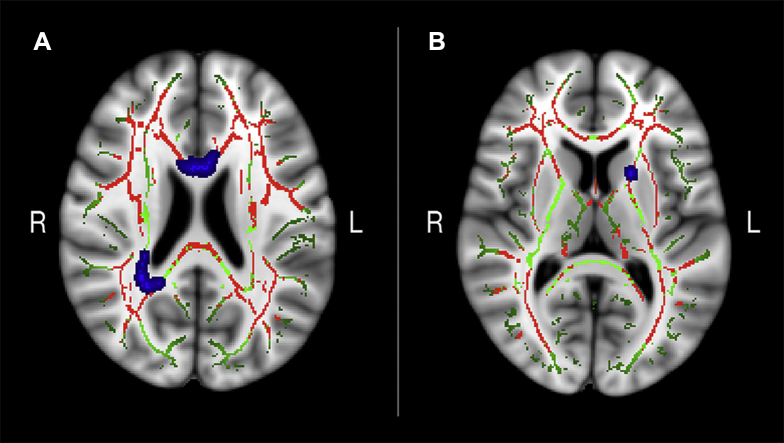
MD clusters related to memory improvement. (A) Cluster 1 (172 voxels) and cluster 2 (53 voxels) shown in blue. Axial view of Talairach coordinates x = 90, y = 137, and z = 94. (B) Cluster 3 (17 voxels) shown in blue, axial view of Talairach coordinates x = 109, y = 136, and z = 82. Clusters are overlaid on the conjunction mask (in red), the mean FA skeleton (in green), and the standard MNI152 T1 1-mm3 brain template. The results are thresholded at p < 0.05 and corrected for multiple comparisons. Significant areas are dilated for illustrative purposes. Abbreviations: FA, fractional anisotropy; MD, mean diffusivity.
Fig. 5
Fig. 5
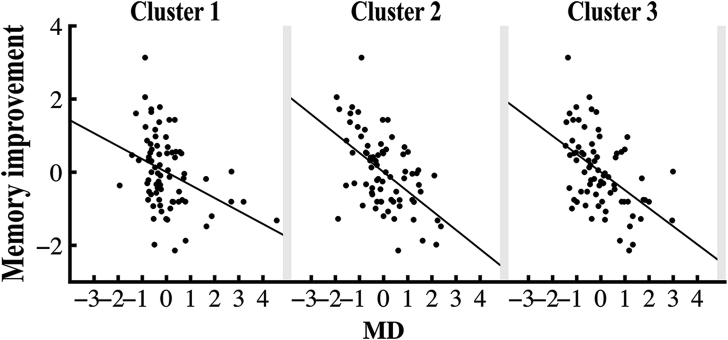
Relationship between memory improvement and MD clusters. MD values in the clusters plotted against memory improvement, corrected for the effect of age, sex, and memory performance at baseline. Linear fit is calculated and shown for each cluster with its respective correlation. Abbreviation: MD, mean diffusivity.

References

    1. Andersson J.L.R., Jenkinson M., Smith S. 2010. Non-Linear Registration, Aka Spatial Normalisation. FMRIB technical report TR07JA2.
    1. Andersson J.L.R., Skare S., Ashburner J. How to correct susceptibility distortions in spin-echo echo-planar images: application to diffusion tensor imaging. Neuroimage. 2003;20:870–888. - PubMed
    1. Andersson J.L.R., Sotiropoulos S.N. ISMRM; Milan: 2016. A Gaussian Process Based Method for Detecting and Correcting Dropout in Diffusion Imaging; p. 2567.
    1. Andersson J.L., Sotiropoulos S.N. An integrated approach to correction for off-resonance effects and subject movement in diffusion MR imaging. Neuroimage. 2016;125:1063–1078. - PMC - PubMed
    1. Barnes D.E., Santos-Modesitt W., Poelke G., Kramer A.F., Castro C., Middleton L.E., Yaffe K. The Mental Activity and Exercise (MAX) trial: a randomized controlled trial to enhance cognitive function in older adults. JAMA Intern. Med. 2013;173:797–804. - PMC - PubMed

Publication types