


Association between dietary acid load and the risk of cardiovascular disease: nationwide surveys (KNHANES 2008-2011)
- PMID: 27565571
- PMCID: PMC5002186
- DOI: 10.1186/s12933-016-0436-z
Association between dietary acid load and the risk of cardiovascular disease: nationwide surveys (KNHANES 2008-2011)
Abstract
Background: Acid-base imbalance has been reported to increase incidence of hypertension and diabetes. However, the association between diet-induced acid load and cardiovascular disease (CVD) risk in the general population has not been fully investigated.
Methods: This was a population-based, retrospectively registered cross-sectional study using nationally representative samples of 11,601 subjects from the Korea National Health and Nutrition Examination Survey 2008-2011. Individual CVD risk was evaluated using atherosclerotic cardiovascular disease (ASCVD) risk equations according to 2013 ACC/AHA guideline assessment in subjects aged 40-79 without prior CVD. Acid-base status was assessed with both the potential renal acid load (PRAL) and the dietary acid load (DAL) scores derived from nutrient intake.
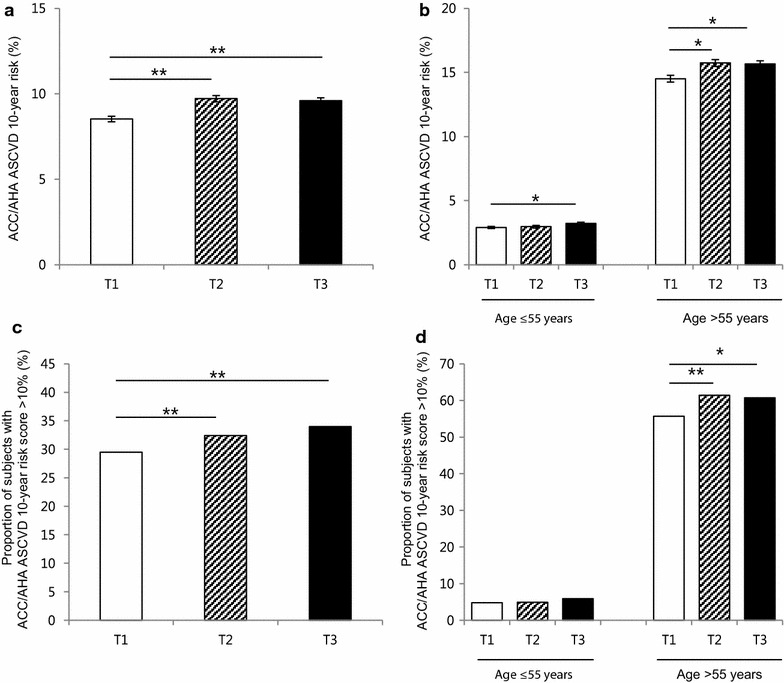
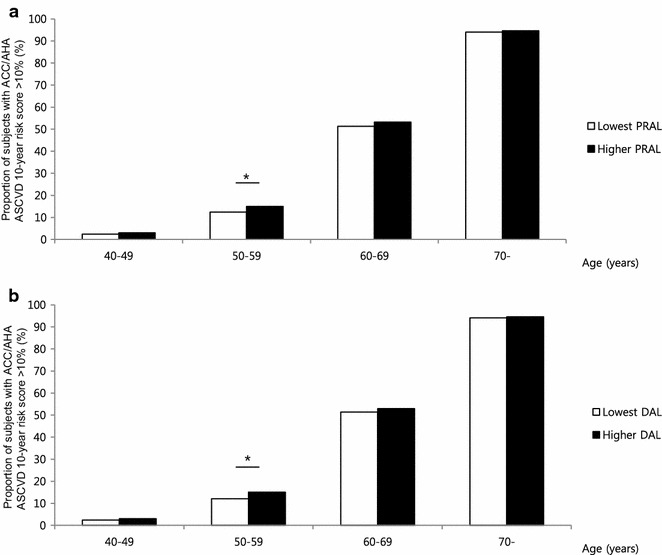
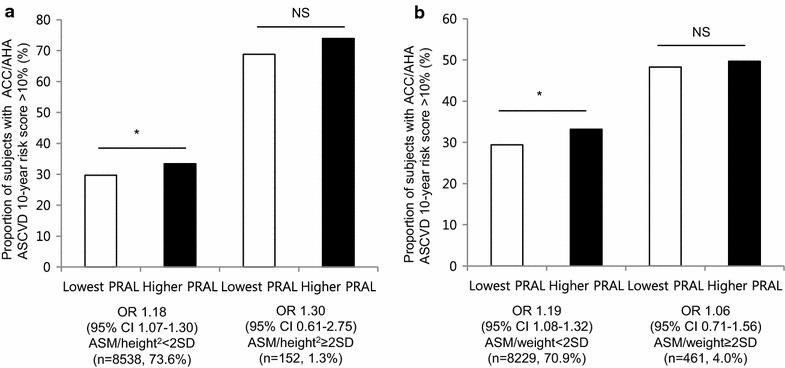
Results: Individuals in the highest PRAL tertile had a significant increase in 10 year ASCVD risks (9.6 vs. 8.5 %, P < 0.01) and tended to belong to the high-risk (10 year risk >10 %) group compared to those in the lowest PRAL tertile (odds ratio [OR] 1.23, 95 % confidence interval [CI] 1.22-1.35). The association between higher PRAL score and high CVD risk was stronger in the middle-aged group. Furthermore, a multiple logistic regression analysis also demonstrated this association (OR 1.20 95 % CI 1.01-1.43). Subgroup analysis stratified obesity or exercise status; individuals in unhealthy condition with lower PRAL scores had comparable ASCVD risk to people in the higher PRAL group that were in favorable physical condition. In addition, elevated PRAL scores were associated with high ASCVD risk independent of obesity, exercise, and insulin resistance, but not sarcopenia. Similar trends were observed with DAL scores.
Conclusion: Diet-induced acid load was associated with increased risk of CVD, independent of obesity and insulin resistance.
Keywords: Atherosclerosis; Diet; Epidemiology; Risk factors.
Figures


References
-
- Mortality GBD, Causes of Death C Global, regional, and national age-sex specific all-cause and cause-specific mortality for 240 causes of death, 1990–2013: a systematic analysis for the Global Burden of Disease Study 2013. Lancet. 2015;385(9963):117–171. doi: 10.1016/S0140-6736(14)61682-2. - DOI - PMC - PubMed
-
- Mozaffarian D, Benjamin EJ, Go AS, Arnett DK, Blaha MJ, Cushman M, de Ferranti S, Despres JP, Fullerton HJ, Howard VJ, et al. Heart disease and stroke statistics–2015 update: a report from the American Heart Association. Circulation. 2015;131(4):e29–e322. doi: 10.1161/CIR.0000000000000152. - DOI - PubMed
Publication types
MeSH terms
Substances
LinkOut - more resources
Full Text Sources
Other Literature Sources
