. 2016 Nov 15:513:1-6.
doi: 10.1016/j.ab.2016.08.023. Epub 2016 Aug 25.

Enthalpy screen of drug candidates

Affiliations

Enthalpy screen of drug candidates

Arne Schön et al. Anal Biochem. .

Abstract

The enthalpic and entropic contributions to the binding affinity of drug candidates have been acknowledged to be important determinants of the quality of a drug molecule. These quantities, usually summarized in the thermodynamic signature, provide a rapid assessment of the forces that drive the binding of a ligand. Having access to the thermodynamic signature in the early stages of the drug discovery process will provide critical information towards the selection of the best drug candidates for development. In this paper, the Enthalpy Screen technique is presented. The enthalpy screen allows fast and accurate determination of the binding enthalpy for hundreds of ligands. As such, it appears to be ideally suited to aid in the ranking of the hundreds of hits that are usually identified after standard high throughput screening.


Figures

Figure 1
Figure 1
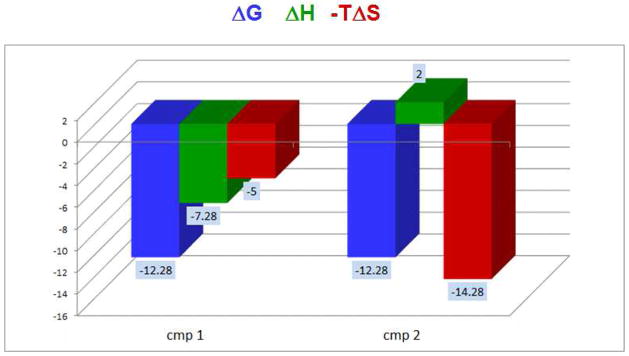
Hypothetical situation for two ligands that exhibit the same binding affinity but different thermodynamic signatures. The binding of cmp1 is characterized by favorable enthalpy and entropy whereas the binding of cmp2 is entropically driven and characterized by unfavorable enthalpy. The thermodynamic signatures of cmp1 and cmp2 reflect that the binding is controlled by different types of molecular interactions. Even though the affinity is the same under the measuring conditions, their response to changes in the environment will be different and also other drug like properties like selectivity.
Figure 2
Figure 2
Enthalpy screen data for two HIV-1 protease inhibitors, KNI-10769 and KNI-10006. In these experiments 2 μL of 50 μM protease are injected into the reaction cell containing buffer (top row) or 100 μM inhibitor. The injection of protease into buffer provides the heat of dilution (QBuf). The interval between the injections is 200 s and the rate of injection 1 μL/s. The solution in the calorimetric cell was stirred at a constant rate of 200 rpm. The buffer was 10 mM sodium acetate, pH 5.0, with 2% DMSO. All measurements were carried out at 25 °C.
Figure 3
Figure 3
The correlation between the enthalpy values obtained by the enthalpy screen and the values obtained by a standard ITC titration under identical conditions. The correlation coefficient is 0.96.
Figure 4
Figure 4
Comparison of the thermodynamic signatures for the FDA approved HIV-1 protease inhibitors indinavir and amprenavir, obtained from ITC standard titration data (Kd, ΔH, −TΔS) (left) and by combining published inhibition data (Ki) and binding enthalpy obtained from enthalpy screen (right). Despite minor numerical differences, the binding characteristics and the nature of the predominant binding forces are well defined in both cases.
Figure 5
Figure 5
Thermodynamic signatures for eleven HIV-1 protease inhibitors. The first nine correspond to a series of allophenylnorstatine inhibitors (KNI inhibitors) and the remaining two, to indinavir and amprenavir. This data demonstrates that the thermodynamic signatures obtained with enthalpy screen data provides critical information towards the ranking and optimization of drug candidates.

References

    1. Ohtaka H, Freire E. Adaptive inhibitors of the HIV-1 protease. Prog Biophys Mol Biol. 2005;88:193–208. - PubMed
    1. Ladbury JE, Klebe G, Freire E. Adding calorimetric data to decision making in lead discovery: a hot tip. Nat Rev Drug Discov. 2010;9:23–27. - PubMed
    1. Carbonell T, Freire E. Binding thermodynamics of statins to HMG-CoA reductase. Biochemistry. 2005;44:11741–11748. - PubMed
    1. Sarver RW, Peevers J, Cody WL, Ciske FL, Dyer J, Emerson SD, Hagadorn JC, Holsworth DD, Jalaie M, Kaufman M, Mastronardi M, McConnell P, Powell NA, Quin J, 3rd, Van Huis CA, Zhang E, Mochalkin I. Binding thermodynamics of substituted diaminopyrimidine renin inhibitors. Anal Biochem. 2007;360:30–40. - PubMed
    1. Chaires JB. Calorimetry and thermodynamics in drug design. Annu Rev Biophys. 2008;37:135–151. - PubMed

Publication types

MeSH terms