


Intracerebral Hemorrhage Outcomes in Patients with Systemic Cancer
- PMID: 27569708
- PMCID: PMC5344037
- DOI: 10.1016/j.jstrokecerebrovasdis.2016.08.006
Intracerebral Hemorrhage Outcomes in Patients with Systemic Cancer
Abstract
Background: Single-center studies suggest that patients with cancer have similar outcomes after intracerebral hemorrhage (ICH) compared to patients without cancer. However, these studies were limited by small sample sizes and high rates of intratumoral hemorrhage. Our hypothesis was that systemic cancer patients without brain involvement fare worse after ICH than patients without cancer.
Methods: We identified all patients diagnosed with spontaneous ICH from 2002 to 2011 in the Nationwide Inpatient Sample. Our predictor variable was systemic cancer. Our primary outcome was discharge disposition, dichotomized into favorable discharge (home/self-care or rehabilitation) or unfavorable discharge (nursing facility, hospice, or death). We used logistic regression to compare outcomes and performed secondary analyses by cancer subtype (i.e., nonmetastatic solid tumors, nonmetastatic hematologic tumors, and metastatic solid or hematologic tumors).
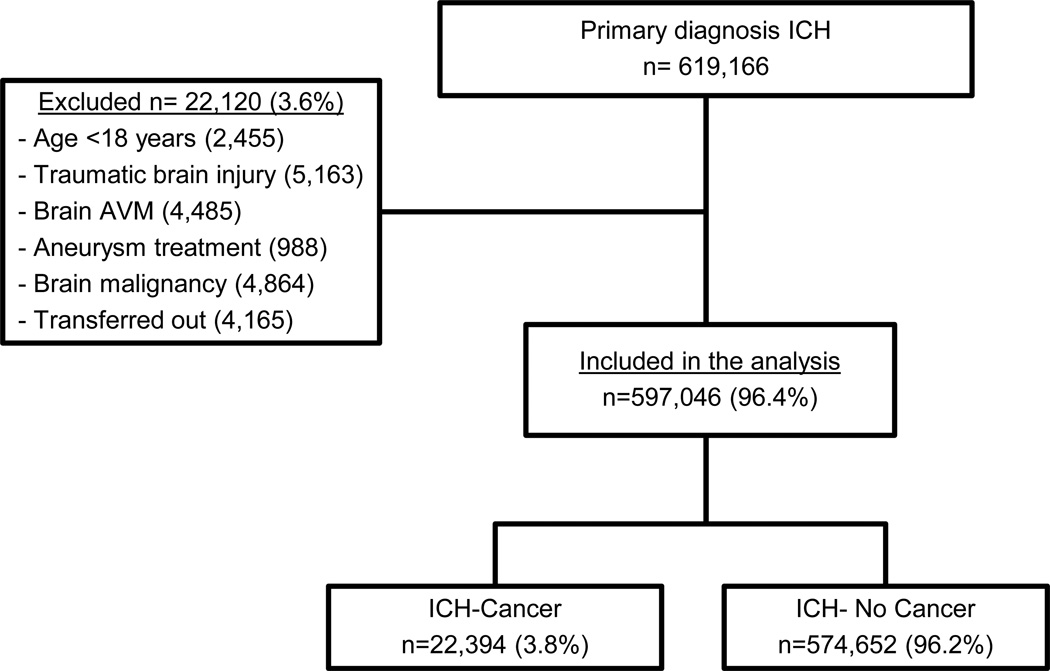
Results: Among 597,046 identified ICH patients, 22,394 (3.8%) had systemic cancer. Stroke risk factors such as hypertension and diabetes were more common in patients without cancer, whereas anticoagulant use and higher Charlson comorbidity scores were more common among cancer patients. In multivariate logistic regression analysis adjusted for demographics, comorbidities, and hospital-level characteristics, patients with cancer had higher odds of death (OR 1.62, 95% CI 1.56-1.69) and lower odds of favorable discharge (OR .59, 95% CI .56-.63) than patients without cancer. Among cancer groups, patients with nonmetastatic hematologic tumors and those with metastatic disease fared the worst.
Conclusions: Patients with systemic cancer have higher mortality and less favorable discharge outcomes after ICH than patients without cancer. Cancer subtype may influence outcomes after ICH.
Keywords: Intracerebral hemorrhage; cancer; clinical outcomes; malignancy.
Copyright © 2016 National Stroke Association. Published by Elsevier Inc. All rights reserved.
Conflict of interest statement
The authors have no conflict of interests to report.
Figures
References
-
- McCormick WF, Rosenfield DB. Massive brain hemorrhage: a review of 144 cases and an examination of their causes. Stroke. 1973;4(6):946–954. - PubMed
-
- Schrader B, Barth H, Lang EW, Buhl R, Hugo HH, Biederer J, et al. Spontaneous intracranial haematomas caused by neoplasms. Acta neurochirurgica. 2000;142(9):979–985. - PubMed
-
- Velander AJ, DeAngelis LM, Navi BB. Intracranial hemorrhage in patients with cancer. Curr Atheroscler Rep. 2012;14(4):373–381. - PubMed
-
- Licata B, Turazzi S. Bleeding cerebral neoplasms with symptomatic hematoma. J Neurosurg Sci. 2003;47(4):201–210. - PubMed
MeSH terms
Grants and funding
LinkOut - more resources
Full Text Sources
Other Literature Sources
