


High-density lipoprotein subpopulation profiles in lipoprotein lipase and hepatic lipase deficiency
- PMID: 27573733
- PMCID: PMC5064856
- DOI: 10.1016/j.atherosclerosis.2016.08.014
High-density lipoprotein subpopulation profiles in lipoprotein lipase and hepatic lipase deficiency
Abstract
Background and aims: Our aim was to gain insight into the role that lipoprotein lipase (LPL) and hepatic lipase (HL) plays in HDL metabolism and to better understand LPL- and HL-deficiency states.
Methods: We examined the apolipoprotein (apo) A-I-, A-II-, A-IV-, C-I-, C-III-, and E-containing HDL subpopulation profiles, assessed by native 2-dimensional gel-electrophoresis and immunoblotting, in 6 homozygous and 11 heterozygous LPL-deficient, 6 homozygous and 4 heterozygous HL-deficient, and 50 control subjects.
Results: LPL-deficient homozygotes had marked hypertriglyceridemia and significant decreases in LDL-C, HDL-C, and apoA-I. Their apoA-I-containing HDL subpopulation profile was shifted toward small HDL particles compared to controls. HL-deficient homozygotes had moderate hypertriglyceridemia, modest increases in LDL-C and HDL-C level, but normal apoA-I concentration. HL-deficient homozygotes had a unique distribution of apoA-I-containing HDL particles. The normally apoA-I:A-II, intermediate-size (α-2 and α-3) particles were significantly decreased, while the normally apoA-I only (very large α-1, small α-4, and very small preβ-1) particles were significantly elevated. In contrast to control subjects, the very large α-1 particles of HL-deficient homozygotes were enriched in apoA-II. Homozygous LPL- and HL-deficient subjects also had abnormal distributions of apo C-I, C-III, and E in HDL particles. Values for all measured parameters in LPL- and HL-deficient heterozygotes were closer to values measured in controls than in homozygotes.
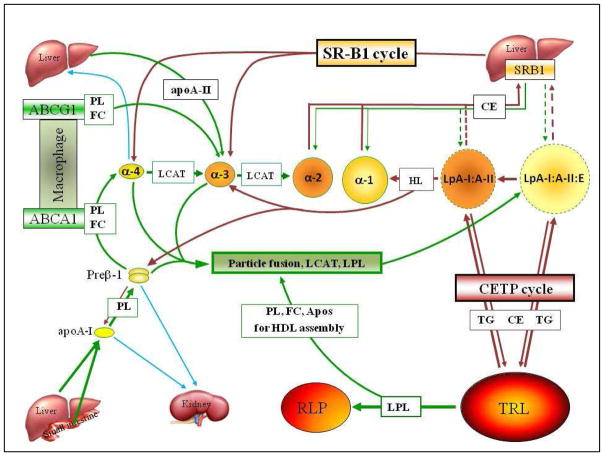
Conclusions: Our data are consistent with the concept that LPL is important for the maturation of small discoidal HDL particles into large spherical HDL particles, while HL is important for HDL remodeling of very large HDL particles into intermediate-size HDL particles.
Keywords: Apolipoproteins; HDL particles; HDL remodeling; Lipoprotein metabolism; Reverse cholesterol transport.
Copyright © 2016 Elsevier Ireland Ltd. All rights reserved.
Conflict of interest statement
The authors declared they do not have anything to disclose regarding conflict of interest with respect to this manuscript.
Figures


References
-
- Gordon DJ, Probstfield JL, Garrison RJ, Neaton JD, Castelli WP, Knoke JD, Jacobs DR, Jr, Bangdiwala S, Tyroler HA. High-density lipoprotein cholesterol and cardiovascular disease. Four prospective American studies. Circulation. 1989;79(1):8–15. - PubMed
-
- Ballantyne CM, Herd JA, Ferlic LL, Dunn JK, Farmer JA, Jones PH, Schein JR, Gotto AM., Jr Influence of low HDL on progression of coronary artery disease and response to fluvastatin therapy. Circulation. 1999;99(6):736–43. - PubMed
-
- Nicholls SJ, Tuzcu EM, Sipahi I, Grasso AW, Schoenhagen P, Hu T, Wolski K, Crowe T, Desai MY, Hazen SL, Kapadia SR, Nissen SE. Statins, high-density lipoprotein cholesterol, and regression of coronary atherosclerosis. JAMA. 2007;297(5):499–508. - PubMed
-
- Brunzell J. Familial lipoprotein lipase deficiency and other causes of the chylomicronemia syndrome. In: Sriver C, Baudet A, Sly w, Valle D, editors. The Metabolic and Molecular Basis of Inherited Disease. 7. New York: 1995. pp. 1913–32.
MeSH terms
Substances
Grants and funding
LinkOut - more resources
Full Text Sources
Other Literature Sources
Miscellaneous
