


Accuracy of Oncologists' Life-Expectancy Estimates Recalled by Their Advanced Cancer Patients: Correlates and Outcomes
- PMID: 27574869
- PMCID: PMC5144872
- DOI: 10.1089/jpm.2016.0121
Accuracy of Oncologists' Life-Expectancy Estimates Recalled by Their Advanced Cancer Patients: Correlates and Outcomes
Abstract
Background: Oncologists are often reluctant to discuss life-expectancy estimates with their patients because of concerns about their inaccuracy and limited evidence regarding benefits.
Objective: Determine oncologist accuracy in predicting their advanced cancer patients' life expectancy and correlates associated with accuracy.
Design: Multicenter prospective, longitudinal study of patients with advanced cancer, assessed once at baseline and followed to death. At baseline, patients were asked whether their oncologist had provided them with a life-expectancy estimate.
Setting/subjects: Eighty-five patients with advanced cancer recruited from outpatient cancer clinics.
Measurements: Patients' baseline sociodemographic and time to death, and clinical characteristics were examined to determine their associations with the accuracy of the oncologists' life-expectancy estimates as recalled by their patients.
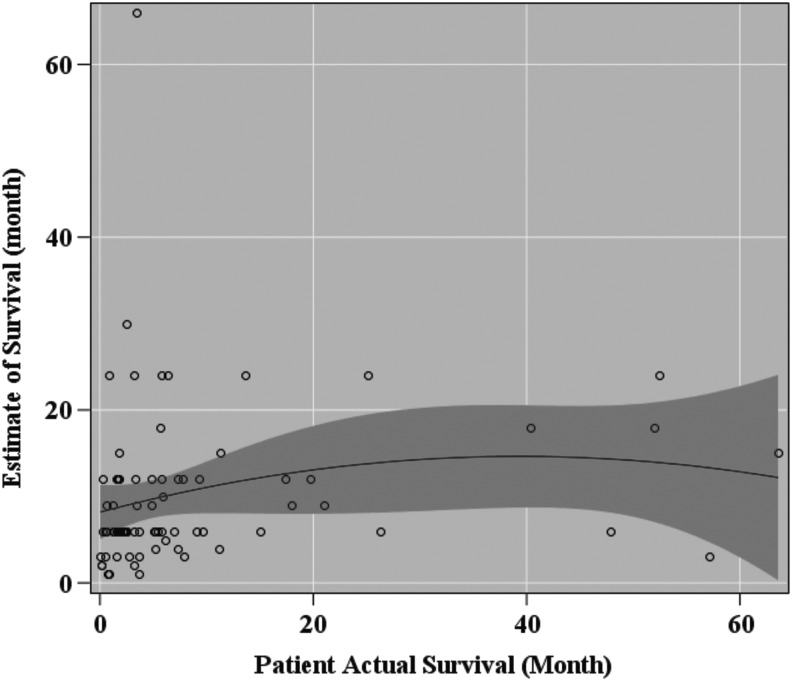
Results: Seventy-four percent (63/85) of patients recalled that physician life-expectancy estimates were accurate to within a year; estimates were most accurate when patients had 9-12 months to live. Factors significantly (p < 0.05) positively associated with oncologists' greater accuracy to within a year were the patient's age, recruitment from a community-based oncology clinic, poor performance status, and quality-of-life at baseline. Oncologists' prognoses that were accurate to within a year were associated with greater likelihood of patients, at baseline, acknowledging that they were terminally ill (OR = 12.20, 95% CI = 2.24-66.59), engaging in an end-of-life discussion (OR = 4.22, 95% CI = 1.45-12.29), completing a do-not-resuscitate (DNR) order (OR = 2.94, 95% CI = 1.03-8.41), a lower likelihood of using palliative chemotherapy (OR = 0.30, 95% CI = 0.11-0.85), and clinical trial enrollment (OR = 0.09, 95% CI = 0.02-0.50).
Conclusions: Oncologists are able to estimate their patients' life expectancy to within a year. Accuracy to within a year is associated with higher rates of DNR order completion, advance care planning, and lower likelihood of chemotherapy use near death.
Conflict of interest statement
Author Disclosure Statement No competing financial interests exist.
Figures
References
MeSH terms
Grants and funding
LinkOut - more resources
Full Text Sources
Other Literature Sources
Medical
