Comparative Study
. 2016 Nov 1;151(11):1046-1055.
doi: 10.1001/jamasurg.2016.2317.

Bariatric Surgery and Long-term Durability of Weight Loss

Affiliations
Comparative Study

Bariatric Surgery and Long-term Durability of Weight Loss

Matthew L Maciejewski et al. JAMA Surg. .

Abstract

Importance: Bariatric surgery induces significant weight loss for severely obese patients, but there is limited evidence of the durability of weight loss compared with nonsurgical matches and across bariatric procedures.

Objectives: To examine 10-year weight change in a large, multisite, clinical cohort of veterans who underwent Roux-en-Y gastric bypass (RYGB) compared with nonsurgical matches and the 4-year weight change in veterans who underwent RYGB, adjustable gastric banding (AGB), or sleeve gastrectomy (SG).

Design, setting, and participants: In this cohort study, differences in weight change up to 10 years after surgery were estimated in retrospective cohorts of 1787 veterans who underwent RYGB from January 1, 2000, through September 30, 2011 (573 of 700 eligible [81.9%] with 10-year follow-up), and 5305 nonsurgical matches (1274 of 1889 eligible [67.4%] with 10-year follow-up) in mixed-effects models. Differences in weight change up to 4 years were compared among veterans undergoing RYGB (n = 1785), SG (n = 379), and AGB (n = 246). Data analysis was performed from September 9, 2014, to February 12, 2016.

Exposures: Bariatric surgical procedures and usual care.

Main outcomes and measures: Weight change up to 10 years after surgery through December 31, 2014.

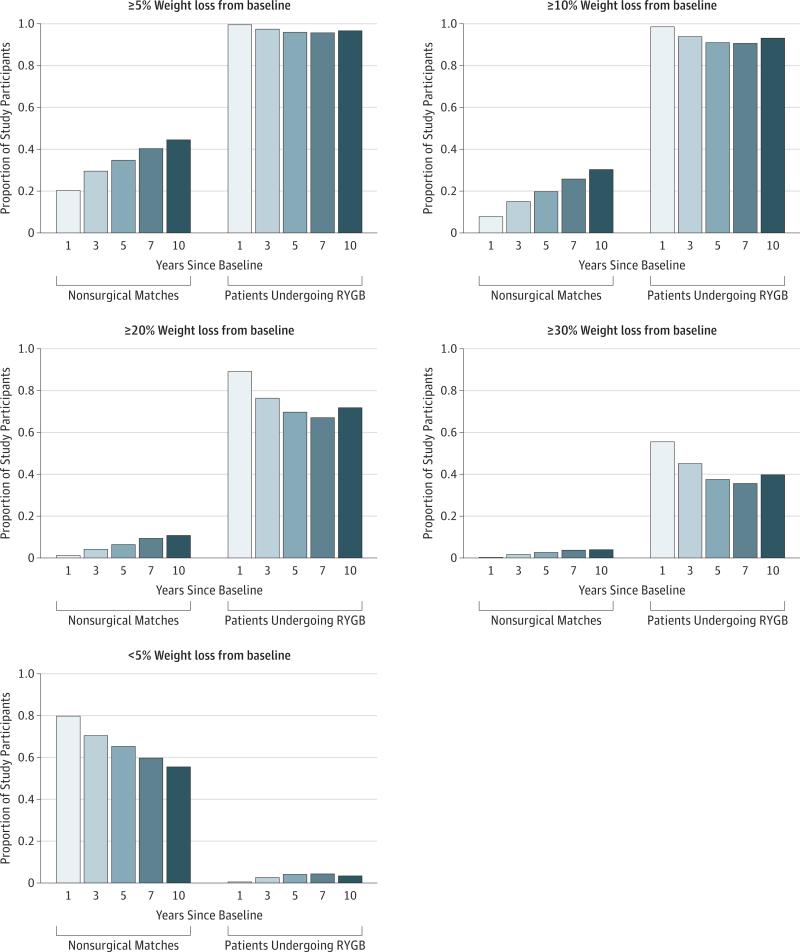
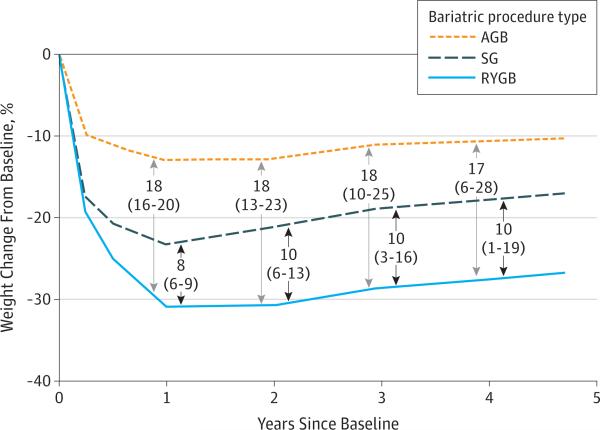
Results: The 1787 patients undergoing RYGB had a mean (SD) age of 52.1 (8.5) years and 5305 nonsurgical matches had a mean (SD) age of 52.2 (8.4) years. Patients undergoing RYGB and nonsurgical matches had a mean body mass index of 47.7 and 47.1, respectively, and were predominantly male (1306 [73.1%] and 3911 [73.7%], respectively). Patients undergoing RYGB lost 21% (95% CI, 11%-31%) more of their baseline weight at 10 years than nonsurgical matches. A total of 405 of 564 patients undergoing RYGB (71.8%) had more than 20% estimated weight loss, and 224 of 564 (39.7%) had more than 30% estimated weight loss at 10 years compared with 134 of 1247 (10.8%) and 48 of 1247 (3.9%), respectively, of nonsurgical matches. Only 19 of 564 patients undergoing RYGB (3.4%) regained weight back to within an estimated 5% of their baseline weight by 10 years. At 4 years, patients undergoing RYGB lost 27.5% (95% CI, 23.8%-31.2%) of their baseline weight, patients undergoing AGB lost 10.6% (95% CI, 0.6%-20.6%), and patients undergoing SG lost 17.8% (95% CI, 9.7%-25.9%). Patients undergoing RYGB lost 16.9% (95% CI, 6.2%-27.6%) more of their baseline weight than patients undergoing AGB and 9.7% (95% CI, 0.8%-18.6%) more than patients undergoing SG.

Conclusions and relevance: Patients in the Veterans Administration health care system lost substantially more weight than nonsurgical matches and sustained most of this weight loss in the long term. Roux-en-Y gastric bypass induced significantly greater weight loss among veterans than SG or AGB at 4 years. These results provide further evidence of the beneficial association between surgery and long-term weight loss that has been demonstrated in shorter-term studies of younger, predominantly female populations.


Figures
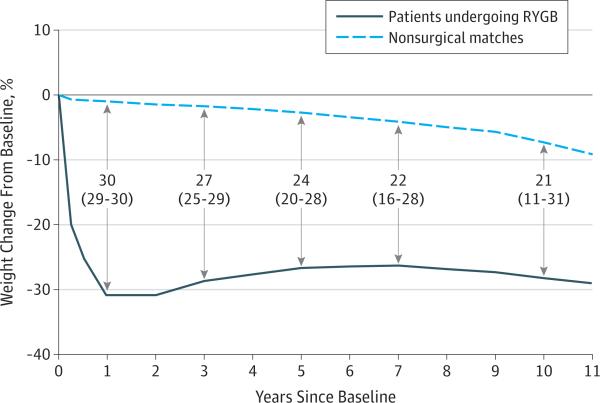
Figure 1
Figure 1. Differences in Estimated Weight Changes Among Patients Undergoing Roux-en-Y Gastric Bypass (RYGB) and Nonsurgical Matches
Estimated values, differences, and 95% CIs (shown in parentheses) were generated from a penalized spline mixed-effects model (7092 patients: 5305 nonsurgical matches and 1787 patients undergoing RYGB). Numbers and arrows in the center of the figure represent the differences and 95% CIs of the differences between nonsurgical matches and patients undergoing RYGB at years 1, 3, 5, 7, and 10. The sample for whom there was follow-up weight data for each year are as follows: year 1, n = 6894 patients (5131 nonsurgical matches and 1763 patients undergoing RYGB); year 3, n = 6301 (4629 nonsurgical matches and 1672 patients undergoing RYGB); year 5, n = 5172 (3748 nonsurgical matches and 1424 patients undergoing RYGB); year 7, n = 3942 (2806 nonsurgical matches and 1136 patients undergoing RYGB); and year 10, n = 1847 (1274 nonsurgical matches and 573 patients undergoing RYGB).
Figure 2
Figure 2. Proportion of Patients Undergoing Roux-en-Y Gastric Bypass (RYGB) and Nonsurgical Matches With Weight Loss of Less Than 5%, 5% or More, 10% or More, 20% or More, or 30% or More at 1, 3, 5, 7, and 10 Years
Predicted weights at 1, 3, 5, 7, and 10 years after baseline were estimated from a penalized spline mixed-effects model. Only individuals who had a weight measurement within 12 months of (6 months before to 6 months after) and a measurement after the year after surgery were included in this figure. The sample sizes for the proportions at each year are as follows: year 1, n = 6615 (4883 nonsurgical matches and 1732 patients undergoing RYGB); year 3, n = 5900 (4307 nonsurgical matches and 1593 patients undergoing RYGB); year 5, n = 4867 (3519 nonsurgical matches and 1348 patients undergoing RYGB); year 7, n = 3736 (2652 nonsurgical matches and 1084 patients undergoing RYGB); and year 10, n = 1811 (1247 nonsurgical matches and 564 patients undergoing RYGB).
Figure 3
Figure 3. Differences in Estimated Percentage of Weight Change From Baseline by Surgical Procedure Type
Estimated values, differences, and 95% CIs (shown in parentheses) were generated from a penalized spline mixed-effects model (2410 patients: 246 in the adjustable gastric banding [AGB] group, 379 in the sleeve gastrectomy [SG] group, and 1785 in the Roux-en-Y gastric bypass [RYGB] group). Numbers and arrows in the center of the figure represent the differences and 95% CIs of the differences between the AGB and RYGB groups (top) and the SG and RYGB groups (bottom) at years 1, 2, 3, and 4. The sample for whom there was follow-up weight data for each year and procedure are as follows: year 1, n = 2373 patients (244 patients undergoing AGB, 374 patients undergoing SG, and 1755 patients undergoing RYGB); year 2, n = 2300 (237 patients undergoing AGB, 363 patients undergoing SG, and 1700 patients undergoing RYGB); year 3, n = 2183 (230 patients undergoing AGB, 325 patients undergoing SG, and 1628 patients undergoing RYGB); and year 4, n = 1845 (202 patients undergoing AGB, 181 patients undergoing SG, and 1462 patients undergoing RYGB).
Figure 4
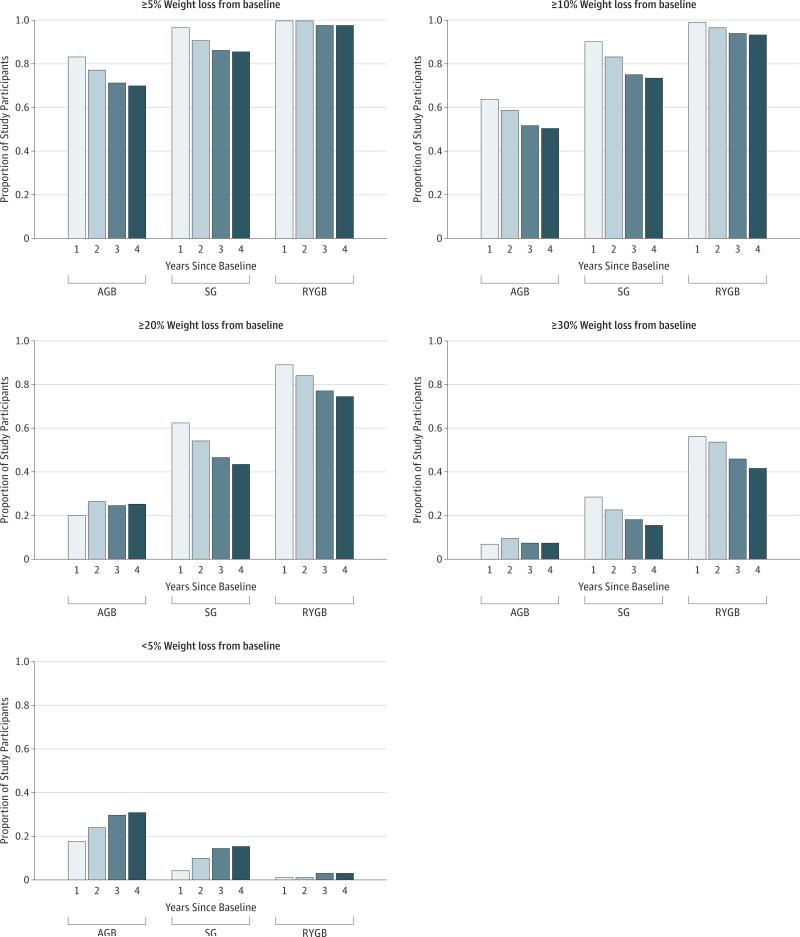
Figure 4. Proportion of Patients Undergoing Adjustable Gastric Banding (AGB), Sleeve Gastrectomy (SG), and Roux-en-Y Gastric Bypass (RYGB) With Weight Loss of Less Than 5%, 5% or More, 10% or More, 20% or More, or 30% or More at 1, 2, 3, and 4 Years by Procedure
Individual predicted weights at 1, 2, 3, and 4 years after surgery were estimated from a penalized spline mixed-effects model. Only patients who had a weight measurement within 12 months (6 months before to 6 months after) of the year after surgery were included in this figure. The sample sizes for the proportions at each year are as follows: year 1, n = 2336 patients (243 patients undergoing AGB, 369 patients undergoing SG, and 1724 patients undergoing RYGB); year 2, n = 2231 (233 patients undergoing AGB, 358 patients undergoing SG, and 1640 patients undergoing RYGB); year 3, n = 2116 (225 patients undergoing AGB, 315 patients undergoing SG, and 1576 patients undergoing RYGB); and year 4, n = 1809 (200 patients undergoing AGB, 178 patients undergoing SG, and 1431 patients undergoing RYGB).

Comment in

References

    1. Buchwald H, Avidor Y, Braunwald E, et al. Bariatric surgery: a systematic review and meta-analysis. JAMA. 2004;292(14):1724–1737. - PubMed
    1. Picot J, Jones J, Colquitt JL, et al. The clinical effectiveness and cost-effectiveness of bariatric (weight loss) surgery for obesity: a systematic review and economic evaluation. Health Technol Assess. 2009;13(41):1–190, 215-357, iii-iv. - PubMed
    1. Gloy VL, Briel M, Bhatt DL, et al. Bariatric surgery versus non-surgical treatment for obesity: a systematic review and meta-analysis of randomised controlled trials. BMJ. 2013;347:f5934. - PMC - PubMed
    1. Arterburn DE, Courcoulas AP. Bariatric surgery for obesity and metabolic conditions in adults. BMJ. 2014;349:g3961. - PMC - PubMed
    1. Trastulli S, Desiderio J, Guarino S, et al. Laparoscopic sleeve gastrectomy compared with other bariatric surgical procedures: a systematic review of randomized trials. Surg Obes Relat Dis. 2013;9(5):816–829. - PubMed

Publication types