Prediction of Postpartum Weight in Low-Income Mexican-Origin Women From Childhood Experiences of Abuse and Family Conflict
- PMID: 27583713
- PMCID: PMC5096993
- DOI: 10.1097/PSY.0000000000000391
Prediction of Postpartum Weight in Low-Income Mexican-Origin Women From Childhood Experiences of Abuse and Family Conflict
Abstract
Objectives: The postpartum period represents a crucial transition period in which weight gain or loss can affect lifetime obesity risk. This study examined the prevalence of obesity and the influence of childhood abuse and family conflict on postpartum weight among low-income Mexican-origin women. Depressive symptoms and partner support were evaluated as mediators.
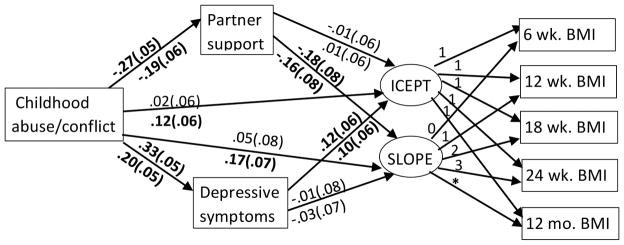
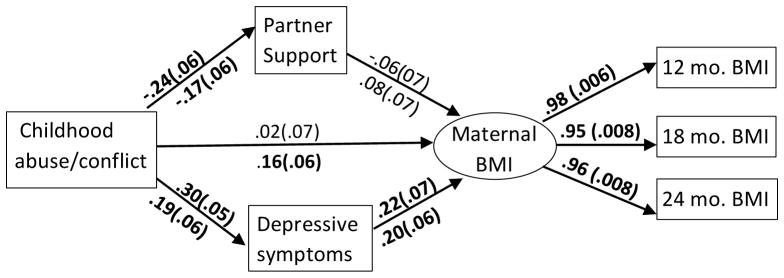
Methods: At a prenatal assessment, low-income Mexican-origin women (N = 322; mean [SD] age, 27.8 [6.5]) reported on childhood abuse and family conflict. Weight was measured 7 times between 6 weeks and 2 years postpartum and calculated as body mass index. Regression and growth models were used to estimate the impact of childhood abuse, childhood family conflict, partner support, and depressive symptoms on weight and weight change.
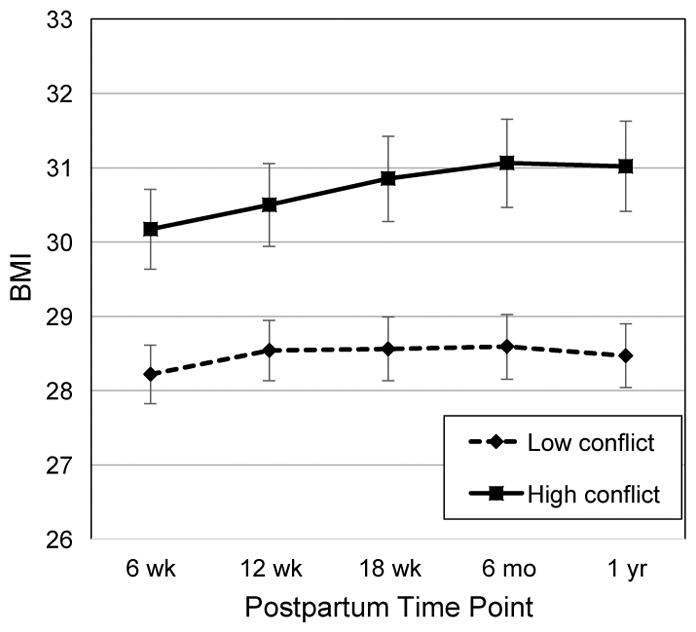
Results: Higher family conflict predicted higher weight across the first (β = .12; p = .037) and second (β = .16; p = .012) postpartum years. Family conflict (β = .17; p = .018) and low partner support (β = -.16; p = .028) also predicted increasing weight in the first year. Partner support partially mediated the effect of childhood abuse on weight change in the first year (p = .031). Depressive symptomatology mediated the effects of childhood abuse and family conflict on weight status in the second year (abuse: p = .005; conflict: p = .023).
Conclusions: For low-income Mexican-origin women with a history of childhood abuse or high family conflict, depression and low partner support may be important targets for obesity prevention efforts in the postpartum period.
Conflict of interest statement
The authors have no conflicts of interest, financial or otherwise.
Figures
References
-
- Shonkoff JP, Boyce W, McEwen BS. Neuroscience, molecular biology, and the childhood roots of health disparities: Building a new framework for health promotion and disease prevention. JAMA. 2009;301(21):2252–2259. - PubMed
-
- Managing overweight and obesity in adults: Systematic evidence review from the Obesity Expert Panel. National Institutes of Health Web site. 2013 https://www.nhlbi.nih.gov/sites/www.nhlbi.nih.gov/files/obesity-evidence....
-
- Flegal KM, Carroll MD, Kit BK, Ogden CL. Prevalence of obesity and trends in the distribution of body mass index among US adults, 1999–2010. JAMA. 2012;307(5):491–497. - PubMed
Publication types
MeSH terms
Grants and funding
LinkOut - more resources
Full Text Sources
Other Literature Sources
Medical